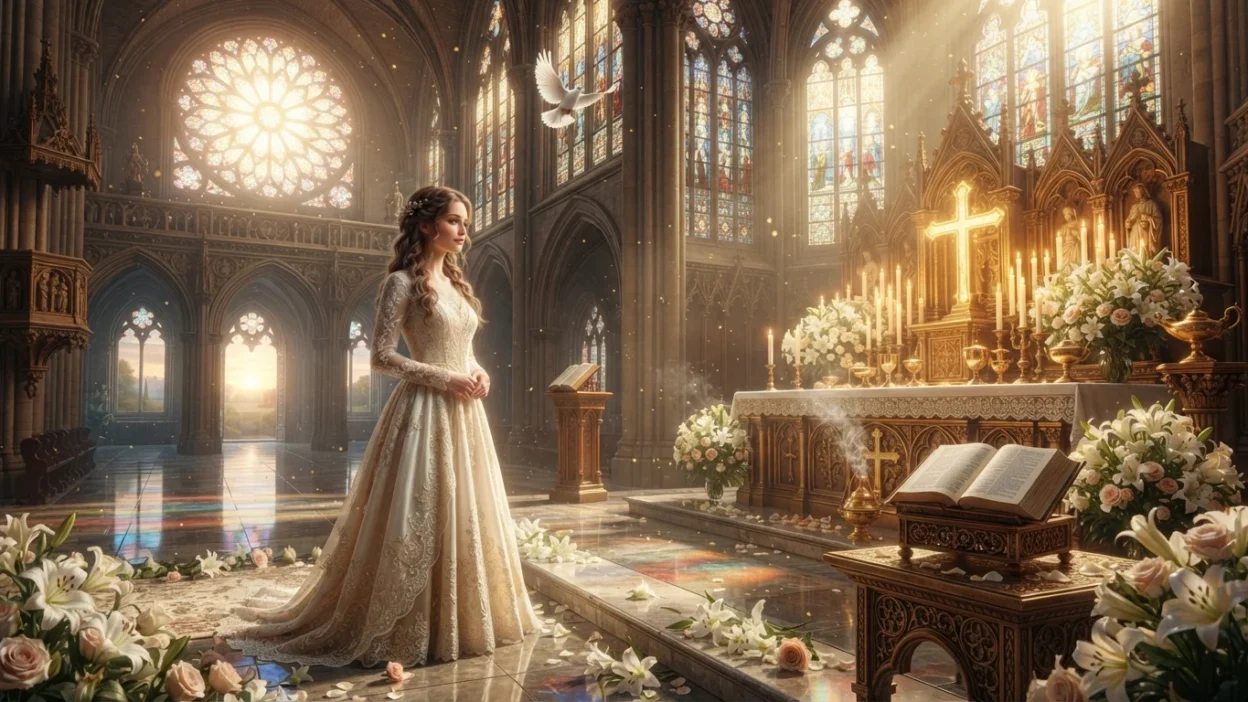
Altar symbolism represents sacred devotion, offering, sacrifice, prayer, remembrance, transformation and the relationship between people and the divine. Across different religious and spiritual traditions, altars have provided a dedicated place where ordinary space becomes associated with worship and sacred intention.
An altar may be simple or elaborate, permanent or temporary, but its symbolic power often comes from the meaning people attach to the objects, rituals and prayers placed around it.
Altar Symbolism Meaning (Clear Definition)
Altar symbolism refers to the spiritual and religious meanings associated with an altar and the objects or rituals connected with it.
Common symbolic meanings include:
- Devotion
- Worship
- Offering
- Sacrifice
- Prayer
- Gratitude
- Remembrance
- Purification
- Transformation
- Sacred connection
- Commitment
- Hope
At its deepest level, an altar can symbolize a deliberate meeting point between human intention and the sacred.
What Does Altar Symbolism Represent?
An altar often represents the act of giving something meaningful to a higher purpose.
Historically, offerings placed on altars could include food, flowers, incense, lamps, animals, or other valued objects, depending on the religious tradition.
Today, an altar may symbolize:
Devotion — dedicating time and attention to spiritual practice.
Offering — giving something meaningful as an expression of gratitude or faith.
Sacrifice — surrendering something valuable for a sacred purpose.
Remembrance — honoring a person, event, deity, ancestor, or spiritual ideal.
Transformation — marking a significant spiritual or personal transition.
Spiritual Meaning of Altar Symbolism
Spiritually, an altar can represent a place of focus and intentionality.
It may symbolize:
- Inner reflection
- Prayer
- Gratitude
- Spiritual discipline
- Renewal
- Healing
- Commitment
- Hope
- Sacred remembrance
- Connection with the divine
A personal altar can also serve as a physical reminder of the values a person wants to carry into everyday life.
Biblical / Religious Meaning of Altar Symbolism
Altars appear throughout the Hebrew Bible and Christian Scriptures.
In the Old Testament, altars are associated with worship, sacrifice, offerings, covenant, remembrance, and encounters with God.
Figures such as Noah, Abraham, Isaac, Jacob and Moses are associated with altar-building or altar worship in biblical narratives.
In ancient Israelite worship, the altar was an important part of the tabernacle and later the Temple.
In Christianity, altar symbolism developed in different ways across denominations. In Catholic, Orthodox, Anglican, and some other traditions, the altar has an important place in Eucharistic worship.
In many Protestant traditions, the emphasis and terminology can differ considerably.
Because religious practices vary, the meaning of an altar should always be understood within its specific theological and historical context.
Altar Symbolism in History and Culture
Altars have existed in many ancient civilizations.
Ancient Greek and Roman religions used altars for offerings to gods.
Ancient Israelites used altars in their worship.
Ancient Egyptian religious practices included altar-like offering arrangements.
Many Indigenous and other traditional cultures have developed their own forms of sacred offering spaces.
Across cultures, the altar frequently appears at the intersection of ritual, offering, remembrance, and sacred space.
Altar Symbolism and Offering
One of the oldest meanings associated with an altar is offering.
An offering can represent something given freely in gratitude, devotion, or worship.
Symbolically, an offering may communicate:
“Something valuable is being dedicated to something greater than myself.”
This is why flowers, food, incense, candles, and other meaningful objects can appear around sacred spaces.
The specific meaning varies significantly between traditions.
Altar Symbolism and Sacrifice
Sacrifice is another major historical association.
In many ancient religious traditions, sacrifices were performed as part of worship or ritual.
In Christianity, the symbolism of sacrifice is particularly connected with the crucifixion of Jesus Christ and the Eucharist, although different Christian denominations understand this relationship differently.
The broader symbolic idea of sacrifice can represent:
- Surrender
- Commitment
- Love
- Devotion
- A costly offering
- Transformation
Altar Symbolism and Candles
Candles frequently appear on religious altars.
They can symbolize:
- Light
- Prayer
- Hope
- Divine presence
- Remembrance
- Faith
- Spiritual guidance
A single flame surrounded by darkness can visually communicate the idea that hope remains even in difficult circumstances.
Altar Symbolism and Flowers
Flowers can symbolize different things depending on the tradition and context.
Common associations include:
- Beauty
- Purity
- Devotion
- Gratitude
- Renewal
- Mortality
- Love
- Remembrance
White flowers may evoke purity and peace, while roses can symbolize love or devotion.
In some traditions, specific flowers have highly particular religious meanings.
Altar Symbolism and Incense
Incense has been used in religious rituals for thousands of years.
Its rising smoke can symbolize:
- Prayer
- Offering
- Purification
- Sacred presence
- Transcendence
The imagery of smoke rising upward can naturally evoke the idea of prayers ascending toward heaven.
However, incense has different theological meanings across religious traditions.
Altar Symbolism and Fire
Fire can represent:
- Divine presence
- Purification
- Transformation
- Sacrifice
- Spiritual energy
- Illumination
An altar flame can therefore symbolize the continuing presence of faith or devotion.
Altar Symbolism and Water
Water may be placed near or associated with sacred spaces as a symbol of:
- Purification
- Renewal
- Life
- Cleansing
- Transformation
Its meaning varies according to the religious practice involved.
Altar Symbolism and the Cross
In Christian contexts, a cross positioned behind or upon an altar can symbolize:
- Jesus Christ
- Sacrifice
- Redemption
- Resurrection
- Salvation
- Hope
The cross becomes especially powerful when combined with candles, flowers, sacred vessels, and light.
Altar Symbolism and Sacred Texts
A sacred text placed near an altar can represent:
- Divine revelation
- Wisdom
- Guidance
- Religious teaching
- Truth
- Devotion
In Christian settings, this may be a Bible.
In other traditions, different scriptures or sacred texts may occupy this role.
The text becomes a symbolic connection between belief, teaching, worship and spiritual practice.
Altar Symbolism and Sacred Objects
Objects placed on an altar often communicate specific meanings.
Depending on the tradition, these may include:
- Candles
- Flowers
- Incense
- Religious statues
- Crosses
- Sacred books
- Bowls
- Lamps
- Ritual vessels
- Offerings
- Images of revered figures
There is no universal altar arrangement. Meaning comes from the religious tradition and ritual context.
Altar Symbolism in Dreams
Dreaming about an altar can have many personal interpretations.
Seeing an Altar
An altar may symbolize devotion, commitment, spiritual reflection, or something you consider deeply important.
Praying at an Altar
This may represent seeking guidance, forgiveness, comfort, or connection.
A Beautiful Altar
A beautiful altar can symbolize spiritual inspiration, peace, devotion, or hope.
A Broken Altar
A damaged altar may symbolize disrupted beliefs, loss, disappointment, spiritual questioning, or the ending of an important commitment.
Lighting a Candle on an Altar
This may symbolize hope, remembrance, prayer, or beginning a new spiritual chapter.
Standing Before an Altar
This can symbolize a major decision, commitment, transition, or willingness to dedicate yourself to something meaningful.
Dream interpretations are subjective and should not automatically be considered predictions.
Altar Symbolism and Marriage
In many Christian wedding ceremonies, couples stand before an altar.
The altar can therefore become a symbol of:
- Commitment
- Covenant
- Love
- Faith
- Partnership
- Responsibility
This association is especially strong in churches where marriage is understood as a sacred covenant.
Altar Symbolism and Remembrance
Altars can also serve as places of remembrance.
A memorial altar may contain:
- Photographs
- Flowers
- Candles
- Personal objects
- Written messages
Such an arrangement can symbolize love, memory, grief, gratitude, and continuing connection.
Different cultures have distinctive memorial traditions, and not every remembrance altar has the same religious meaning.
Altar Symbolism in Literature and Art
In literature and visual art, an altar often represents commitment and sacrifice.
A character standing before an altar may be facing:
- A life-changing decision
- A marriage
- A sacrifice
- A spiritual crisis
- A vow
- A confrontation with faith
A neglected altar can symbolize forgotten beliefs.
A brightly illuminated altar can represent hope.
An empty altar may represent absence, loss, or spiritual uncertainty.
Altar Symbolism and Transformation
An altar can mark moments when life changes.
People may approach an altar to:
- Make a vow
- Pray
- Give thanks
- Remember someone
- Seek forgiveness
- Celebrate
- Mark a religious milestone
Because of this, the altar can symbolize the threshold between who a person was and who they are choosing to become.
Altar Symbolism and Sacred Space
An altar often transforms an ordinary location into a place of special meaning.
Even a simple table can become an altar when it is intentionally dedicated to prayer, remembrance, worship, or spiritual practice.
This demonstrates an important symbolic principle:
Sacredness is often created through intention, ritual and meaning not simply through physical appearance.
Frequently Asked Questions About Altar Symbolism
What does an altar symbolize?
An altar commonly symbolizes worship, devotion, offering, sacrifice, prayer, remembrance, commitment and connection with the sacred.
What does an altar symbolize spiritually?
Spiritually, an altar can represent intentional devotion, prayer, gratitude, surrender, transformation and a person’s relationship with the divine.
What does a candle on an altar symbolize?
A candle may symbolize faith, hope, prayer, remembrance, spiritual guidance,or divine presence, depending on the tradition.
What does an altar symbolize in Christianity?
In many Christian traditions, an altar is associated with worship, Eucharistic celebration, sacrifice, Christ, devotion, and sacred remembrance.
What does an altar symbolize in dreams?
A dream altar may symbolize commitment, spiritual reflection, devotion, a major decision, remembrance or something the dreamer considers deeply meaningful.
What does an altar symbolize at a wedding?
In Christian wedding settings, an altar can symbolize sacred commitment, covenant, love, partnership and faith.
Conclusion
Altar symbolism is deeply connected with offering, devotion, worship, sacrifice, remembrance, prayer and transformation.
A candle can represent hope. Flowers can express devotion or remembrance. Incense can symbolize prayer. Sacred texts can represent divine wisdom. A cross can communicate Christian sacrifice and redemption. Together, these elements transform an ordinary surface into a powerful representation of sacred intention.
Across different cultures and religions, altars demonstrate humanity’s desire to dedicate something meaningful, remember what matters, seek guidance and create a physical place for spiritual connection.
Ultimately, altar symbolism reminds us that an altar is not merely an object or piece of furniture it is a symbolic place where devotion, intention, memory, sacrifice and hope meet the sacred.