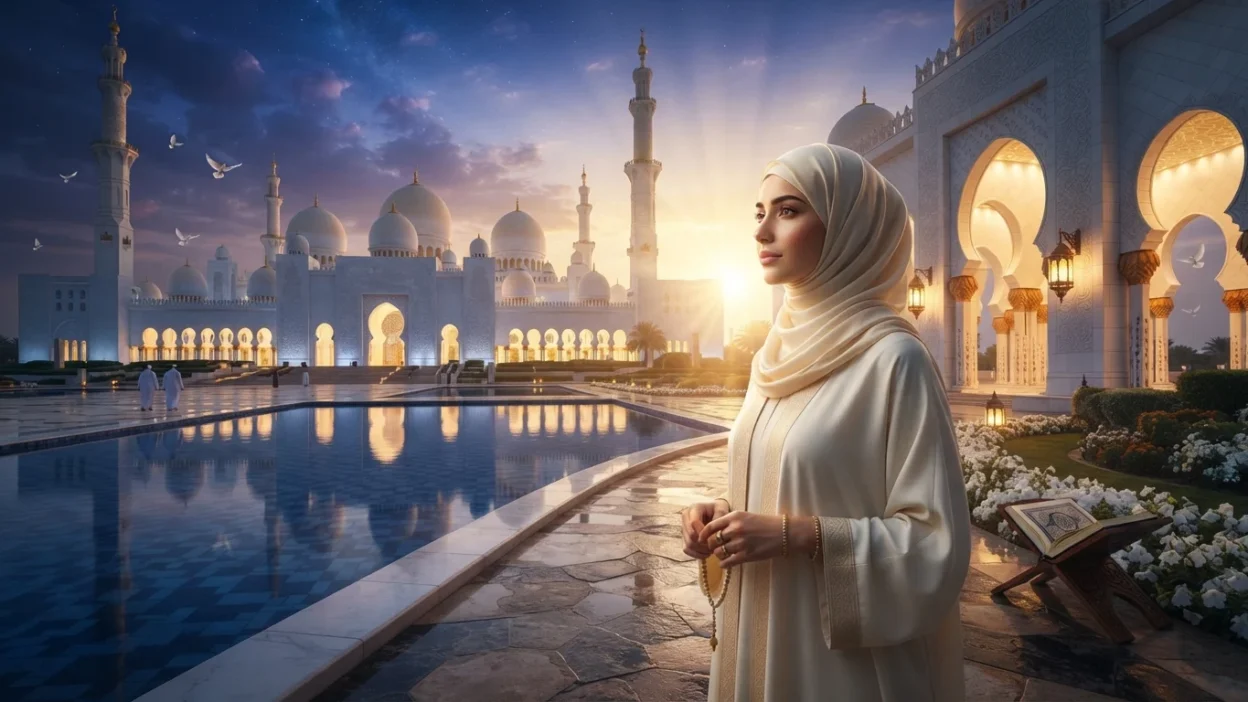
Mosque symbolism represents worship, submission to God, community, spiritual reflection, peace, equality, guidance and the connection between everyday life and faith. A mosque is more than an architectural structure; it is a sacred space where Muslims gather for prayer, remembrance, learning and community.
From the graceful minaret and domed prayer hall to geometric patterns, calligraphy, carpets, light and the open courtyard, mosque symbolism communicates ideas of faith, unity, humility, divine remembrance and spiritual orientation.
Mosque Symbolism Meaning (Clear Definition)
Mosque symbolism refers to the religious, architectural, artistic and cultural meanings associated with mosques and their visual elements.
Common symbolic themes include:
- Worship
- Submission to God
- Prayer
- Unity
- Equality
- Community
- Guidance
- Peace
- Humility
- Spiritual cleanliness
- Knowledge
- Divine remembrance
The Arabic word masjid is related to the idea of a place of prostration, emphasizing worship and submission to God.
What Does Mosque Symbolism Represent?
A mosque primarily represents a place of worship and community.
Its architecture often reinforces ideas central to Islamic practice.
The prayer hall provides a space for Muslims to stand together in worship.
The qibla, the direction toward the Kaaba in Mecca, gives worshippers a shared spiritual orientation.
The mihrab, which indicates the qibla direction, can visually emphasize this orientation.
The mosque therefore symbolizes not only a physical building but also the idea of turning toward God together as a community.
Spiritual Meaning of Mosque Symbolism
Spiritually, a mosque may represent:
- Faith
- Prayer
- Submission to God
- Humility
- Peace
- Reflection
- Spiritual discipline
- Community
- Guidance
- Gratitude
- Knowledge
- Remembrance of God
For Muslims, entering a mosque can provide an opportunity to step away from everyday distractions and focus on worship and spiritual reflection.
Islamic Meaning of Mosque Symbolism
In Islam, the mosque is fundamentally a place for worship and remembrance of Allah.
The Qur’an describes mosques as places where God’s name is remembered and emphasizes their sacred purpose.
The mosque also has an important communal role. Muslims may gather there for the five daily prayers, Friday prayer, religious education, community activities and special occasions.
Importantly, Islam does not require one universal architectural style for mosques. Mosque designs vary enormously across cultures and historical periods.
Mosque Symbolism in History and Culture
Mosque architecture developed across a vast geographic area, from the Middle East and North Africa to South Asia, Central Asia, Southeast Asia, Europe, and beyond.
Different regions developed distinctive architectural traditions.
Examples include:
- Ottoman domes and courtyards
- Persian tilework
- Mughal architecture
- North African geometric ornament
- Andalusian arches
- Ottoman-style minarets
- South Asian mosque complexes
This diversity shows that mosque symbolism is both religious and cultural.
The central purpose remains worship, while architectural expression reflects local history, craftsmanship, climate, and artistic traditions.
Mosque Symbolism in Architecture
Mosque Dome
The dome is one of the most recognizable elements of mosque architecture.
However, the dome is not a universal theological requirement in Islam.
Where used, it can create a sense of spaciousness and draw the eye upward. Its shape can contribute to an atmosphere of transcendence and contemplation.
Mosque Minaret
A minaret is a tower traditionally associated with a mosque.
Historically, minarets have been used for the call to prayer, although modern technology has changed how the adhan is broadcast.
Symbolically, a minaret can represent:
- The public presence of Islam
- The call to prayer
- Spiritual orientation
- Community
- Connection between earthly life and worship
Mihrab
The mihrab is a niche in the wall of the prayer space that indicates the direction of the qibla.
It can symbolize:
- Orientation toward Mecca
- Prayer
- Spiritual focus
- Unity among worshippers
The mihrab is one of the most important architectural features in many mosques.
Qibla
The qibla is the direction toward the Kaaba in Mecca.
It symbolizes a shared orientation among Muslims around the world.
Whether praying in Indonesia, Pakistan, Egypt, Turkey, Europe, or elsewhere, Muslims face the same direction during formal prayer.
This creates a powerful symbol of global unity in worship.
Mosque Courtyard
Many traditional mosques feature courtyards.
A courtyard may provide space for gathering, circulation, reflection, or ritual preparation.
Architecturally, it can also create a transition between the outside world and the prayer space.
Prayer Hall
The prayer hall represents the central communal space for worship.
Rows of worshippers standing together can visually express:
- Unity
- Equality
- Discipline
- Humility
- Shared devotion
Mosque Symbolism and Islamic Calligraphy
Islamic calligraphy is among the most distinctive forms of mosque decoration.
Arabic verses from the Qur’an and other religious inscriptions can transform walls, domes, arches, and architectural surfaces into expressions of faith.
Calligraphy can symbolize:
- Divine revelation
- Knowledge
- Remembrance
- Beauty
- Sacred words
- Devotion
The Qur’an’s message is central to Islamic faith, making religious calligraphy an especially meaningful architectural art form.
Mosque Symbolism and Geometric Patterns
Geometric patterns are widely used in Islamic art and architecture.
They may include:
- Stars
- Circles
- Polygons
- Interlocking patterns
- Repeating symmetrical designs
These patterns can create a visual sense of:
- Order
- Balance
- Harmony
- Continuity
- Mathematical beauty
It is important not to assign one fixed spiritual meaning to every geometric pattern. Their meanings vary according to artistic and cultural context.
Mosque Symbolism and Light
Light is an important architectural feature in many mosques.
Sunlight entering through windows, screens, or domes can create an atmosphere of serenity and contemplation.
In Islamic thought, light also has profound symbolic associations. The Qur’an’s famous Light Verse in Surah An-Nur uses the imagery of light in a rich spiritual metaphor.
Therefore, luminous mosque interiors can evoke ideas of:
- Guidance
- Divine illumination
- Knowledge
- Peace
- Spiritual awareness
Mosque Symbolism and Prayer Carpets
Prayer carpets provide a clean and comfortable surface for worship.
Many feature geometric or floral patterns.
Symbolically, the prayer carpet can represent a personal space of devotion, where the worshipper pauses, stands, bows, and prostrates before God.
The repeated rows of carpets can also reinforce the communal nature of prayer.
Mosque Symbolism and Cleanliness
Cleanliness has an important place in Islamic worship.
Ablution, or wudu, is performed before many forms of formal prayer.
Mosques may therefore include spaces specifically designed for washing.
Symbolically, water and cleanliness can evoke:
- Preparation
- Purification
- Discipline
- Renewal
- Respect for worship
Mosque Symbolism and the Kaaba
The Kaaba in Mecca is Islam’s most sacred sanctuary and the direction toward which Muslims face during prayer.
Mosques around the world are oriented toward it through the qibla.
The Kaaba therefore has a profound symbolic connection with:
- Unity
- Worship
- Pilgrimage
- Sacred orientation
- Global Muslim community
A mosque does not replace the Kaaba; rather, its prayer orientation connects Muslim worshippers to the wider sacred geography of Islam.
Mosque Symbolism and the Crescent
The crescent and star are widely recognized around the world as symbols associated with Islam.
However, they are not universal religious symbols prescribed by the Qur’an or required for mosques.
Their widespread association with Islam developed historically, particularly through the Ottoman Empire and later cultural and political use.
Therefore, a mosque can be fully Islamic without displaying a crescent.
Mosque Symbolism in Literature and Art
Mosques frequently appear in literature, photography, paintings, and films as symbols of:
- Faith
- Home
- Community
- Peace
- Cultural identity
- Spiritual reflection
- Heritage
- Belonging
A mosque illuminated at night may symbolize spiritual guidance.
A mosque surrounded by mountains may represent peace and contemplation.
A crowded mosque during prayer may symbolize unity and shared devotion.
Mosque Symbolism in Dreams
Dreaming about a mosque can have different meanings depending on a person’s beliefs, experiences, and emotions.
Entering a Mosque
This may symbolize seeking guidance, peace, faith, community, or spiritual reflection.
Praying in a Mosque
This may represent devotion, a desire for guidance, repentance, gratitude, or inner peace.
Seeing a Beautiful Mosque
A beautiful mosque may symbolize spiritual inspiration, hope, serenity, or admiration for sacred architecture.
Seeing an Empty Mosque
An empty mosque might represent loneliness, spiritual questioning, nostalgia, or a desire to reconnect with faith.
Seeing a Mosque at Night
A glowing mosque at night may symbolize hope and guidance during a period of uncertainty.
Seeing a Mosque From Far Away
This could symbolize a spiritual goal, a desire for connection, or a journey toward greater understanding.
Dream interpretation is personal and should not automatically be considered a prediction or supernatural message.
Mosque Symbolism and Community
One of the most important aspects of mosque symbolism is community.
The mosque brings people together for worship regardless of differences in wealth, occupation, ethnicity, or social position.
Rows of worshippers standing together can symbolize:
Equality + unity + humility + shared faith
This communal dimension is central to the mosque’s meaning.
Mosque Symbolism and Peace
A peaceful mosque environment can symbolize a retreat from the noise and pressures of everyday life.
Soft light, quiet prayer, rhythmic recitation, architectural symmetry, and communal worship can create an atmosphere of calm.
For many Muslims, the mosque represents a place where they can pause, pray, reflect and reconnect with God.
Frequently Asked Questions About Mosque Symbolism
What does a mosque symbolize?
A mosque symbolizes worship, prayer, submission to God, community, unity, humility, spiritual reflection and remembrance.
What does a mosque symbolize spiritually?
Spiritually, a mosque can symbolize connection with Allah, guidance, prayer, peace, devotion, humility and spiritual discipline.
What does a mosque dome symbolize?
A dome is not required in Islam, but where used it can create a sense of openness and upward movement, contributing to an atmosphere of contemplation and transcendence.
What does a minaret symbolize?
A minaret is traditionally associated with the call to prayer and can symbolize the mosque’s presence within the community and the invitation to worship.
What does the mihrab symbolize?
The mihrab indicates the qibla direction and therefore symbolizes orientation toward the Kaaba and focused communal prayer.
What does mosque light symbolize?
Light in mosque architecture can evoke guidance, knowledge, peace and divine illumination, especially in connection with Qur’anic imagery of light.
Is the crescent a required Islamic symbol?
No. The crescent is widely associated with Islam culturally and historically, but it is not a required symbol of Islam or an essential feature of mosque architecture.
Conclusion
Mosque symbolism brings together faith, architecture, worship, community, beauty and spiritual orientation.
The minaret can evoke the call to prayer. The mihrab establishes the direction of worship. The qibla connects Muslims around the world to the Kaaba. Geometric patterns express artistic order, while calligraphy gives visual prominence to sacred words. Light can evoke guidance, and the prayer hall represents unity and shared devotion.
At its heart, the mosque symbolizes more than architecture. It represents a place where people turn toward God, pray together, seek knowledge, practice humility, and strengthen their connection with their community and faith.
Ultimately, mosque symbolism reminds us that sacred architecture can transform physical space into an environment of worship, reflection, unity and spiritual purpose.