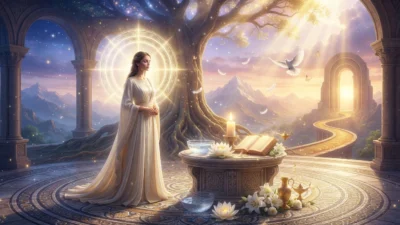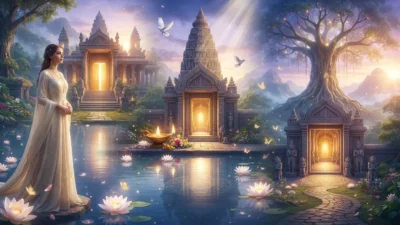
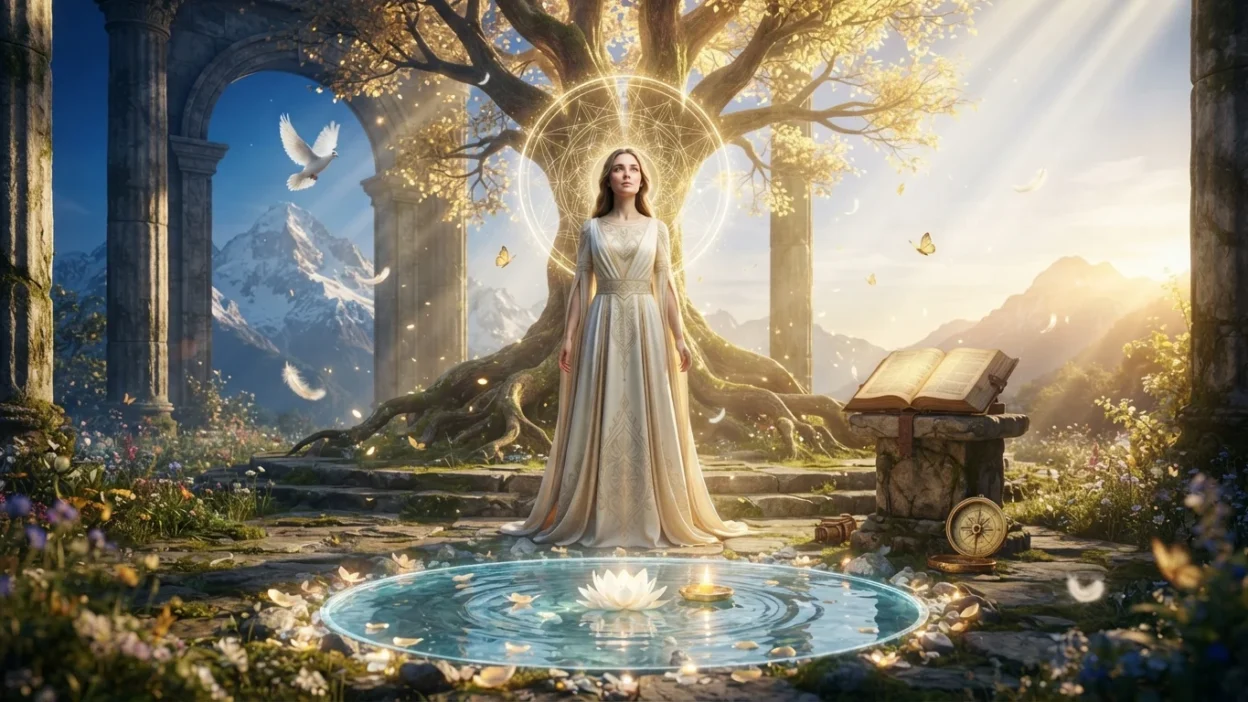
Sacred symbolism represents holiness, divine connection, spiritual truth, reverence, transcendence, purity, protection and the deeper meaning people attach to objects, places, actions and natural elements. Across religions and cultures, sacred symbols help communicate ideas that ordinary words may struggle to express.
From a glowing candle and sacred circle to a temple, tree, river or piece of religious art, sacred symbolism transforms familiar things into reminders of faith, devotion, mystery, and connection with something greater than ourselves.
Sacred Symbolism Meaning (Clear Definition)
Sacred symbolism refers to the use of images, objects, patterns, places, numbers, animals, natural elements and rituals to represent spiritual or religious ideas.
Common meanings include:
- Holiness
- Divine presence
- Faith
- Purity
- Protection
- Spiritual wisdom
- Reverence
- Transcendence
- Unity
- Renewal
- Devotion
- Mystery
A sacred symbol is meaningful because a particular community or tradition associates it with something considered holy, spiritually significant or worthy of reverence.
What Does Sacred Symbolism Represent?
Sacred symbolism often represents the relationship between the physical and spiritual worlds.
A simple candle can symbolize divine light. Water can represent cleansing and renewal. A mountain can represent closeness to heaven or spiritual elevation.
Sacred symbols may also communicate ideas that are difficult to explain directly, such as:
- The nature of God or the divine
- The mystery of existence
- Life and death
- Creation
- Spiritual transformation
- Human connection
- Moral values
- The search for meaning
The power of sacred symbolism comes from its ability to turn an abstract belief into something visible, memorable, and emotionally meaningful.
Spiritual Meaning of Sacred Symbolism
Spiritually, sacred symbolism can represent a person’s connection with the divine, the universe, nature, or a deeper sense of existence.
It may symbolize:
- Spiritual awakening
- Inner peace
- Divine guidance
- Faith
- Gratitude
- Meditation
- Protection
- Transformation
- Compassion
- Wisdom
- Unity
For many people, sacred symbols serve as reminders to pause, reflect, pray, meditate, or reconnect with their deepest values.
Biblical / Religious Meaning of Sacred Symbolism
Sacred symbolism is central to many religious traditions, including Christianity, Judaism, Islam, Hinduism, Buddhism, Sikhism, and numerous Indigenous and traditional spiritual systems.
In Christianity, symbols such as the cross, dove, lamb, bread, wine, water, light, and fish have important theological associations.
In Judaism, symbols and objects such as the Star of David, menorah, Torah scrolls, and ritual objects can carry religious and cultural significance.
In Islam, geometric patterns, calligraphy, the mosque, the Qur’an, and other religious elements can communicate reverence and devotion. The crescent and star are widely associated with Islam culturally, although they are not a universal or foundational symbol prescribed by the Qur’an.
In Hindu traditions, symbols such as Om, the lotus, mandalas, and various deities and sacred objects can represent different dimensions of spiritual reality.
Buddhist symbolism includes the Dharma wheel, lotus, Bodhi tree, and Buddha images, each carrying different philosophical and spiritual meanings.
Because sacred symbolism varies greatly between traditions, a symbol should always be understood within its specific religious and cultural context.
Sacred Symbolism in History and Culture
Human societies have used sacred symbols for thousands of years.
Ancient civilizations expressed religious ideas through:
- Temples
- Sacred mountains
- Sun symbols
- Sacred animals
- Trees
- Water
- Fire
- Geometric patterns
- Statues
- Amulets
- Ritual objects
Sacred symbolism helped communities preserve beliefs and pass them from one generation to another.
A symbol could communicate an entire worldview without requiring written language.
Sacred Symbolism in Nature
Nature is one of the richest sources of sacred symbolism.
Sun
The sun can symbolize:
- Divine light
- Life
- Creation
- Renewal
- Power
- Illumination
Moon
The moon can represent:
- Mystery
- Cycles
- Reflection
- Intuition
- Transformation
Water
- Cleansing
- Renewal
- Life
- Rebirth
- Spiritual purification
Fire
Fire can represent:
- Divine presence
- Purification
- Transformation
- Passion
- Spiritual energy
Tree
A sacred tree can symbolize:
- Life
- Wisdom
- Growth
- Connection
- Stability
- The relationship between earth and heaven
Mountain
Mountains can represent:
- Spiritual elevation
- Revelation
- Strength
- Sacred space
- Closeness to the divine
Sacred Symbolism in Literature and Art
Artists and writers frequently use sacred symbols to explore profound human questions.
A glowing light may represent spiritual truth.
A temple may symbolize sanctuary.
A journey toward a mountain may represent spiritual development.
A broken religious object might symbolize a crisis of faith.
A sacred garden may represent paradise, innocence, or inner peace.
Because sacred symbols carry layers of cultural meaning, they can make literature and art feel deeper and more emotionally powerful.
Sacred Symbolism in Dreams
Sacred symbols appearing in dreams can have personal as well as cultural meanings.
Seeing a Sacred Place
A temple, church, mosque, shrine, or other sacred place may symbolize a search for peace, guidance, belonging, or meaning.
Seeing a Sacred Light
A bright spiritual light may represent hope, clarity, inspiration, or awakening.
Seeing a Cross
For someone familiar with Christianity, a cross may evoke faith, sacrifice, redemption, or spiritual devotion.
Seeing a Lotus
A lotus may symbolize purity, growth, transformation, or rising above difficult circumstances, particularly in traditions where the lotus has established religious significance.
Seeing a Sacred Tree
A sacred tree may symbolize grounding, wisdom, growth, ancestry, and connection between different realms of existence.
Dream interpretation is highly personal, so the meaning of a sacred symbol depends heavily on the dreamer’s experiences, beliefs, and emotions.
Sacred Geometry Symbolism
Sacred geometry refers to geometric forms that have been given spiritual, philosophical, or symbolic significance in particular traditions.
Examples include:
- Circles
- Spirals
- Mandalas
- Triangles
- Hexagons
- Symmetrical patterns
The circle is particularly common as a symbol of unity, eternity, wholeness, and cycles.
A mandala can represent wholeness, balance, meditation, or the structure of the cosmos depending on the tradition.
It is important to remember that not every geometric pattern is inherently sacred. Its meaning comes from the cultural or spiritual context in which it is used.
Sacred Symbolism and Light
Light is perhaps one of the most universal sacred metaphors.
It can represent:
- Truth
- Wisdom
- Divine presence
- Hope
- Purity
- Consciousness
- Spiritual awakening
This symbolism appears across many religious and philosophical traditions.
A candle burning in darkness can therefore become a powerful image of faith surviving uncertainty.
Sacred Symbolism and Circles
The circle often represents completeness.
Because it has no obvious beginning or end, it can symbolize:
- Eternity
- Unity
- Wholeness
- Infinity
- Cycles
- Spiritual completeness
Circles appear in religious art, architecture, ritual objects, mandalas, and other symbolic traditions around the world.
Sacred Symbolism and Protection
Sacred symbols are sometimes used as reminders of protection.
Religious pendants, prayer objects, sacred inscriptions, protective figures, and blessed objects can provide believers with a tangible reminder of faith and spiritual security.
The symbolic meaning may be:
Faith → Trust → Protection → Peace
The specific beliefs surrounding protection vary considerably between traditions.
Sacred Symbolism and Purity
Many sacred traditions use white clothing, water, flowers, light, and other imagery to express purity.
Purity can refer to:
- Spiritual cleansing
- Innocence
- Moral integrity
- Renewal
- Devotion
- Inner clarity
A white flower placed in a sacred setting can therefore communicate reverence and spiritual beauty.
Sacred Symbolism and Transformation
Sacred symbolism frequently represents transformation.
Water can symbolize cleansing.
Fire can symbolize purification.
The butterfly can represent metamorphosis.
The rising sun can symbolize renewal.
A spiritual journey can represent the movement from:
Confusion → Understanding → Awakening
This makes sacred symbolism especially powerful in stories about personal growth.
Sacred Symbolism and Sacred Spaces
A sacred space is not simply a physical location. It can represent a place separated from ordinary life for worship, reflection, prayer, or contemplation.
Examples include:
- Temples
- Churches
- Mosques
- Synagogues
- Shrines
- Monasteries
- Sacred groves
- Pilgrimage sites
- Mountains
- Rivers
These places can symbolize connection, reverence, community, and transcendence.
Frequently Asked Questions About Sacred Symbolism
What does sacred symbolism mean?
Sacred symbolism refers to objects, images, places, patterns, or natural elements that represent spiritual, religious, or holy ideas.
What does sacred symbolism represent spiritually?
It can represent divine connection, faith, purity, protection, wisdom, spiritual awakening, transformation, reverence, and transcendence.
What are common sacred symbols?
Common examples include crosses, circles, light, water, fire, lotus flowers, sacred trees, religious architecture, prayer objects, and sacred geometric patterns.
What does a sacred circle symbolize?
A sacred circle often represents unity, wholeness, eternity, infinity, balance, and the cycles of existence, depending on the tradition.
What does sacred light symbolize?
Sacred light commonly represents divine presence, truth, wisdom, hope, purity, guidance, and spiritual awakening.
Why are symbols important in religion?
Symbols allow religious communities to express complex spiritual ideas through memorable visual forms and objects connected with worship, ritual, identity, and tradition.
Conclusion
Sacred symbolism gives visible form to faith, mystery, devotion, divine connection, spiritual wisdom and the search for meaning.
Across cultures, people have found sacred meaning in light, water, fire, mountains, trees, circles, flowers, animals, architecture, and religious objects. While the meanings differ from one tradition to another, sacred symbols often help people connect the visible world with ideas that are deeper and harder to express.
A candle can represent hope. Water can represent renewal. A mountain can represent spiritual elevation. A circle can represent wholeness. A sacred space can represent connection with the divine.
Ultimately, sacred symbolism reminds us that ordinary things can become powerful reminders of what people hold most meaningful, holy and worthy of reverence.