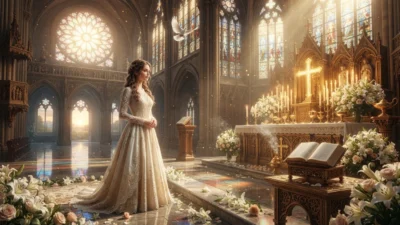

Church symbolism represents faith, worship, community, divine presence, sanctuary, hope, salvation, spiritual guidance and the relationship between humanity and the sacred. Churches are not only places of worship but also powerful symbolic spaces where architecture, light, colors, objects and rituals communicate religious beliefs.
From the cross above a church to stained glass windows and soaring towers, every element can carry layers of spiritual and historical meaning.
Church Symbolism Meaning (Clear Definition)
Church symbolism refers to the religious meanings communicated through church buildings, architecture, artwork, objects, colors, furnishings, rituals and visual elements.
Common meanings include:
- Faith
- Worship
- Sanctuary
- Community
- Divine presence
- Hope
- Salvation
- Spiritual guidance
- Sacrifice
- Resurrection
- Eternity
- Peace
A church can symbolically represent a meeting place between the human and the divine.
What Does Church Symbolism Represent?
Church symbolism often represents faith, belonging, protection and spiritual connection.
A church building can function as a physical sanctuary while also symbolizing an inner sanctuary a place of refuge, reflection, prayer, and hope.
Its architecture may communicate a journey from earthly life toward heaven.
For example, a tall church tower reaching toward the sky can symbolize human aspiration toward the divine.
A doorway can represent entering sacred space.
A central altar can represent worship and devotion.
Light entering through stained glass can represent divine illumination.
Spiritual Meaning of Church Symbolism
Spiritually, church symbolism may represent:
- Connection with God
- Prayer
- Faith
- Spiritual guidance
- Protection
- Forgiveness
- Community
- Hope
- Renewal
- Inner peace
- Salvation
For many Christians, entering a church can symbolize stepping away from ordinary distractions and entering a space dedicated to worship and spiritual reflection.
Biblical Meaning of Church Symbolism
The word church in the New Testament is associated with the gathered community of believers rather than simply a physical building.
The Greek word ekklesia is commonly translated as “assembly” or “gathering.”
This distinction is important because Christian symbolism includes both:
The church as a community of people
and
the church as a physical place of worship.
The New Testament uses imagery such as the body of Christ, the bride of Christ, a flock, and a spiritual house to describe the community of believers.
The physical church building developed later as Christianity established dedicated spaces for worship.
Church Symbolism in History and Culture
Church architecture has evolved dramatically across history.
Different periods developed distinctive architectural languages, including:
- Early Christian
- Byzantine
- Romanesque
- Gothic
- Renaissance
- Baroque
- Modern Christian architecture
Each style expresses different ideas about worship, beauty, community, and the relationship between earth and heaven.
Gothic cathedrals, for example, are famous for their soaring vertical architecture, stained glass, pointed arches, and dramatic light.
These features can create a sense of transcendence and awe.
Church Symbolism in Architecture
Church Doors
Church doors can symbolize entrance, invitation, transition, and entering sacred space.
Crossing the threshold may represent moving from ordinary life into an environment dedicated to worship.
Church Tower
A tower reaching toward the sky can symbolize:
- Spiritual aspiration
- Divine connection
- Guidance
- Prayer
- Heaven
Church towers have also historically served practical purposes, such as bells and community gathering.
Bell Tower
Church bells can symbolize:
- Calling people to worship
- Community
- Celebration
- Mourning
- Spiritual remembrance
The sound of bells historically connected religious spaces with the wider community.
Church Windows
Windows represent light, vision, revelation and divine illumination.
Stained-glass windows transform ordinary sunlight into colorful religious imagery, making light itself part of the spiritual experience.
Church Nave
The nave is the central area where the congregation gathers in many church designs.
Symbolically, it can represent community, shared worship and the collective journey of believers.
Altar
The altar is one of the most significant elements in many Christian traditions.
Depending on denomination and context, it can symbolize:
- Worship
- Sacrifice
- Communion
- Christ
- Devotion
- Sacred presence
Its exact theological meaning varies between Christian traditions.
Church Symbolism and the Cross
The cross is the central symbol of Christianity.
It can represent:
- Jesus Christ
- Sacrifice
- Redemption
- Resurrection
- Faith
- Salvation
- Hope
A cross placed above a church can immediately communicate the building’s Christian identity.
The empty cross can also symbolize the Christian belief in Christ’s resurrection.
Church Symbolism and Stained Glass
Stained-glass windows are among the most recognizable features of historic churches.
They can represent:
- Divine light
- Biblical stories
- Saints
- Christian teachings
- Spiritual beauty
- Revelation
The transformation of ordinary sunlight through colored glass can itself become a metaphor for spiritual illumination.
Church Symbolism and Candles
Candles are commonly associated with prayer, remembrance, hope, and spiritual light.
A candle burning inside a dark church can symbolize:
Faith overcoming darkness.
It may also represent a person’s prayer or remembrance, depending on the tradition.
Church Symbolism and Bells
Church bells have both practical and symbolic importance.
They can represent:
- A call to worship
- Community
- Celebration
- Mourning
- Time
- Spiritual remembrance
Their sound can extend beyond the church walls, symbolically connecting the religious community with the surrounding world.
Church Symbolism and the Dove
The dove is an important Christian symbol associated with the Holy Spirit, particularly in representations of the baptism of Jesus.
It can also evoke:
- Peace
- Purity
- Divine presence
- Spiritual renewal
A dove appearing above or within a church can therefore communicate a sense of spiritual presence and peace.
Church Symbolism and the Fish
The fish is an ancient Christian symbol.
The Greek word ichthys became associated with a Christian confession of faith and was used as a recognizable symbol among early Christians.
Today, the fish can represent:
- Christianity
- Faith
- Christ
- Discipleship
- Christian identity
Church Symbolism and Light
Light is one of the most powerful recurring elements in church architecture.
Sunlight entering through high windows can create an atmosphere of transcendence.
Symbolically, light can represent:
- God
- Truth
- Hope
- Wisdom
- Revelation
- Salvation
- Spiritual awakening
Darkness outside and radiant light inside can create a visual contrast between uncertainty and spiritual hope.
Church Symbolism in Dreams
Dreaming about a church can have many possible interpretations depending on your personal beliefs and emotions.
Entering a Church
This may symbolize seeking guidance, peace, belonging, protection, or spiritual reflection.
An Empty Church
An empty church may represent loneliness, spiritual questioning, nostalgia, or a desire for connection.
A Beautiful Church
A magnificent church may symbolize hope, faith, inspiration, spiritual beauty, or a desire for peace.
A Dark Church
A dark church may represent uncertainty, spiritual doubt, fear, grief, or unresolved questions.
Praying in a Church
This may symbolize seeking comfort, forgiveness, guidance, or emotional support.
A Church on a Mountain
A church positioned high on a mountain can symbolize spiritual aspiration, pilgrimage, revelation, and the search for a higher perspective.
Dream symbolism is personal and should not automatically be interpreted as a prediction or supernatural message.
Church Symbolism and Sanctuary
The idea of sanctuary is central to the symbolic meaning of a church.
A church can represent a place where people seek:
- Safety
- Peace
- Forgiveness
- Community
- Reflection
- Spiritual comfort
This makes church symbolism particularly powerful during periods of grief, uncertainty, celebration, and personal transformation.
Church Symbolism and Community
The church is not simply a building.
In Christian theology, the community of believers itself is called the church.
This gives church symbolism an important social dimension.
A church can represent:
Individual faith + shared community + collective worship
The building becomes a physical expression of relationships, traditions, rituals, and shared beliefs.
Church Symbolism in Literature and Art
Churches frequently appear in literature as symbols of:
- Faith
- Tradition
- Moral authority
- Sanctuary
- Community
- Spiritual conflict
- Hope
- Mystery
- History
A church standing alone in a storm might symbolize enduring faith.
A ruined church may symbolize the passage of time, cultural change, loss, or forgotten traditions.
A brightly illuminated church in darkness can symbolize hope.
Frequently Asked Questions About Church Symbolism
What does a church symbolize?
A church commonly symbolizes faith, worship, community, sanctuary, divine connection, hope, spiritual guidance, and belonging.
What does a church symbolize spiritually?
Spiritually, a church may symbolize prayer, connection with God, refuge, forgiveness, community, spiritual renewal, and worship.
What does a church represent in the Bible?
Biblically, the church primarily refers to the gathered community of believers, often described through images such as the body of Christ and the bride of Christ.
What does a church door symbolize?
A church door can symbolize entrance, invitation, transition, and entering sacred space.
What does a church tower symbolize?
A church tower reaching toward the sky can symbolize spiritual aspiration, divine connection, prayer, guidance, and heaven.
What does stained glass symbolize in a church?
Stained glass can symbolize divine light, revelation, biblical teaching, spiritual beauty, and the transformation of ordinary light into sacred imagery.
Conclusion
Church symbolism brings together architecture, faith, history, community, art and spirituality.
A church door can symbolize entering sacred space. A tower can point toward heaven. Stained glass can transform sunlight into an image of divine illumination. Bells can call a community together. Candles can represent prayer and hope. The cross can communicate sacrifice, redemption, resurrection and Christian faith.
Most importantly, the church symbolizes more than a building. In Christian thought, it also represents a community of believers united in worship and faith.
Ultimately, church symbolism reminds us that sacred spaces can become powerful expressions of human hope, devotion, community and the enduring search for connection with the divine.