Yoga symbolism represents balance, harmony, self awareness, discipline, union, transformation, inner peace and the connection between body, mind and consciousness. While modern yoga is often associated with physical postures, yoga has a much broader history rooted in South Asian philosophical and religious traditions.
From the lotus posture and mandala to the breath, sacred geometry, sun imagery, mountains and flowing water, yoga symbolism expresses the idea of bringing different aspects of life into greater harmony.
Yoga Symbolism Meaning (Clear Definition)
Yoga symbolism refers to the symbolic meanings associated with yoga practices, postures, philosophical concepts, imagery and traditional objects.
Common themes include:
- Balance
- Union
- Self awareness
- Discipline
- Inner peace
- Spiritual growth
- Mindfulness
- Transformation
- Harmony
- Breath
- Concentration
- Liberation
The Sanskrit word yoga is related to the idea of joining or yoking. In different historical contexts, this has been understood in philosophical and spiritual ways, including the relationship between individual consciousness and ultimate reality.
What Does Yoga Symbolism Represent?
Yoga symbolism often represents integration.
Rather than treating the body, mind, emotions, and spiritual life as completely separate, many yoga traditions explore relationships among them.
A balanced yoga posture can symbolize stability.
Controlled breathing can represent awareness.
A mountain pose can evoke groundedness.
A lotus can represent spiritual development.
The circular form of a mandala can symbolize wholeness.
Together, these images communicate the movement from fragmentation toward harmony.
Spiritual Meaning of Yoga Symbolism
Spiritually, yoga symbolism can represent:
- Inner awakening
- Self knowledge
- Discipline
- Awareness
- Detachment
- Compassion
- Concentration
- Transformation
- Liberation
- Harmony
However, yoga does not have one single spiritual interpretation. Different schools of yoga have developed distinct philosophical ideas and practices.
For some traditions, yoga is primarily a spiritual discipline. For many modern practitioners, it may also be practiced as physical exercise, relaxation or mindfulness.
Religious Meaning of Yoga Symbolism
Yoga developed within the broader religious and philosophical traditions of South Asia and has important historical relationships with Hindu, Buddhist and Jain traditions, among others.
Classical yoga philosophy is particularly associated with the Yoga Sutras of Patanjali, which describe an eight limbed path including ethical principles, physical posture, breath regulation, sensory withdrawal, concentration, meditation and samadhi.
Modern yoga classes often focus primarily on physical postures and breathing, which represent only part of yoga’s historical development.
It is therefore important to distinguish traditional yoga philosophy from contemporary fitness oriented yoga.
Yoga Symbolism in History and Culture
Yoga has a long and complex history extending over thousands of years.
Its development includes ideas found in ancient Indian texts and later philosophical traditions.
Over centuries, different forms of yoga emphasized:
- Meditation
- Devotion
- Knowledge
- Breath practices
- Physical postures
- Mantra
- Ethical discipline
- Concentration
Modern yoga became increasingly global during the nineteenth and twentieth centuries and developed many new interpretations.
This history explains why the word “yoga” today can refer to both a profound philosophical tradition and a wide range of modern physical practices.
Yoga Symbolism and the Lotus
The lotus is one of the most recognizable symbols associated with yoga and South Asian spirituality.
Because lotus flowers emerge from muddy water while blooming above the surface, they can symbolize:
- Purity
- Spiritual growth
- Transformation
- Awakening
- Rising above difficulties
The lotus also appears prominently in Hindu and Buddhist imagery, where its meanings can become much more specific.
Yoga Symbolism and Lotus Pose
Padmasana, or lotus pose, is traditionally associated with meditation.
The posture can symbolize:
- Stability
- Concentration
- Stillness
- Meditation
- Spiritual discipline
However, lotus pose is not required for yoga or meditation. It can also be physically demanding for some people, and other seated positions may be used.
Yoga Symbolism and Mountain Pose
Tadasana, or mountain pose, is a powerful visual metaphor.
The practitioner stands upright and grounded like a mountain.
It can symbolize:
- Stability
- Strength
- Grounding
- Balance
- Presence
- Confidence
The mountain remains steady while weather changes around it, making it a useful metaphor for maintaining inner stability amid changing circumstances.
Yoga Symbolism and the Sun
The sun is an important symbol in several yoga traditions.
Surya Namaskar, commonly translated as Sun Salutation, is a sequence of movements traditionally associated with honoring or acknowledging the sun.
The sun can symbolize:
- Light
- Vitality
- Awareness
- Energy
- Renewal
- Life
Its symbolism is particularly powerful at sunrise, when darkness gives way to light.
Yoga Symbolism and the Breath
Breath is central to many yoga practices.
Pranayama refers broadly to traditional yogic practices involving regulation of the breath.
Symbolically, breath can represent:
- Life
- Awareness
- Presence
- Energy
- Rhythm
- Connection between body and mind
The movement of breathing provides a natural anchor for attention.
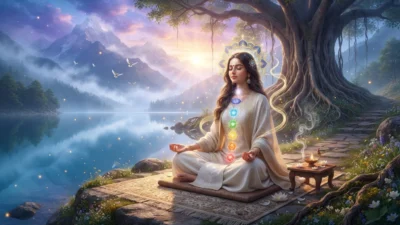
Yoga Symbolism and Chakras
The chakra system is an important part of certain Hindu and later yoga traditions, although chakra concepts vary considerably across historical and modern systems.
The Sanskrit word chakra means “wheel” or “disc.”
Modern popular culture often presents seven major chakras arranged along the body, each associated with particular colors, locations, and psychological or spiritual themes.
These modern interpretations should not be treated as a single universal description of all historical yoga traditions.
Within contemporary symbolism, chakras commonly represent:
- Energy
- Awareness
- Emotional development
- Spiritual growth
- Balance
Yoga Symbolism and the Mandala
A mandala is a geometric design with deep significance in several South Asian religious traditions.
Mandalas can symbolize:
- Wholeness
- Cosmic order
- Balance
- Sacred space
- Unity
- Concentration
In certain Hindu and Buddhist practices, mandalas can serve specific ritual or contemplative purposes.
They are therefore more than generic decorative patterns.
Yoga Symbolism and Om
The sacred syllable Om, often represented by the symbol ॐ, has profound significance in Hindu traditions and appears in some yoga contexts.
It can be associated with:
- Sacred sound
- Consciousness
- The universe
- Meditation
- Spiritual reality
Its exact philosophical interpretation varies across traditions and texts.
Yoga Symbolism and Meditation
Meditation is deeply connected with traditional yoga philosophy.
The relationship between physical posture, breath, concentration, meditation, and deeper states of awareness is particularly important in classical yoga systems.
Symbolically, this progression can be understood as:
Body → Breath → Mind → Awareness → Deeper realization
This is one reason yoga imagery frequently portrays a calm person seated in meditation surrounded by nature.
Yoga Symbolism and Water
Water is often used in yoga imagery as a symbol of:
- Calmness
- Flow
- Adaptability
- Purification
- Renewal
- Emotional balance
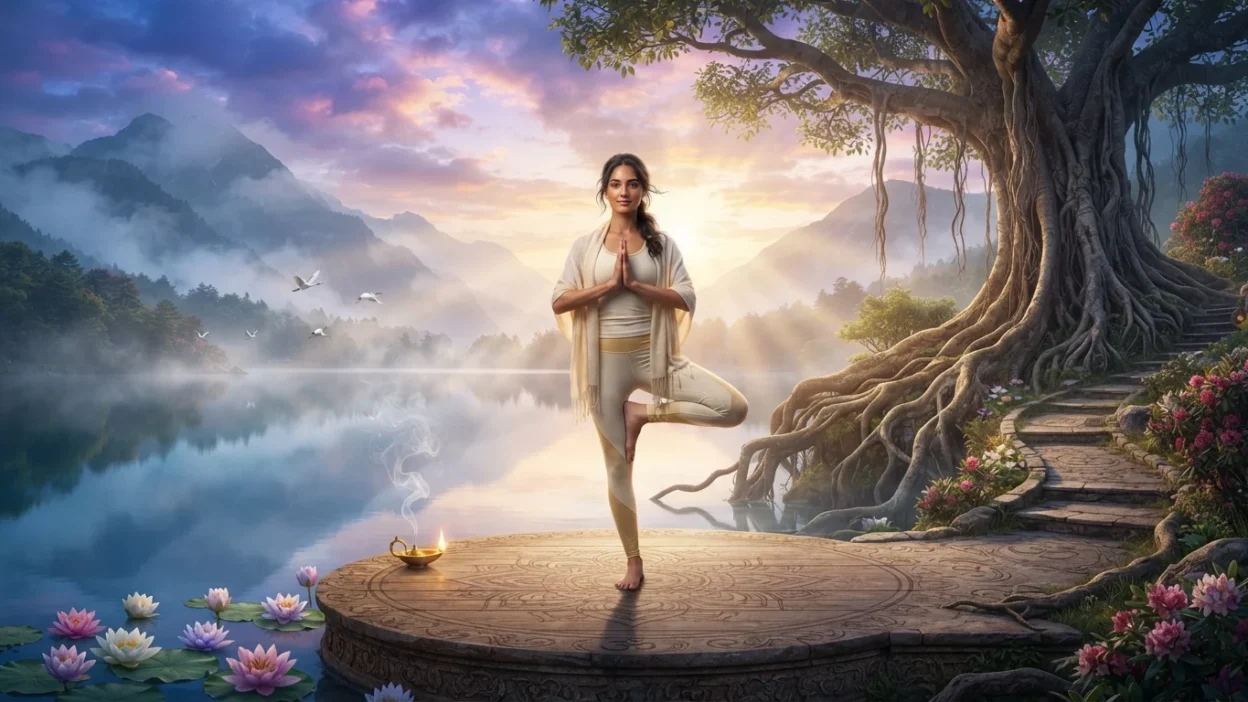
A calm lake beside a yoga practitioner creates a visual metaphor for a mind that has become quiet and reflective.
Yoga Symbolism and Trees
Trees are powerful symbols of grounding and growth.
Their roots can represent:
- Stability
- Connection
- Foundation
- Grounding
Their branches can represent:
- Growth
- Expansion
- Awareness
- Aspiration
A person practicing yoga beneath a large tree therefore symbolizes being deeply grounded while continuing to grow.
Yoga Symbolism and Balance
Balance is one of the most recognizable themes in modern yoga imagery.
Balancing postures can represent:
- Focus
- Patience
- Discipline
- Awareness
- Adaptability
- Inner stability
The symbolism is especially powerful because maintaining physical balance requires constant adjustment.
This can mirror the broader lesson of life:
Balance is not the absence of movement; it is the ability to respond to movement without losing stability.
Yoga Symbolism and Inner Transformation
Yoga symbolism often portrays transformation as an inner process.
The goal is not simply to become physically flexible.
Traditional yoga philosophy explores questions concerning:
- The nature of the self
- Consciousness
- Desire
- Suffering
- Attachment
- Knowledge
- Liberation
Modern yoga may emphasize physical wellbeing, but its historical philosophical background is considerably broader.
Yoga Symbolism in Dreams
Dreaming about yoga can have many personal interpretations.
Practicing Yoga
This may symbolize a desire for balance, self awareness, discipline or emotional calm.
Doing a Difficult Yoga Pose
This may represent facing a challenge that requires patience and persistence.
Practicing Yoga in Nature
This can symbolize a desire to reconnect with yourself and the natural world.
Seeing a Lotus During Yoga
A lotus may symbolize spiritual growth, transformation, purity or awakening.
Losing Balance During Yoga
This may symbolize uncertainty, instability, distraction or difficulty maintaining balance in some area of life.
Dream interpretations are subjective and should not be treated as predictions.
Yoga Symbolism in Literature and Art
Yoga frequently appears in literature, photography, painting, film, and modern wellness imagery.
A solitary practitioner on a mountain can symbolize self discovery.
A person practicing yoga at sunrise can symbolize renewal.
A balanced pose beside still water can symbolize inner harmony.
A lotus surrounded by meditation imagery can represent spiritual awakening.
These visual metaphors make yoga particularly powerful in storytelling.
Frequently Asked Questions About Yoga Symbolism
What does yoga symbolize?
Yoga commonly symbolizes union, balance, self awareness, discipline, harmony, spiritual growth, mindfulness and transformation.
What does yoga symbolize spiritually?
In traditional contexts, yoga can symbolize a disciplined path toward deeper self-knowledge, concentration, spiritual realization and liberation.
What does the lotus symbolize in yoga?
The lotus can symbolize purity, spiritual growth, transformation and awakening, particularly within Hindu and Buddhist traditions.
What does mountain pose symbolize?
Mountain pose can symbolize stability, grounding, strength, balance and remaining centered amid change.
What does Om symbolize in yoga?
Om is a sacred syllable with deep significance in Hindu traditions and is associated in various contexts with sacred sound, consciousness, meditation and ultimate reality.
What do chakras symbolize?
In various traditional and modern systems, chakras are understood as subtle centers associated with different aspects of spiritual or embodied experience. Their interpretations vary considerably.
Conclusion
Yoga symbolism brings together body, breath, mind, nature, philosophy and spiritual aspiration.
The lotus can represent awakening. The mountain symbolizes stability. The sun evokes vitality and renewal. Breath represents life and awareness. Mandalas can express sacred order and wholeness. Balance postures remind us that stability requires continual attention.
At the same time, yoga is much more than a collection of modern wellness symbols. Its history is rooted in complex South Asian philosophical and religious traditions that explore consciousness, discipline, meditation, ethics, knowledge, devotion and liberation.
Ultimately, yoga symbolism reminds us that true balance is not about becoming perfectly still or perfectly controlled; it is about developing the awareness and discipline to remain centered while life continues to change around us.