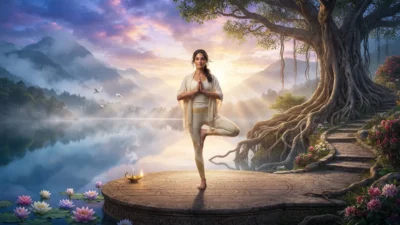
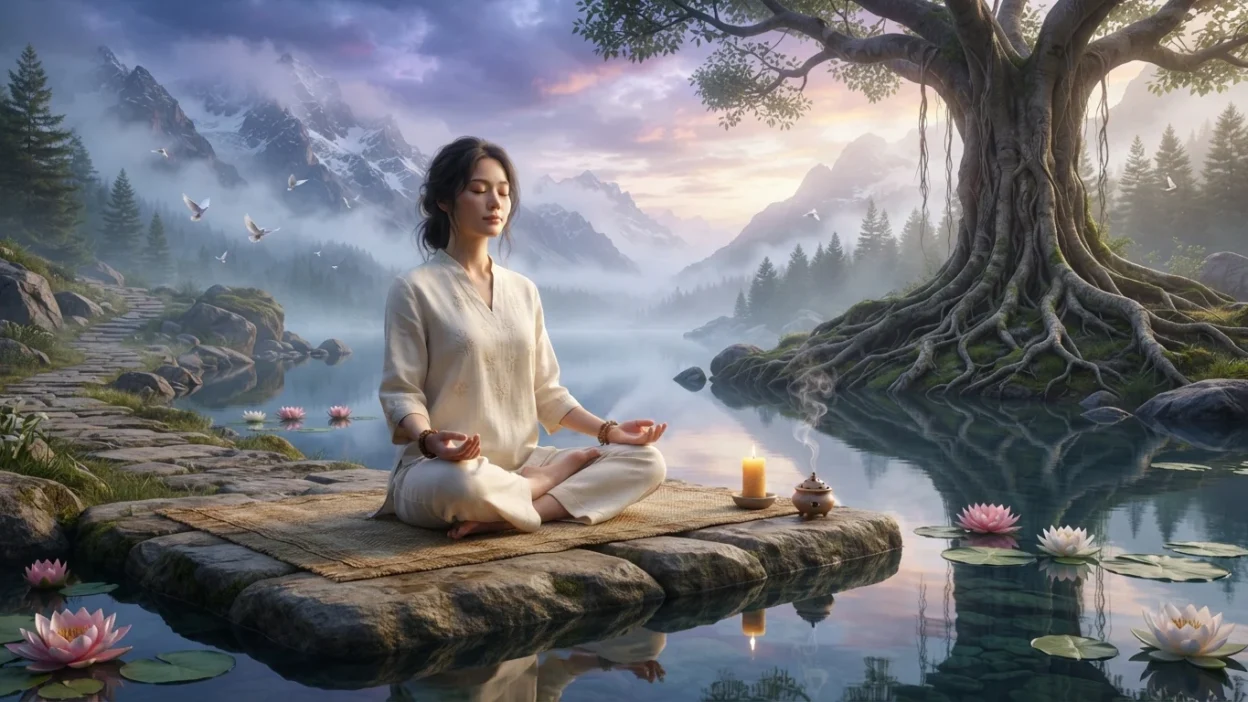
Meditation symbolism represents inner peace, mindfulness, self awareness, balance, spiritual awakening, stillness, concentration and the journey inward. Across different cultures and traditions, meditation is often represented through symbolic postures, natural elements, sacred spaces, light, circles, lotus flowers, mountains and flowing water.
These symbols communicate a simple but profound idea: when the external world becomes quiet, a person can turn inward and become more aware of the mind, body and present moment.
Meditation Symbolism Meaning (Clear Definition)
Meditation symbolism refers to the visual, spiritual, and cultural symbols associated with meditation and contemplative practices.
Common meanings include:
- Inner peace
- Mindfulness
- Stillness
- Self-awareness
- Balance
- Concentration
- Spiritual growth
- Enlightenment
- Emotional clarity
- Detachment
- Renewal
- Inner transformation
Meditation symbolism often portrays the movement from outer noise toward inner stillness.
What Does Meditation Symbolism Represent?
Meditation symbolism commonly represents the journey inward.
Unlike symbols focused on external achievement, meditation symbols often emphasize slowing down, observing, accepting, and becoming present.
A quiet mountain may symbolize stability.
Still water may represent a calm mind.
A lotus may symbolize spiritual growth.
A circle can represent wholeness.
A candle flame may represent concentration and awareness.
A person sitting peacefully in meditation can symbolize the discovery of stillness within.
Spiritual Meaning of Meditation Symbolism
Spiritually, meditation symbolism can represent:
- Awakening
- Inner wisdom
- Connection with the present moment
- Spiritual discipline
- Self-discovery
- Peace
- Detachment
- Compassion
- Awareness
- Transformation
Different traditions understand meditation differently. Some emphasize concentration, others mindfulness, contemplation, prayer, visualization, mantra, or insight.
Therefore, meditation should not be treated as one universal spiritual practice.
Religious Meaning of Meditation Symbolism
Meditative and contemplative practices appear in many religious traditions.
In Buddhism, meditation is closely associated with mindfulness, concentration, insight, compassion, and liberation.
In Hindu traditions, meditation can be connected with yoga, concentration, self-knowledge, devotion, and spiritual realization.
In Christianity, contemplative prayer and meditation on scripture have long histories in various traditions.
In Islam, practices of remembrance such as dhikr can involve focused repetition and spiritual awareness, although Islamic prayer and dhikr should not simply be equated with modern secular meditation.
Other religious and philosophical traditions also have contemplative practices.
The meaning of meditation symbolism therefore depends heavily on religious, cultural, and philosophical context.
Meditation Symbolism in History and Culture
Meditative traditions have existed for thousands of years.
South Asian philosophical and religious traditions developed sophisticated systems of contemplation and meditation.
Buddhist traditions later developed numerous approaches emphasizing mindfulness, concentration, loving-kindness, visualization, and insight.
Meditative practices also developed in China, Japan, Tibet, and elsewhere, often interacting with Buddhism, Daoism, Confucianism, and local traditions.
In the modern world, meditation has also become popular as a secular practice associated with mindfulness, relaxation, concentration, and stress management.
This history shows that meditation symbolism has evolved while maintaining a recurring theme: turning attention inward.
Meditation Symbolism and the Lotus
The lotus is one of the most recognizable symbols associated with meditation and spiritual traditions in South Asia and Buddhism.
Because the lotus grows from muddy water while producing a beautiful flower above the surface, it can symbolize:
- Purity
- Transformation
- Spiritual growth
- Awakening
- Rising beyond difficulty
The lotus is especially important in Buddhist and Hindu symbolism, although its exact meaning varies between traditions.
Meditation Symbolism and the Lotus Position
The seated lotus or cross-legged meditation posture is widely associated with meditation.
It can symbolize:
- Stability
- Balance
- Concentration
- Stillness
- Grounding
- Spiritual discipline
However, meditation does not require the lotus position. People can meditate sitting on a chair, kneeling, standing, walking, or lying down depending on the practice.
Meditation Symbolism and the Mountain
The mountain is a powerful meditation symbol.
A mountain can represent:
- Stability
- Strength
- Stillness
- Patience
- Perspective
- Spiritual elevation
A meditator sitting like a mountain visually communicates the idea of remaining stable while thoughts and emotions move around them.
The mountain does not need to stop the wind to remain a mountain.
Likewise, meditation can symbolize learning to remain grounded while experiences come and go.
Meditation Symbolism and Still Water
Still water is another powerful symbol.
It can represent:
- Calmness
- Clarity
- Reflection
- Emotional balance
- Awareness
When water is disturbed, its reflection becomes unclear.
This provides a useful metaphor for the mind: when mental activity settles, perception may feel clearer.
Meditation Symbolism and the Circle
Circles frequently symbolize:
- Wholeness
- Unity
- Completion
- Continuity
- Balance
- Eternity
In some Buddhist contexts, the enso a hand drawn circle in Zen traditions can symbolize ideas such as enlightenment, emptiness, freedo, and the beauty of imperfection, although interpretations vary.
Meditation Symbolism and Light
Light can symbolize:
- Awareness
- Wisdom
- Enlightenment
- Clarity
- Inner awakening
- Understanding
A meditation scene illuminated by a soft beam of sunlight can therefore represent the movement from confusion toward awareness.
However, light symbolism is broader than meditation and should not automatically be assigned a single religious interpretation.
Meditation Symbolism and the Candle Flame
A candle flame can represent focused attention.
The flame remains visually centered even as it gently moves.
For this reason, it can symbolize:
- Concentration
- Awareness
- Inner clarity
- Spiritual focus
- Hope
In certain meditation practices, an actual candle flame may be used as an object of concentration, while in other contexts the candle is simply symbolic.
Meditation Symbolism and Breath
Breath is central to many meditation practices.
Symbolically, breath can represent:
- Life
- Presence
- Continuity
- Renewal
- Awareness
- Connection between body and mind
Watching the breath can become a symbolic reminder to return from thoughts about the past or future to the present moment.
Meditation Symbolism and Trees
Trees are frequently used as visual symbols of meditation.
Their roots represent:
- Grounding
- Stability
- Connection to the earth
Their branches represent:
- Growth
- Expansion
- Awareness
- Connection with the sky
An ancient tree beside a meditating person can therefore symbolize rootedness combined with spiritual growth.
Meditation Symbolism and Wind
Wind can symbolize the movement of thoughts.
A person sitting peacefully while leaves move in the wind creates a visual metaphor:
The environment can change without disturbing inner awareness.
Wind may also symbolize freedom, impermanence, and the natural movement of life.
Meditation Symbolism and Incense
Incense is associated with meditation and religious practices in many cultures.
Its rising smoke can symbolize:
- Transcendence
- Purification
- Spiritual atmosphere
- Impermanence
- Prayer
- The movement of attention upward
The exact meaning varies by tradition.
Meditation Symbolism and Mandalas
Mandalas are intricate geometric designs used in various Hindu and Buddhist contexts.
They can represent:
- Cosmic order
- Wholeness
- Balance
- Sacred space
- Concentration
- The structure of reality
Mandalas may be used as objects of contemplation or visualization in particular traditions.
They should not be treated simply as generic “meditation symbols,” because their religious meanings can be highly specific.
Meditation Symbolism and Silence
Silence may be one of the most universal symbols of meditation.
It can represent:
- Stillness
- Listening
- Awareness
- Reflection
- Presence
- Freedom from distraction
Silence does not necessarily mean the mind contains no thoughts.
Instead, it can symbolize observing thoughts without allowing every thought to control attention.
Meditation Symbolism in Dreams
Dreaming about meditation can have different personal meanings.
Meditating Peacefully
This may symbolize a desire for balance, rest, clarity, or emotional stability.
Meditating on a Mountain
A mountain meditation dream may represent strength, perspective, patience, or spiritual aspiration.
Meditating Beside Water
This may symbolize emotional healing, clarity, reflection, or the desire for inner calm.
Seeing a Lotus During Meditation
A lotus may represent personal growth, renewal, transformation, or spiritual awakening.
Being Unable to Meditate
This might symbolize distraction, anxiety, unresolved thoughts, or difficulty finding peace.
Dream interpretation is subjective and should not be considered a guaranteed prediction.
Meditation Symbolism and Inner Transformation
Meditation symbolism is ultimately about transformation through awareness.
The transformation may not involve changing the outside world.
Instead, it can symbolize changing the way a person relates to:
- Thoughts
- Emotions
- Memories
- Desires
- Fear
- Uncertainty
- Everyday experiences
This makes meditation symbolism especially powerful in literature and visual storytelling.
Meditation Symbolism in Literature and Art
Artists and writers frequently portray meditation using:
- Mountains
- Water
- Lotus flowers
- Candles
- Trees
- Moonlight
- Temples
- Empty rooms
- Circular patterns
- Sunrise
A character sitting alone beside a lake may symbolize self-discovery.
A meditator beneath an ancient tree may represent wisdom.
A person surrounded by darkness with a small light beside them may symbolize finding awareness during difficult circumstances.
Frequently Asked Questions About Meditation Symbolism
What does meditation symbolize?
Meditation commonly symbolizes inner peace, mindfulness, self-awareness, balance, concentration, spiritual growth and transformation.
What does meditation symbolize spiritually?
Spiritually, meditation can symbolize awakening, wisdom, contemplation, inner connection, compassion and the journey toward deeper awareness.
What does the lotus symbolize in meditation?
The lotus can symbolize purity, spiritual growth, transformation and awakening, particularly within Buddhist and Hindu traditions.
What does a mountain symbolize in meditation?
A mountain can symbolize stability, stillness, strength, patience, grounding and spiritual elevation.
What does still water symbolize in meditation?
Still water commonly symbolizes calmness, clarity, reflection and a quiet mind.
What does a candle symbolize in meditation?
A candle flame can represent concentration, awareness, clarity, spiritual focus and hope.
Conclusion
Meditation symbolism transforms simple natural and visual elements into powerful representations of inner peace and awareness.
The lotus can symbolize spiritual growth. The mountain represents stability. Still water evokes clarity. A candle flame suggests concentration. A tree represents grounding and growth. A circle can express wholeness. Silence creates a symbolic space for reflection.
Although meditation has different meanings across religions and cultures, its symbolism repeatedly returns to one profound idea: the journey toward greater awareness begins by becoming still enough to notice what is happening within.
Ultimately, meditation symbolism reminds us that peace is not always found by controlling the world around us; sometimes it begins by changing the way we observe and experience it.