
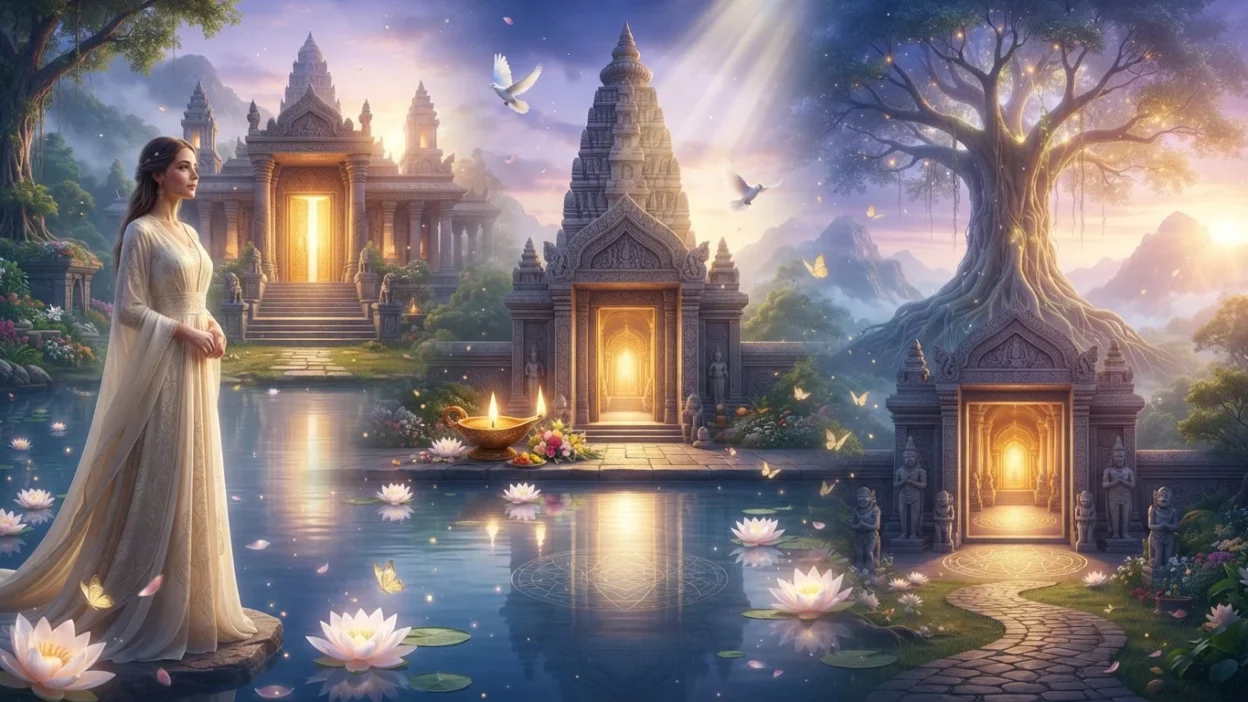
Temple symbolism represents sacred space, divine presence, spiritual connection, devotion, wisdom, protection, transcendence and the journey from ordinary life toward a deeper sense of meaning. Across cultures and religious traditions, temples have been designed not simply as buildings, but as symbolic environments where architecture, nature, light, ritual and sacred imagery work together.
From towering entrances and sacred courtyards to statues, lamps, water, flowers, and intricate geometric designs, temple symbolism communicates ideas about the divine, the human soul, spiritual transformation and the search for inner peace.
Temple Symbolism Meaning (Clear Definition)
Temple symbolism refers to the spiritual and religious meanings associated with temple architecture, objects, artwork, spaces, rituals and decorative elements.
Common meanings include:
- Sacredness
- Divine presence
- Worship
- Devotion
- Spiritual wisdom
- Protection
- Purification
- Enlightenment
- Transformation
- Inner peace
- Community
- Transcendence
A temple often symbolizes a meeting point between the human world and the sacred.
What Does Temple Symbolism Represent?
Temple symbolism commonly represents a journey from the ordinary toward the sacred.
The entrance may symbolize leaving everyday concerns behind. A courtyard can represent transition and preparation. The central sanctuary can represent the heart of spiritual reality.
Depending on the tradition, a temple may also symbolize:
The universe — with its architecture reflecting a sacred understanding of cosmic order.
The human body or soul — with inner chambers representing deeper spiritual awareness.
The sacred mountain — with towers or elevated structures symbolizing ascent toward the divine.
A sanctuary — offering a place for prayer, meditation, worship, and reflection.
Spiritual Meaning of Temple Symbolism
Spiritually, temples can represent:
- Connection with the divine
- Inner peace
- Prayer and meditation
- Spiritual awakening
- Devotion
- Purification
- Wisdom
- Protection
- Transformation
- Transcendence
For many worshippers, entering a temple is more than entering a physical structure. It can symbolize turning inward, becoming mindful, and reconnecting with one’s spiritual values.
Religious Meaning of Temple Symbolism
The word temple applies to different religious traditions, and the symbolism is not identical across them.
In Hindu traditions, temples can be understood as sacred spaces centered on the presence of a deity and structured through elaborate architectural and ritual systems.
In Buddhism, temples can serve as places for meditation, teaching, devotion, and community practice.
In Judaism, the ancient Jerusalem Temple held profound religious significance as the central sanctuary of ancient Israel. Its historical and theological meaning is distinct from modern places of Jewish worship.
In other cultures and traditions, temples have served as sacred centers dedicated to particular deities, ancestors, spiritual practices, or cosmological beliefs.
Because temple symbolism varies considerably, each temple should be interpreted within its specific religious and cultural context.
Temple Symbolism in History and Culture
Temples are among humanity’s oldest monumental structures.
Ancient civilizations constructed temples as centers of:
- Worship
- Ritual
- Community
- Learning
- Art
- Pilgrimage
- Cultural identity
Examples can be found throughout South Asia, East Asia, the Mediterranean, the Middle East, Africa, and the Americas.
Temple architecture often reflects the worldview of the civilization that created it.
A temple’s orientation, proportions, entrance, central chamber, sculptures, gardens, and relationship with the surrounding landscape can all communicate religious ideas.
Temple Symbolism in Architecture
Temple Entrance
A temple entrance can symbolize transition from the ordinary world into sacred space.
Passing through a gate may represent leaving behind distractions and preparing for worship or meditation.
Temple Gate
Large gates can symbolize:
- Protection
- Transition
- Thresholds
- Sacred boundaries
- Entry into spiritual space
In some traditions, temple gates are also decorated with guardian figures that symbolically protect the sacred environment.
Temple Tower
Tall temple structures can symbolize:
- Spiritual ascent
- Cosmic connection
- The sacred mountain
- Divine presence
- Aspiration toward enlightenment
Their upward movement naturally draws the eye toward the sky.
Temple Courtyard
A courtyard can represent a transitional space between the outside world and the innermost sacred area.
It may symbolize:
- Preparation
- Community
- Reflection
- Purification
- Gathering
Inner Sanctuary
The innermost chamber of a temple often carries special sacred significance.
Depending on the tradition, it may represent:
- Divine presence
- Mystery
- The spiritual center
- Enlightenment
- Sacred revelation
Temple Symbolism and Water
Water is one of the most widespread sacred symbols.
Temple ponds, fountains, rivers, and ritual water may symbolize:
- Purification
- Renewal
- Life
- Cleansing
- Transformation
- Spiritual preparation
A temple reflected in calm water can also symbolize inner stillness and contemplation.
Temple Symbolism and Fire
- Divine presence
- Purification
- Transformation
- Devotion
- Sacred energy
- Illumination
Lamps and flames are especially meaningful in traditions where light is associated with spiritual knowledge and the removal of darkness.
Temple Symbolism and Light
Light can represent:
- Wisdom
- Divine presence
- Truth
- Enlightenment
- Hope
- Spiritual awakening
A beam of sunlight entering a dark temple can create a powerful symbolic contrast between darkness and spiritual understanding.
Temple Symbolism and Flowers
Flowers frequently appear in temple settings.
Depending on the tradition, flowers may symbolize:
- Purity
- Beauty
- Devotion
- Impermanence
- Renewal
- Spiritual awakening
The lotus is particularly important in several Asian religious traditions, where it can symbolize purity and spiritual development.
Temple Symbolism and the Lotus
The lotus grows from muddy water while producing a beautiful flower above the surface.
This natural process has made it a powerful metaphor for spiritual growth rising above difficulty and impurity.
In Buddhist, Hindu, and other South Asian traditions, lotus imagery can carry specific religious meanings connected with deities, teachings, purity, or enlightenment.
Temple Symbolism and Sacred Geometry
Many temples incorporate carefully structured geometric patterns and proportions.
Sacred geometry can symbolize:
- Cosmic order
- Balance
- Harmony
- Unity
- Infinity
- The structure of creation
Mandalas and other geometric systems can be especially significant in traditions where architecture and religious cosmology are closely connected.
However, not every geometric design should automatically be labeled “sacred.” Its meaning depends on the tradition and context.
Temple Symbolism and Statues
Religious statues within temples can represent deities, teachers, saints, guardians, ancestors, or other sacred figures depending on the tradition.
Their gestures, posture, clothing, objects, and surrounding imagery may communicate specific teachings or stories.
A statue is therefore often more than decoration. It can function as a focus for devotion, meditation, teaching, or remembrance.
Temple Symbolism and Bells
Temple bells appear in several religious traditions.
Depending on context, a bell may symbolize:
- Awakening
- Attention
- Prayer
- Purification
- The beginning or ending of ritual
- Spiritual awareness
The sound of a bell can encourage worshippers to become mentally present and attentive.
Temple Symbolism in Literature and Art
Temples frequently appear in literature as symbols of:
- Mystery
- Wisdom
- Spiritual discovery
- Sanctuary
- Ancient knowledge
- Transformation
- Cultural heritage
A character entering an ancient temple may symbolize entering an unknown part of themselves.
A ruined temple may represent the passage of time, lost civilizations, memory, or the impermanence of human achievement.
A temple illuminated at dawn can symbolize renewal and spiritual awakening.
Temple Symbolism in Dreams
Dreaming about a temple can have many possible personal meanings.
Entering a Temple
This may symbolize seeking guidance, peace, spiritual understanding, or a deeper connection with yourself.
Seeing an Ancient Temple
An ancient temple may represent tradition, wisdom, ancestry, history, or the search for forgotten knowledge.
A Golden Temple
Gold may symbolize spiritual value, enlightenment, prosperity, sacred beauty, or something deeply treasured.
A Temple on a Mountain
This can symbolize spiritual aspiration, a difficult journey toward wisdom, or the desire to reach a higher perspective.
A Destroyed Temple
A ruined temple may symbolize loss, changing beliefs, grief, cultural memory, or a period of spiritual questioning.
Praying in a Temple
This may represent devotion, a desire for guidance, gratitude, hope, or the need for emotional peace.
Dream symbolism is subjective, so these interpretations should be understood as possibilities rather than predictions.
Temple Symbolism and Protection
Many temples incorporate guardian figures, gates, walls, or other protective imagery.
These elements can symbolize the boundary between:
Sacred and ordinary
Order and chaos
Protection and danger
The temple itself can become a symbolic refuge where people seek peace, spiritual protection, and guidance.
Temple Symbolism and Inner Transformation
Perhaps one of the deepest meanings of temple symbolism is transformation.
The movement from the outer entrance toward an inner sanctuary can be understood metaphorically as a journey from:
Distraction → Reflection → Understanding → Inner Peace
This makes temple architecture particularly powerful as a metaphor for spiritual growth.
The outer world represents everyday life.
The inner sanctuary represents deeper awareness.
The journey between them represents the individual’s search for meaning.
Frequently Asked Questions About Temple Symbolism
What does a temple symbolize?
A temple commonly symbolizes sacred space, divine presence, worship, devotion, spiritual wisdom, protection, inner peace and connection with the divine.
What does temple symbolism mean spiritually?
Spiritually, temple symbolism can represent meditation, prayer, purification, transformation, enlightenment, spiritual awakening and the journey toward deeper understanding.
What does a temple entrance symbolize?
A temple entrance can symbolize crossing from ordinary life into sacred space and preparing for spiritual reflection or worship.
What does temple water symbolize?
Water around or within temples can symbolize purification, renewal, life, cleansing and spiritual preparation.
What does a temple tower symbolize?
A temple tower can symbolize spiritual ascent, the sacred mountain, cosmic connection and aspiration toward the divine.
What does a temple symbolize in dreams?
A temple in a dream may symbolize spirituality, guidance, wisdom, peace, tradition, personal reflection or a search for deeper meaning.
Conclusion
Temple symbolism brings together architecture, spirituality, nature, ritual, history and human longing for transcendence.
A temple gate can represent a sacred threshold. Water can symbolize purification. Fire can represent transformation. Flowers can express devotion and purity. Towers can point toward spiritual ascent. The inner sanctuary can represent the deepest center of sacred experience.
Although temples have different meanings across religions and cultures, they frequently serve as powerful reminders of humanity’s desire to seek wisdom, connect with the sacred, find inner peace and understand something greater than ordinary existence.
Ultimately, temple symbolism reminds us that the journey into a sacred place can also become a symbolic journey inward toward reflection, awareness, devotion and spiritual transformation.