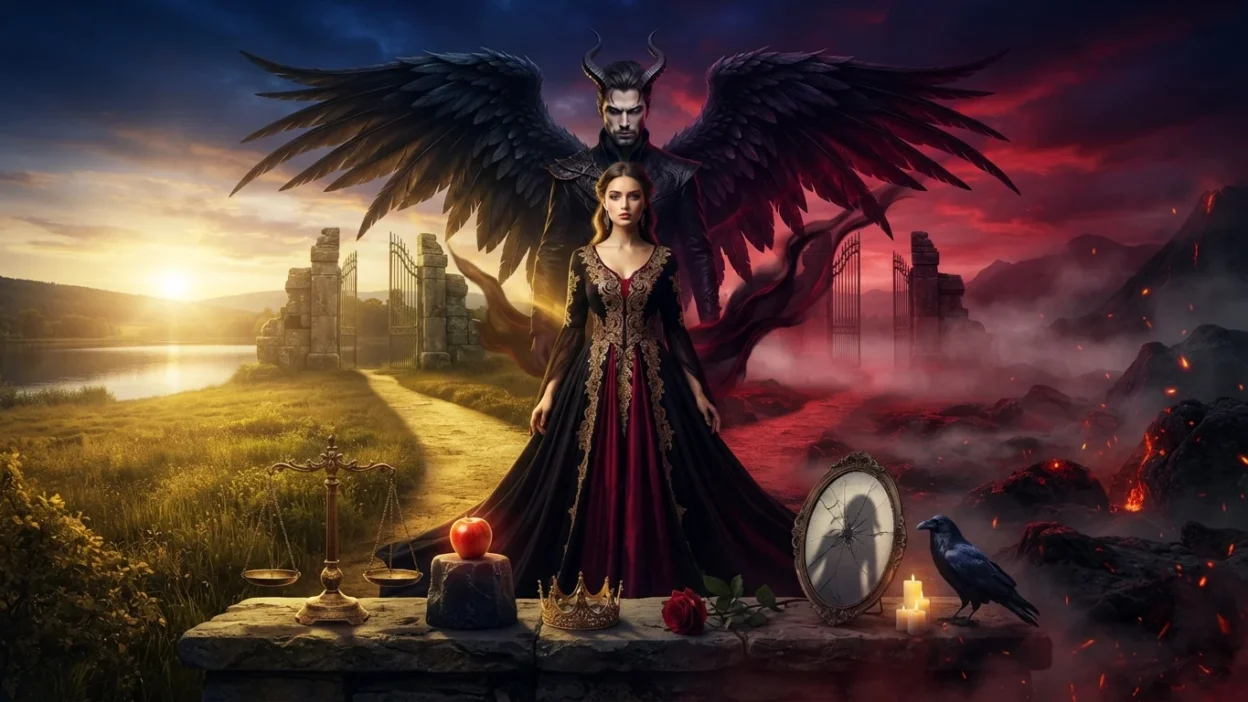
Demon symbolism represents fear, temptation, inner conflict, destructive impulses, chaos, spiritual struggle, hidden darkness and the unknown. Across religions, mythology, folklore, literature and art, demons have been used to personify forces that threaten, challenge or disturb the individual or society.
However, demon symbolism is not always simply about evil. In literature and psychological interpretations, a demon can represent unresolved emotions, suppressed fears, destructive habits, trauma, temptation or the parts of ourselves we struggle to understand.
Demon Symbolism Meaning (Clear Definition)
Demon symbolism refers to the religious, cultural, psychological, and artistic meanings associated with demons and demonic figures.
Common symbolic meanings include:
- Fear
- Temptation
- Chaos
- Destruction
- Inner conflict
- Hidden emotions
- Spiritual struggle
- Rebellion
- Darkness
- The unknown
- Guilt
- Transformation
A demon often symbolizes a threatening force—whether external, spiritual, emotional, or psychological—that challenges a person’s sense of safety or identity.
What Does Demon Symbolism Represent?
Demon symbolism commonly represents the darker forces that humans fear or struggle to control.
In a story, a demon may represent an external enemy. In another interpretation, it may symbolize something internal, such as anger, addiction, guilt, jealousy, fear, or destructive desire.
This makes demon imagery particularly powerful because it can represent both:
External conflict — something threatening from outside.
Internal conflict — something difficult within ourselves.
Spiritual Meaning of Demon Symbolism
In religious contexts, demons are generally associated with spiritual opposition, temptation, corruption, or forces considered harmful.
Symbolically, demon imagery may represent:
- Spiritual testing
- Temptation
- Evil
- Deception
- Fear
- Separation from the sacred
- Moral struggle
- Spiritual vulnerability
- Protection through faith
Interpretations differ significantly between religious traditions, so there is no single universal definition of a demon.
Biblical / Religious Meaning of Demon Symbolism
The Bible contains references to demons and evil spirits, particularly in the New Testament.
Within Christian theology, demons are generally understood as spiritual beings opposed to God and associated with evil.
Biblical demon symbolism can therefore communicate ideas involving:
- Spiritual opposition
- Temptation
- Evil
- Deception
- Possession
- Deliverance
- Spiritual authority
- The conflict between good and evil
However, the modern visual image of a horned, red, monstrous demon is largely shaped by later artistic and popular traditions. Biblical texts describe evil spirits in different ways and do not provide one standardized physical appearance.
Other religious traditions also have their own concepts of destructive or troublesome supernatural beings, and these should not automatically be treated as identical to the Christian concept of a demon.
Demon Symbolism in History and Culture
Demon-like beings appear in mythology and folklore across many societies.
Different cultures have described supernatural beings associated with:
- Illness
- Nightmares
- Death
- Temptation
- Chaos
- Nature
- Protection
- Punishment
- Misfortune
Importantly, not every supernatural being considered a demon in modern popular culture was originally understood as purely evil.
Historical traditions often contain complex supernatural figures whose roles could include protection, punishment, mischief, danger, or judgment.
Demon Symbolism in Literature and Art
Demons have been powerful literary symbols for centuries.
Authors and artists use demons to explore:
- Human temptation
- Fear
- Guilt
- Ambition
- Desire
- Rebellion
- Trauma
- Moral uncertainty
- Social fears
- The unknown
A demon can function as a mirror of the protagonist’s weaknesses.
For example, a character fighting a demon may actually be fighting their own anger, guilt, addiction, or fear.
This is one reason demon symbolism remains powerful in modern storytelling.
Demon Symbolism in Dreams
Dreams involving demons can feel extremely vivid, but they do not automatically indicate a supernatural event.
Dream symbolism is highly personal and can be influenced by emotions, beliefs, memories, stress, and experiences.
Seeing a Demon
A demon may symbolize fear, anxiety, temptation, guilt, anger, or a situation that feels threatening.
Being Chased by a Demon
This may represent avoiding a difficult emotion, problem, memory, or responsibility.
Fighting a Demon
Fighting a demon can symbolize confronting fear, resisting destructive behavior, or attempting to overcome a difficult part of yourself.
Defeating a Demon
Defeating a demon may represent overcoming an obstacle, gaining confidence, breaking a harmful pattern, or confronting something that once frightened you.
Talking to a Demon
Talking with a demon may symbolize negotiating with temptation or trying to understand a difficult part of yourself.
A Demon Disappearing
A disappearing demon can symbolize emotional release, acceptance, healing, or the resolution of an internal conflict.
Black Demon Symbolism
Black demon imagery is often associated with:
- Mystery
- Fear
- Darkness
- The unknown
- Hidden emotions
- Shadow aspects
- Uncertainty
Black does not inherently mean evil, but in many artistic traditions darkness is used visually to represent what is hidden or difficult to understand.
Red Demon Symbolism
Red is commonly associated with intense demon imagery.
It can symbolize:
- Anger
- Danger
- Desire
- Passion
- Aggression
- Power
- Temptation
A red demon therefore often communicates intense uncontrolled energy or dangerous desire.
Demon Horns Symbolism
Horns are common in modern demon imagery, although their historical meanings are much more complicated.
In contemporary symbolism, horns may represent:
- Aggression
- Power
- Defiance
- Instinct
- Wildness
- Primal energy
Their association with demons developed through various artistic, folkloric, and religious traditions.
Demon Wings Symbolism
Dark wings can symbolize:
- Corruption
- Fallen nature
- Rebellion
- Freedom
- Isolation
- Transformation
- Loss of innocence
A winged demon can therefore represent a complicated tension between elevation and downfall.
Demon Symbolism and Fire
Fire is one of the most recognizable elements in demon imagery.
It can symbolize:
- Destruction
- Punishment
- Anger
- Passion
- Temptation
- Transformation
- Uncontrolled energy
Fire is especially powerful because it has both destructive and transformative qualities.
Demon Symbolism and the Shadow Self
One of the most psychologically interesting interpretations of demons is the shadow self.
A demon can symbolize parts of the personality that a person suppresses or refuses to acknowledge.
These might include:
- Anger
- Jealousy
- Fear
- Resentment
- Desire
- Pride
- Guilt
- Aggression
Confronting the symbolic demon can therefore represent becoming aware of one’s darker emotions rather than allowing them to control one’s behavior.
Demon Symbolism and Temptation
Demons frequently represent temptation.
A demon offering wealth, power, pleasure, or knowledge can symbolize the attraction of immediate rewards.
The deeper message often concerns consequences:
Immediate desire vs long term values
Power vs responsibility
Freedom vs self control
Pleasure vs consequence
This makes demon symbolism particularly effective in stories about difficult choices.
Demon Symbolism and Inner Conflict
A person surrounded by demonic figures in artwork may symbolize an internal struggle rather than literal supernatural beings.
The demons can represent competing emotions:
- Fear vs courage
- Anger vs forgiveness
- Desire vs responsibility
- Pride vs humility
- Despair vs hope
The demon becomes a visual representation of the battle happening within the mind.
Demon Symbolism and Protection
Interestingly, demon imagery can sometimes be used as a protective symbol.
In some cultures and artistic traditions, frightening supernatural figures have been placed at entrances, buildings, or objects to ward off other dangers.
The intimidating appearance itself becomes a symbolic warning:
“Stay away.”
This illustrates why supernatural imagery cannot always be interpreted simply as evil.
Frequently Asked Questions About Demon Symbolism
What does a demon symbolize?
A demon commonly symbolizes fear, temptation, evil, chaos, spiritual struggle, destructive impulses, hidden emotions, inner conflict, and the unknown.
What does demon symbolism mean spiritually?
Spiritually, demon symbolism can represent temptation, spiritual opposition, moral struggle, fear, deception, or forces perceived as harmful, depending on the religious tradition.
What does a demon symbolize in dreams?
A demon in a dream may symbolize fear, anxiety, guilt, temptation, anger, unresolved emotions, or an overwhelming problem.
What does fighting a demon symbolize?
Fighting a demon can symbolize confronting fear, overcoming destructive habits, resisting temptation, or facing a difficult part of oneself.
What does a black demon symbolize?
A black demon may symbolize mystery, fear, hidden emotions, uncertainty, darkness, or the unexplored aspects of the self.
What does a red demon symbolize?
A red demon commonly represents anger, passion, danger, desire, aggression, temptation, and intense emotional energy.
Conclusion
Demon symbolism is powerful because it gives a recognizable form to fear, temptation, chaos, spiritual struggle, destructive impulses and the darker parts of human experience.
In religious traditions, demons can represent spiritual opposition and evil. In literature, they can represent temptation and moral conflict. In psychological symbolism, they can represent suppressed emotions and the shadow self.
Their horns, wings, fire, darkness and imposing forms have developed through centuries of cultural and artistic interpretation, creating a visual language that remains powerful today.
Ultimately, demon symbolism reminds us that the things we fear most can sometimes reveal the conflicts we need to understand, confront and overcome within ourselves.