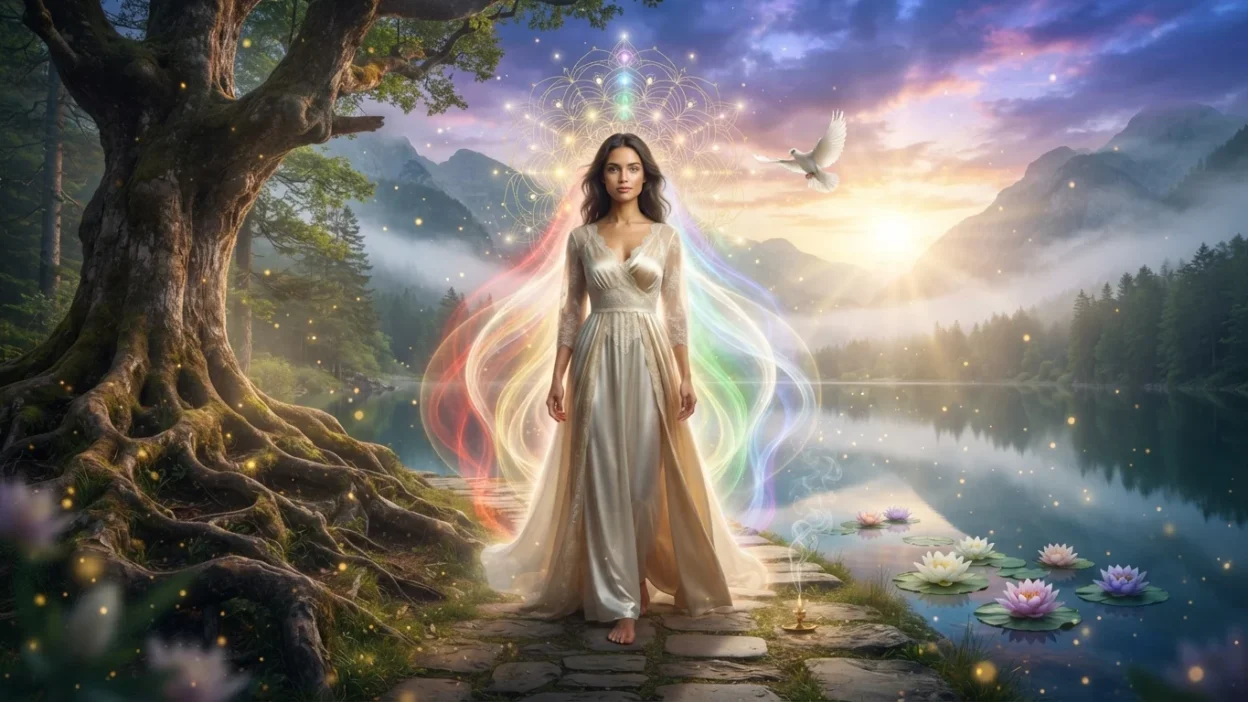
Aura symbolism represents the invisible qualities people associate with a person’s presence, emotions, spiritual state, personality or energy.
Different aura colors are commonly given symbolic meanings, such as red for vitality, blue for calmness, green for compassion, yellow for optimism, purple for spirituality and white for purity or transcendence. These interpretations vary widely and are not scientifically established measurements of a person’s health or character.
Aura Symbolism Meaning (Clear Definition)
Aura symbolism refers to the symbolic meanings assigned to an imagined or spiritually interpreted field of energy surrounding a person or living being.
In modern spiritual symbolism, an aura may represent:
- Energy
- Personality
- Emotion
- Spiritual awareness
- Presence
- Intuition
- Mood
- Inner state
- Protection
- Transformation
What Does Aura Symbolism Represent?
Aura symbolism represents the idea that a person’s inner qualities can somehow be expressed through an external field of light, color, or atmosphere.
For example, an artist might surround a peaceful person with soft blue light to symbolize calmness.
In this sense, aura symbolism is particularly powerful because color becomes a visual language for invisible qualities.
Spiritual Meaning of Aura Symbolism
Spiritually, aura symbolism can represent:
- Inner energy
- Emotional awareness
- Spiritual development
- Intuition
- Personal presence
- Protection
- Healing
- Consciousness
- Transformation
- Connection
Religious Meaning of Aura Symbolism
Aura-like imagery appears in many religious and artistic traditions, although these should not automatically be treated as identical concepts.
Christian art frequently depicts saints and sacred figures with halos, representing holiness or divine favor.
Buddhist and Hindu art sometimes portrays spiritually significant figures with luminous fields, flames, halos, or radiant bodies.
In other traditions, light surrounding a spiritually important person can symbolize sacred presence, wisdom, or extraordinary spiritual attainment.
These historical religious images are distinct from modern claims about reading someone’s aura.
Aura Symbolism in History and Culture
The idea of a luminous presence surrounding exceptional people has appeared in different cultures for centuries.
Religious paintings and sculptures often use golden halos, radiant backgrounds, flames, or circles of light to communicate holiness or spiritual significance.
In the nineteenth and twentieth centuries, various esoteric movements developed more elaborate ideas about invisible energy fields surrounding human beings.
Modern aura symbolism combines elements from these historical traditions with contemporary spirituality, meditation, wellness culture, and popular metaphysical practices.
Aura Color Symbolism
The most recognizable modern aura symbolism involves colors.
These meanings are symbolic or spiritual interpretations rather than scientifically validated properties.
Red Aura Symbolism
Red is commonly associated with:
- Vitality
- Passion
- Courage
- Strength
- Physical energy
- Determination
A red aura is often portrayed as energetic, passionate, and strongly connected to earthly experience.
Orange Aura Symbolism
Orange commonly represents:
- Creativity
- Enthusiasm
- Sociability
- Emotional expression
- Adventure
- Sensuality
It can symbolize warmth and an active approach to life.
Yellow Aura Symbolism
Yellow is frequently associated with:
- Optimism
- Joy
- Confidence
- Intellect
- Creativity
- Mental energy
A bright yellow aura is often used symbolically to portray an enthusiastic and positive personality.
Green Aura Symbolism
Green commonly represents:
- Compassion
- Love
- Growth
- Healing
- Balance
- Connection with nature
Green’s association with plants and renewal makes it a natural symbol for emotional and spiritual growth.
Blue Aura Symbolism
Blue is often associated with:
- Peace
- Communication
- Truth
- Calmness
- Sensitivity
- Emotional depth
A soft blue aura may symbolize tranquility and introspection.
Indigo Aura Symbolism
Indigo is commonly connected with:
- Intuition
- Perception
- Imagination
- Insight
- Inner awareness
It is frequently used in contemporary spiritual artwork to represent a person who appears deeply reflective or intuitive.
Purple Aura Symbolism
Purple is often associated with:
- Spirituality
- Imagination
- Wisdom
- Mysticism
- Transformation
- Higher awareness
Because purple has long been associated with royalty and rarity, it can also symbolize elevated status or extraordinary qualities.
White Aura Symbolism
White is commonly interpreted as:
- Purity
- Peace
- Spiritual clarity
- Innocence
- Protection
- Transcendence
Pink Aura Symbolism
- Love
- Compassion
- Tenderness
- Kindness
- Emotional openness
- Affection
It is especially associated with gentle forms of love and emotional warmth.
Gold Aura Symbolism
Gold can represent:
- Wisdom
- Spiritual illumination
- Achievement
- Divine favor
- Confidence
- Higher awareness
Golden light is particularly common in religious and spiritual artwork.
Aura Symbolism and Chakras
Aura symbolism is often combined with chakra symbolism in modern spiritual culture.
Artists may depict a person surrounded by an aura containing multiple colors corresponding to the seven-chakra model.
This creates an image of:
Body → Energy → Emotion → Awareness → Spirituality
However, aura systems and chakra systems have different historical backgrounds and should not automatically be treated as one unified ancient system.
The popular combination is largely a modern spiritual interpretation.
Aura Symbolism and Personality
Aura colors are sometimes used as a symbolic way of describing personality.
For example:
- Red may symbolize confidence and passion.
- Blue may symbolize calmness and sensitivity.
- Green may symbolize compassion.
- Yellow may symbolize optimism.
- Purple may symbolize imagination and spirituality.
These descriptions can be useful in symbolic storytelling, but they should not be treated as reliable psychological assessments.
A person’s personality cannot be scientifically determined from an aura color.
Aura Symbolism and Protection
In contemporary spiritual imagery, a luminous aura may be depicted as a protective field surrounding the body.
It can symbolize:
- Emotional boundaries
- Spiritual protection
- Inner strength
- Resilience
- Safety
- Positive intention
A bright golden or white aura surrounding a person can visually communicate the feeling of being protected from darkness or negativity.
Aura Symbolism and Healing
Green, blue, white, and golden colors are sometimes used in modern spiritual artwork to symbolize healing.
Green may represent renewal.
Blue may represent calmness.
White may represent purification.
Gold may represent spiritual illumination.
These are symbolic associations, not evidence that aura colors diagnose or treat medical conditions.
Aura Symbolism and Light
Light is perhaps the most important visual element in aura symbolism.
A glowing field around a person can represent:
- Consciousness
- Presence
- Wisdom
- Spiritual awakening
- Hope
- Divine connection
The brighter the symbolic light, the more strongly an artist may want to communicate a person’s inner radiance.
Aura Symbolism in Dreams
Dreaming about auras can have many possible personal interpretations.
Seeing a Bright Aura
This may symbolize admiration, positivity, spiritual curiosity, or recognizing someone’s strong presence.
Seeing a Dark Aura
In symbolic dream interpretation, this may represent fear, emotional uncertainty, negativity, or something that feels unresolved.
It does not prove that another person possesses a “negative energy.”
Seeing Your Own Aura
This may symbolize self-awareness, identity, personal transformation, or curiosity about your inner emotional state.
Seeing a Rainbow Aura
A multicolored aura can symbolize harmony, balance, diversity, integration, or personal growth.
Seeing a White Aura
This may symbolize peace, purity, innocence, spiritual aspiration, or emotional clarity.
Dream interpretation remains subjective and should not be treated as a prediction.
Aura Symbolism in Literature and Art
Aura symbolism is particularly powerful in visual storytelling.
A character surrounded by golden light may appear wise or spiritually significant.
A figure surrounded by blue light may appear peaceful and introspective.
A person surrounded by red light may communicate passion, danger, or intense determination.
A character emerging from darkness into a bright aura can symbolize transformation and awakening.
This makes aura symbolism an effective artistic technique for communicating internal qualities without words.
Aura Symbolism and Nature
Natural elements can strengthen aura symbolism.
A person surrounded by:
- Soft sunlight
- Flowers
- Trees
- Water
- Mountains
- Stars
- Clouds
may appear connected to nature and spiritual harmony.
The aura then becomes a visual bridge between the individual and the surrounding world.
Aura Symbolism and Spiritual Awakening
A growing or expanding aura is often used to symbolize spiritual development.
An image may begin with a small, dim glow and gradually transform into a broad field of golden or white light.
Symbolically, this can represent:
Confusion → Awareness → Understanding → Transformation
This is one of the most common narratives associated with aura imagery.
Frequently Asked Questions About Aura Symbolism
What does an aura symbolize?
Aura symbolism commonly represents energy, personality, emotion, spiritual awareness, presence, intuition, protection, and transformation.
What do aura colors symbolize?
Modern spiritual traditions commonly associate colors with qualities such as vitality, creativity, optimism, compassion, calmness, intuition, spirituality and purity.
What does a red aura symbolize?
A red aura commonly symbolizes passion, vitality, courage, physical energy, determination and strength.
What does a blue aura symbolize?
Blue is often associated with calmness, peace, communication, sensitivity, truth and emotional depth.
What does a green aura symbolize?
Green commonly symbolizes compassion, love, growth, balance, renewal and connection with nature.
What does a purple aura symbolize?
Purple is often associated with spirituality, imagination, intuition, wisdom, mysticism and transformation.
What does a white aura symbolize?
White commonly represents purity, peace, clarity, protection, spiritual aspiration and transcendence.
Are aura colors scientifically proven?
No. Aura-color interpretations are spiritual or symbolic beliefs and are not scientifically established methods for determining personality, health or spiritual condition.
Conclusion
Aura symbolism provides a beautiful visual language for representing qualities that cannot easily be seen.
Red can symbolize passion and vitality. Orange represents creativity. Yellow evokes optimism. Green suggests compassion and growth. Blue communicates peace. Indigo represents insight. Purple evokes spirituality. White symbolizes purity and transcendence. Gold can represent wisdom and illumination.
Although modern aura symbolism has connections to historical religious and esoteric imagery, today’s popular aura color systems should not be confused with scientifically established facts or treated as universal religious doctrine.
Ultimately, aura symbolism reminds us of a powerful artistic idea: what surrounds a person can be used as a metaphor for what lives within them their emotions, presence, character, hopes and sense of spiritual connection.