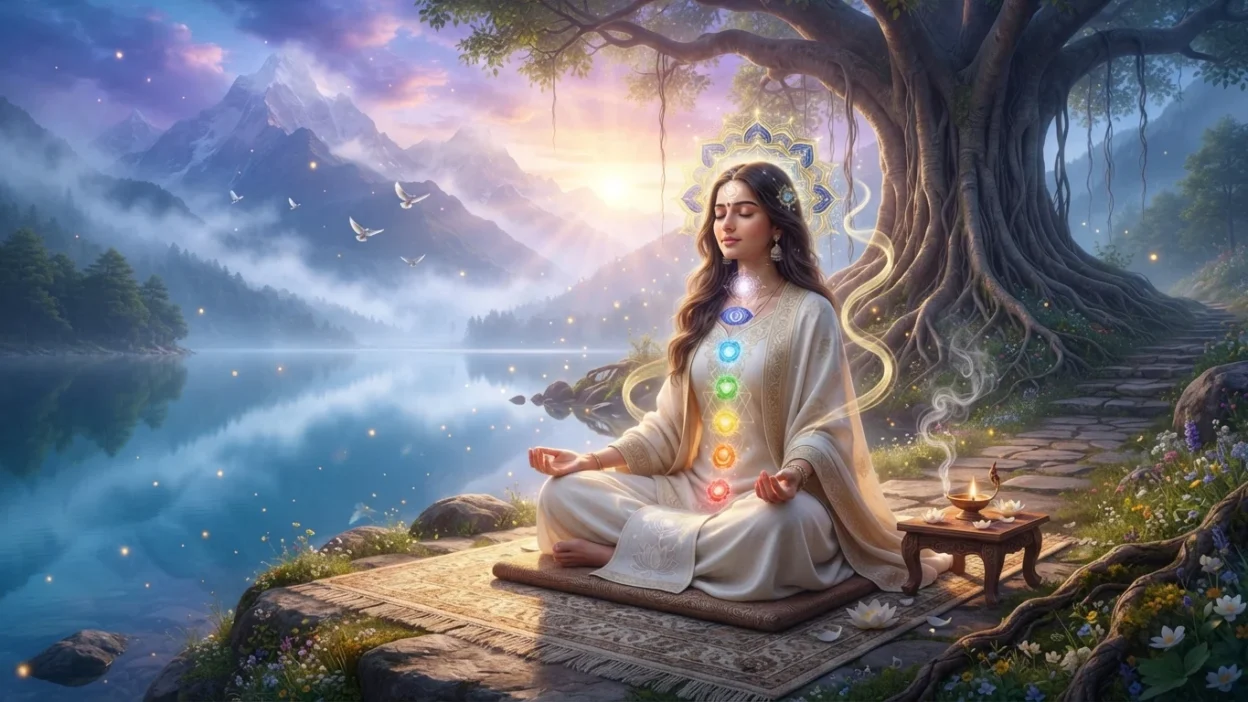
Chakra symbolism represents a traditional and modern system of symbolic ideas concerning subtle centers of consciousness and embodied experience. In contemporary spiritual culture, chakras are often associated with balance, awareness, emotional development, self discovery, healing and spiritual growth.
The familiar seven chakra system often represented through colors ranging from red to violet is widely recognized today. However, it is important to understand that chakra traditions are diverse and historically complex. Different Hindu and Buddhist traditions have described different numbers, locations, symbols and concepts.
Chakra Symbolism Meaning (Clear Definition)
The word chakra comes from Sanskrit cakra, meaning “wheel” or “disc.”
In various Indian tantric and yogic traditions, chakras are described as subtle centers or nodes associated with aspects of the body, mind, consciousness and spiritual practice.
Modern popular spirituality often presents seven primary chakras:
- Root Chakra — Red
- Sacral Chakra — Orange
- Solar Plexus Chakra — Yellow
- Heart Chakra — Green
- Throat Chakra — Blue
- Third Eye Chakra — Indigo
- Crown Chakra — Violet or White
This seven-color framework is a modern popular representation, not a universal description of every historical chakra tradition.
What Does Chakra Symbolism Represent?
Chakra symbolism commonly represents the idea of inner balance and development.
Each chakra is often associated with particular themes:
- Root: grounding and security
- Sacral: creativity and emotional expression
- Solar plexus: confidence and personal agency
- Heart: love and compassion
- Throat: communication and expression
- Third eye: insight and perception
- Crown: spiritual awareness and transcendence
These associations are especially common in contemporary wellness and spiritual practices.
Spiritual Meaning of Chakra Symbolism
Spiritually, chakra symbolism can represent a journey from grounded physical existence toward expanded awareness.
The seven-color model is often visually presented as an ascending sequence:
Earth → Emotion → Will → Love → Expression → Insight → Spiritual Awareness
This makes chakra imagery particularly powerful in artwork and spiritual storytelling.
However, traditional chakra systems do not all follow this exact modern seven-color model.
Religious Meaning of Chakra Symbolism
Chakra concepts have roots in Hindu and Buddhist tantric traditions, as well as related yogic systems.
Historical texts describe subtle channels, centers, energies, mantras, deities, geometric diagrams, and other elements in different ways.
There is therefore no single “official chakra system.”
Some traditions describe different numbers of chakras, while their locations and symbolic meanings can also differ.
The familiar modern seven-chakra rainbow system developed through a mixture of traditional ideas and later interpretations.
Chakra Symbolism in History and Culture
Chakra concepts developed within South Asian religious and philosophical traditions.
The idea became particularly prominent within Tantra and later yogic traditions, where subtle-body practices could involve channels, breath, meditation, mantra, visualization, and spiritual transformation.
Over time, these concepts were interpreted and adapted in different cultural contexts.
In the twentieth and twenty-first centuries, chakra symbolism became increasingly popular worldwide through yoga, meditation, alternative spirituality, wellness culture, and New Age movements.
This explains why contemporary chakra imagery can look quite different from historical Indian representations.
Root Chakra Symbolism
The root chakra, commonly called Muladhara in modern seven-chakra presentations, is generally associated with the base of the body.
Its common modern symbolism includes:
- Grounding
- Security
- Stability
- Survival
- Belonging
- Connection to the earth
Root Chakra Color
Modern popular systems usually associate it with red.
Red represents physical vitality, grounding, strength, and connection to the material world.
Root Chakra Symbol
It is often represented with a lotus containing a square and other traditional symbolic elements.
The exact iconography has historical roots that are more complex than the simplified modern chakra chart.
Sacral Chakra Symbolism
The sacral chakra, commonly called Svadhisthana, is generally associated in modern presentations with the lower abdomen.
It often symbolizes:
- Creativity
- Pleasure
- Emotion
- Sensuality
- Adaptability
- Relationships
Sacral Chakra Color
It is commonly represented as orange.
Orange visually communicates warmth, creativity, movement, and emotional vitality.
Solar Plexus Chakra Symbolism
The solar plexus chakra, commonly called Manipura, is generally associated with the abdomen or navel region.
Its popular symbolic themes include:
- Personal power
- Confidence
- Will
- Motivation
- Determination
- Transformation
Solar Plexus Chakra Color
It is commonly represented by yellow.
Yellow evokes sunlight, energy, confidence, clarity, and vitality.
Heart Chakra Symbolism
The heart chakra, commonly called Anahata, is associated with the heart region in modern seven-chakra systems.
It commonly symbolizes:
- Love
- Compassion
- Forgiveness
- Empathy
- Connection
- Emotional balance
Heart Chakra Color
Modern representations usually use green, sometimes alongside pink.
Green connects naturally with nature, renewal, harmony, and growth.
Heart Chakra Symbol
The heart chakra is frequently represented with an intricate twelve-petaled lotus and intersecting triangles.
This geometry has specific traditional associations and should not be reduced to a generic heart icon.
Throat Chakra Symbolism
The throat chakra, commonly called Vishuddha, is associated with the throat.
Its modern symbolic themes include:
- Communication
- Truth
- Expression
- Listening
- Authenticity
- Creativity
Throat Chakra Color
It is commonly represented by blue.
Blue suggests openness, communication, calmness, and spaciousness.
Third Eye Chakra Symbolism
The third eye chakra, commonly called Ajna, is often associated with the space between the eyebrows.
Modern spiritual symbolism connects it with:
- Intuition
- Insight
- Perception
- Imagination
- Inner awareness
- Discernment
Third Eye Chakra Color
Modern systems commonly represent it with indigo.
The deep color reinforces the symbolism of mystery, contemplation, and inward perception.
Crown Chakra Symbolism
The crown chakra, commonly called Sahasrara, is traditionally associated in modern seven-chakra imagery with the top of the head.
It commonly symbolizes:
- Spiritual awareness
- Transcendence
- Consciousness
- Wisdom
- Unity
- Liberation
Crown Chakra Color
It is often represented by violet, purple, or white.
These colors can evoke mystery, transcendence, purity, and expanded awareness.
Chakra Symbolism and the Rainbow
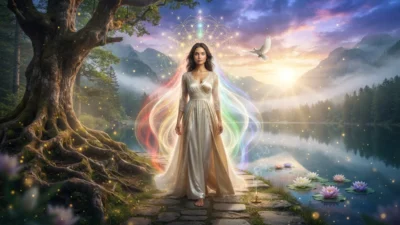
The seven-color chakra system is often displayed as a rainbow column running through the body.
This modern visual arrangement creates a powerful symbolism of:
- Balance
- Integration
- Wholeness
- Harmony
- Movement from earth toward spirit
The rainbow is therefore a convenient contemporary visual language for representing the entire chakra system.
It should not be assumed that every historical chakra tradition used this rainbow-color arrangement.
Chakra Symbolism and Lotus Flowers
Lotus imagery is particularly important in traditional chakra iconography.
The lotus can symbolize:
- Spiritual emergence
- Purity
- Transformation
- Consciousness
- Awakening
Different chakras may be represented with different numbers of lotus petals in particular traditions.
This is why authentic traditional chakra artwork can look considerably more intricate than modern simplified illustrations.
Chakra Symbolism and Sacred Geometry
Chakra imagery frequently incorporates geometric forms.
These may include:
- Circles
- Triangles
- Squares
- Petals
- Interlocking shapes
- Sanskrit syllables
Geometry can symbolize order, balance, structure, and the relationship between different aspects of existence.
Chakra Symbolism and Kundalini
Chakras are often discussed alongside Kundalini, particularly in tantric and yogic traditions.
Modern spiritual literature frequently depicts Kundalini as a serpent-like energy rising through the chakra system.
Traditional Kundalini concepts are complex and vary between sources.
In symbolic imagery, the rising serpent often represents:
- Spiritual awakening
- Transformation
- Latent potential
- Expanded consciousness
- Movement toward liberation
It is important not to reduce this rich religious concept to a simple “energy healing” explanation.
Chakra Symbolism and Meditation
Chakras are often incorporated into contemporary meditation practices through:
- Visualization
- Breath awareness
- Mantra
- Color imagery
- Concentration
- Body awareness
In some traditional practices, specific visualizations and mantras have particular religious meanings.
Modern practitioners may instead use chakra imagery as a framework for reflection and self-awareness.
Chakra Symbolism and Yoga
Chakra concepts are often associated with yoga, particularly certain tantric and subtle-body traditions.
Modern yoga classes sometimes use chakra themes to explore concepts such as:
- Grounding
- Confidence
- Compassion
- Communication
- Intuition
- Spiritual awareness
However, not every form of yoga is based on chakras, and chakra symbolism should not be treated as a universal feature of yoga.
Chakra Symbolism in Dreams
Dreaming about chakras can have different personal interpretations.
Seeing Bright Chakras
This may symbolize awareness, personal growth, balance, or a desire for transformation.
Seeing a Blocked Chakra
In modern spiritual dream interpretation, this might represent emotional difficulty, insecurity, communication problems, or feeling disconnected.
Seeing All Seven Chakras
This may symbolize a desire for wholeness, balance, integration, or spiritual development.
Seeing a Crown Chakra
This may represent contemplation, spiritual curiosity, or a desire for deeper meaning.
Dream interpretation is subjective and should not be treated as medical, scientific, or prophetic evidence.
Chakra Symbolism in Literature and Art
Chakras have become powerful visual symbols in contemporary art.
Artists often portray a meditating person surrounded by:
- Rainbow-colored light
- Lotus flowers
- Mandalas
- Sacred geometry
- Energy lines
- Mountains
- Cosmic backgrounds
These images can represent the transformation of the individual from grounded physical awareness toward expanded consciousness.
Frequently Asked Questions About Chakra Symbolism
What does chakra symbolism mean?
Chakra symbolism refers to the spiritual and cultural meanings associated with subtle centers described in certain Hindu, Buddhist, tantric and yogic traditions.
What do the seven chakras symbolize?
In the popular modern seven-chakra model, they symbolize grounding, creativity, personal power, love, communication, insight and spiritual awareness.
What do chakra colors symbolize?
Modern chakra systems commonly associate red with grounding, orange with creativity, yellow with personal power, green with love, blue with communication, indigo with insight and violet or white with spiritual awareness.
What does the lotus symbolize in chakra imagery?
The lotus commonly symbolizes spiritual growth, purity, transformation and awakening.
What does the third eye symbolize?
In modern chakra symbolism, the third eye represents intuition, insight, perception, imagination and inner awareness.
What does the crown chakra symbolize?
The crown chakra is commonly associated with spiritual awareness, transcendence, consciousness, unity and liberation.
Conclusion
Chakra symbolism combines color, geometry, lotus imagery, meditation, yoga, breath and spiritual philosophy into a powerful visual language of transformation.
The root chakra represents grounding. The sacral chakra evokes creativity and emotion. The solar plexus symbolizes personal power. The heart represents love and compassion. The throat expresses communication. The third eye suggests insight. The crown represents spiritual awareness.
Yet chakra symbolism is much richer than the familiar rainbow diagram suggests. Its roots lie in diverse South Asian religious and philosophical traditions, where subtle body concepts developed through complex systems of meditation, mantra, ritual, visualization and spiritual practice.
Ultimately, chakra symbolism can be understood as a metaphor for the human search for balance, awareness, integration and deeper understanding of the self and consciousness.