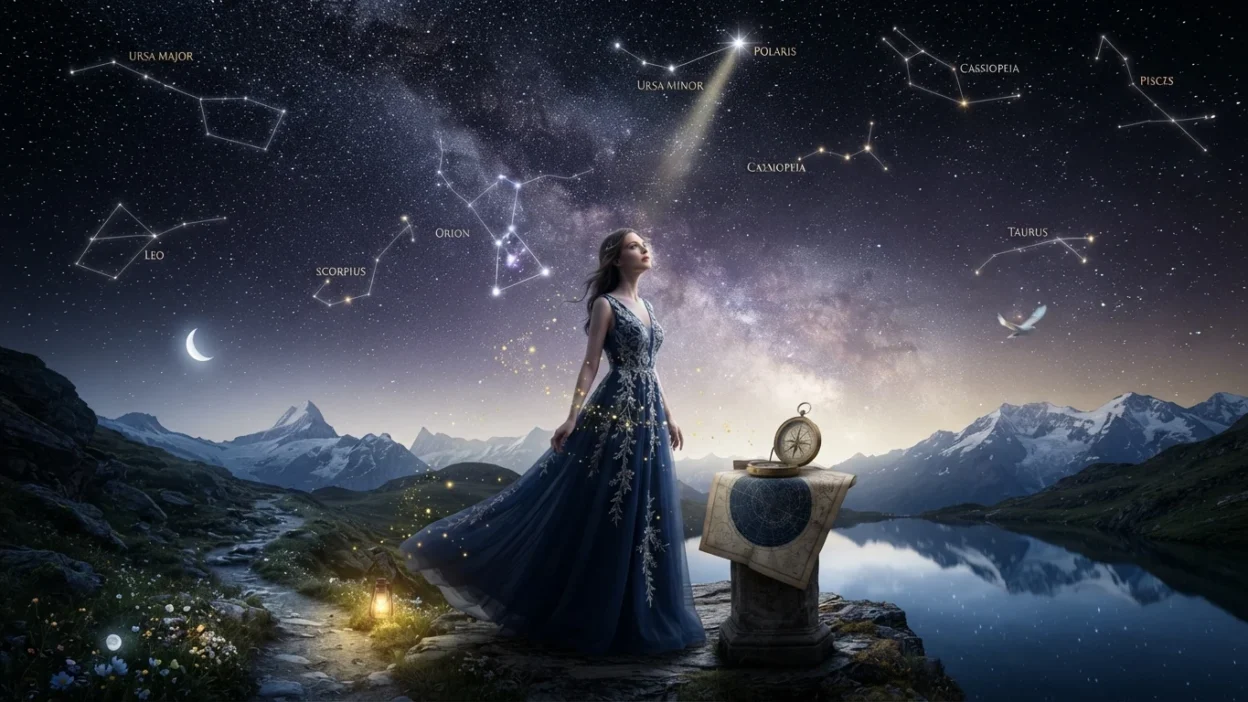
Star constellation symbolism represents the meanings people have attached to recognizable patterns of stars across the night sky. For thousands of years, constellations have served as symbols of guidance, destiny, mythology, navigation, identity, protection, mystery and humanity’s connection with the cosmos.
From Orion and the Big Dipper to the zodiac constellations, different cultures have interpreted the same or similar stars in remarkably different ways. This makes constellation symbolism especially fascinating: the stars remain in the sky, but the stories humans tell about them can change across time and culture.
Star Constellation Symbolism Meaning (Clear Definition)
Star constellation symbolism refers to the symbolic, mythological, spiritual, and cultural meanings associated with recognizable patterns of stars in the night sky.
A constellation may symbolize:
- Guidance
- Destiny
- Protection
- Courage
- Wisdom
- Transformation
- Love
- Heroism
- Mystery
- Eternity
- Exploration
Astronomically, a constellation is an officially recognized region of the sky. The familiar patterns within them are often called asterisms when they are not themselves official constellations.
The symbolic meanings, however, come from human culture rather than from the stars themselves.
What Does Star Constellation Symbolism Represent?
Constellations often represent the human desire to find patterns and meaning in the universe.
A group of distant stars can become a hero, animal, hunter, goddess, creature, or celestial object through storytelling.
This makes constellation symbolism a bridge between:
Sky → Pattern → Story → Meaning
The stars can therefore symbolize both the enormous scale of the universe and humanity’s ability to create stories within it.
Spiritual Meaning of Star Constellation Symbolism
Spiritually, constellations can represent:
- Divine mystery
- Guidance
- Higher purpose
- Destiny
- Hope
- Eternity
- Protection
- Cosmic connection
- Inner exploration
Looking toward a constellation can symbolically represent looking beyond ordinary circumstances toward something greater.
The night sky often becomes a metaphor for the unknown and the search for meaning.
Biblical / Religious Meaning of Star Constellation Symbolism
Stars appear frequently in religious traditions.
The Bible uses stars in several symbolic contexts, including imagery involving creation, descendants, divine promises, signs, and heavenly glory.
The famous Star of Bethlehem, for example, plays an important role in the Christian Nativity story.
Islamic traditions also recognize the importance of stars and celestial bodies in relation to navigation, timekeeping, creation, and contemplation.
However, religious symbolism involving stars should not automatically be equated with astrology. Astronomy, astrology, and religious interpretations of celestial imagery are different traditions and practices.
Star Constellation Symbolism in History and Culture
Constellations are among humanity’s oldest systems for organizing the night sky.
Ancient civilizations observed recurring star patterns and connected them with their mythology, calendars, agriculture, navigation, and religious traditions.
The Greeks associated many constellations with mythological figures.
Ancient Egyptians connected celestial patterns with their religious worldview.
Babylonian astronomers developed sophisticated observations of the sky and contributed to traditions that later influenced Western zodiac systems.
Chinese astronomers developed their own celestial mapping system, which differs substantially from the familiar Western constellations.
Indigenous cultures around the world have also developed rich and distinctive star traditions.
This diversity shows that constellation symbolism is not universal. Different societies have looked at the same sky and created different stories.
Orion Constellation Symbolism


Orion is one of the most recognizable constellations in the night sky.
In Greek mythology, Orion is associated with a great hunter.
Because of this story, Orion can symbolize:
- Courage
- Strength
- Adventure
- Heroism
- Determination
- The warrior spirit
Its distinctive belt makes it particularly memorable and has helped different cultures recognize the pattern for centuries.
Ursa Major Symbolism


Ursa Major, the Great Bear, is one of the most prominent northern constellations.
Its most famous part is the Big Dipper, an asterism within Ursa Major.
The constellation has different stories across cultures.
In Western mythology, it is associated with a bear and the story of Callisto.
In other cultures, the same stars have been interpreted as carts, animals, groups of people, or other objects.
Symbolically, Ursa Major can evoke:
- Protection
- Strength
- Guidance
- Endurance
- Continuity
Ursa Minor and the North Star


Ursa Minor contains Polaris, commonly called the North Star.
Because Polaris appears close to the north celestial pole, it has historically been important for navigation in the Northern Hemisphere.
This gives the North Star powerful symbolism:
- Guidance
- Direction
- Stability
- Faithfulness
- Purpose
- Finding one’s way
The phrase “follow the North Star” has consequently become a powerful metaphor for following a guiding principle or life purpose.
Cassiopeia Symbolism


Cassiopeia is easily recognized by its distinctive W or M shape, depending on its orientation.
In Greek mythology, Cassiopeia was a queen.
Her story is connected with beauty, pride, vanity, punishment, and immortality through placement among the stars.
Symbolically, Cassiopeia can represent:
- Beauty
- Pride
- Ambition
- Consequences
- Femininity
- Eternal remembrance
Scorpius Symbolism


Scorpius is traditionally associated with a scorpion.
In Greek mythology, it is connected with Orion’s story.
The scorpion naturally symbolizes:
- Defense
- Danger
- Transformation
- Survival
- Protection
- Hidden power
Because of its connection with the zodiac, Scorpius also has a strong association with mystery and emotional intensity in popular astrology.
Leo Constellation Symbolism
Leo represents a lion.
In Greek mythology, it is often associated with the Nemean Lion defeated by Hercules.
The lion makes Leo a powerful symbol of:
- Courage
- Leadership
- Strength
- Pride
- Authority
- Nobility
Its symbolism has also contributed to the cultural image of the lion as a celestial representation of bravery.
Taurus Constellation Symbolism
Taurus represents a bull.
In Greek mythology, the constellation is often connected with Zeus in the form of a bull.
The bull can symbolize:
- Strength
- Determination
- Fertility
- Stability
- Physical power
- Persistence
Taurus is also one of the zodiac constellations.
Gemini Constellation Symbolism
Gemini represents the twins Castor and Pollux in Greek mythology.
Its symbolism often includes:
- Brotherhood
- Duality
- Friendship
- Partnership
- Two sides of identity
- Connection
The constellation can therefore represent the idea that identity can contain complementary or contrasting aspects.
Pisces Constellation Symbolism
Pisces represents two fish.
The fish are associated with mythology involving transformation and escape.
Symbolically, fish can represent:
- Adaptability
- Intuition
- Emotional depth
- Freedom
- Transformation
- Connection with water
Its zodiac association has made Pisces especially prominent in modern astrology.
Sagittarius Constellation Symbolism
Sagittarius is commonly represented as an archer, traditionally associated with a centaur in Western mythology.
It can symbolize:
- Adventure
- Exploration
- Knowledge
- Freedom
- Ambition
- Seeking truth
The image of an archer aiming toward the heavens creates a particularly powerful metaphor for aspiration and higher goals.
Constellations and Navigation
One of the most practical forms of constellation symbolism comes from navigation.
Before modern navigation technology, people relied heavily on the night sky to establish direction.
Stars and constellations helped travelers navigate oceans, deserts, and unfamiliar landscapes.
This historical role transformed celestial imagery into a symbol of:
Direction → Safety → Journey → Home
The North Star remains one of the strongest cultural symbols of guidance.
Constellations and Destiny
Constellations are often associated with destiny because of their connection with the zodiac.
In astrology, the positions of celestial bodies are interpreted as having relationships with human personality or events.
However, astrological claims are not scientifically established.
From a symbolic perspective, the zodiac remains culturally powerful because it provides stories and archetypes through which people explore identity, relationships, and personal meaning.
Constellations and Eternity
Stars appear ancient, distant, and enduring from a human perspective.
This makes constellations natural symbols of:
- Eternity
- Permanence
- Memory
- Continuity
- Immortality
A person imagining loved ones among the stars may use the night sky as a symbolic representation of remembering someone beyond physical absence.
Constellations and Hope
A single star can symbolize hope.
A constellation can expand that symbolism into a larger pattern.
Even when the sky is dark, stars remain visible.
This makes them powerful metaphors for finding:
- Hope during hardship
- Direction during uncertainty
- Beauty during darkness
- Meaning during difficult periods
Star Constellation Symbolism in Dreams
Dreaming about constellations can have different personal interpretations.
Seeing a Bright Constellation
This may symbolize hope, guidance, inspiration, or discovering a sense of direction.
Searching for a Constellation
This may represent searching for answers, purpose, identity, or clarity.
A Constellation Disappearing
Symbolically, this could represent uncertainty, loss of direction, changing beliefs, or the end of a particular phase.
A New Constellation Appearing
This may represent discovering something new about yourself or seeing possibilities that were previously hidden.
Dream symbolism remains subjective and should not be treated as prophecy.
Star Constellation Symbolism in Literature and Art
Constellations have inspired poetry, paintings, novels, films, tattoos, jewelry, and architectural designs.
Artists use constellation patterns to represent:
- Destiny
- Love
- Memory
- Exploration
- Mystery
- Connection
- Infinity
A constellation tattoo, for example, can commemorate a birth date, loved one, personal journey, or meaningful identity.
Connecting individual stars with delicate lines also creates a powerful metaphor: separate points can become meaningful when viewed as part of a larger pattern.
Frequently Asked Questions About Star Constellation Symbolism
What does constellation symbolism mean?
Constellation symbolism refers to the cultural, mythological, spiritual, and artistic meanings people associate with recognizable patterns of stars.
What do constellations symbolize spiritually?
They can symbolize guidance, destiny, eternity, protection, mystery, spiritual aspiration, and humanity’s connection with the universe.
What does Orion symbolize?
Orion is commonly associated with courage, strength, heroism, hunting, adventure, and determination through its mythological associations.
What does the North Star symbolize?
The North Star commonly symbolizes guidance, direction, stability, purpose, and finding one’s way.
What does a constellation symbolize in dreams?
A constellation may symbolize guidance, hope, purpose, discovery, or the search for meaning, depending on the dream’s emotional context.
Are constellation meanings universal?
No. Different cultures have created different stories and meanings for the same stars. Western constellation traditions represent only one way of understanding the night sky.
Conclusion
Star constellation symbolism reflects one of humanity’s oldest instincts: looking toward the heavens and finding patterns, stories, and meaning.
Orion can represent courage and heroism. Ursa Major can evoke strength and guidance. Polaris symbolizes direction and stability. Leo represents courage and leadership. Gemini suggests duality and connection. Scorpius evokes protection and transformation. Sagittarius symbolizes exploration and the search for knowledge.
Yet perhaps the deepest symbolism of constellations lies beyond any individual myth.
Thousands of years ago, people looked at distant stars and connected them into stories. Today, we continue doing the same thing.
A constellation reminds us that individual stars can become something greater when we see the relationships between them. In that sense, constellation symbolism can represent not only the universe above us, but also the human search for connection, direction, identity, hope and meaning within an enormous and mysterious world.