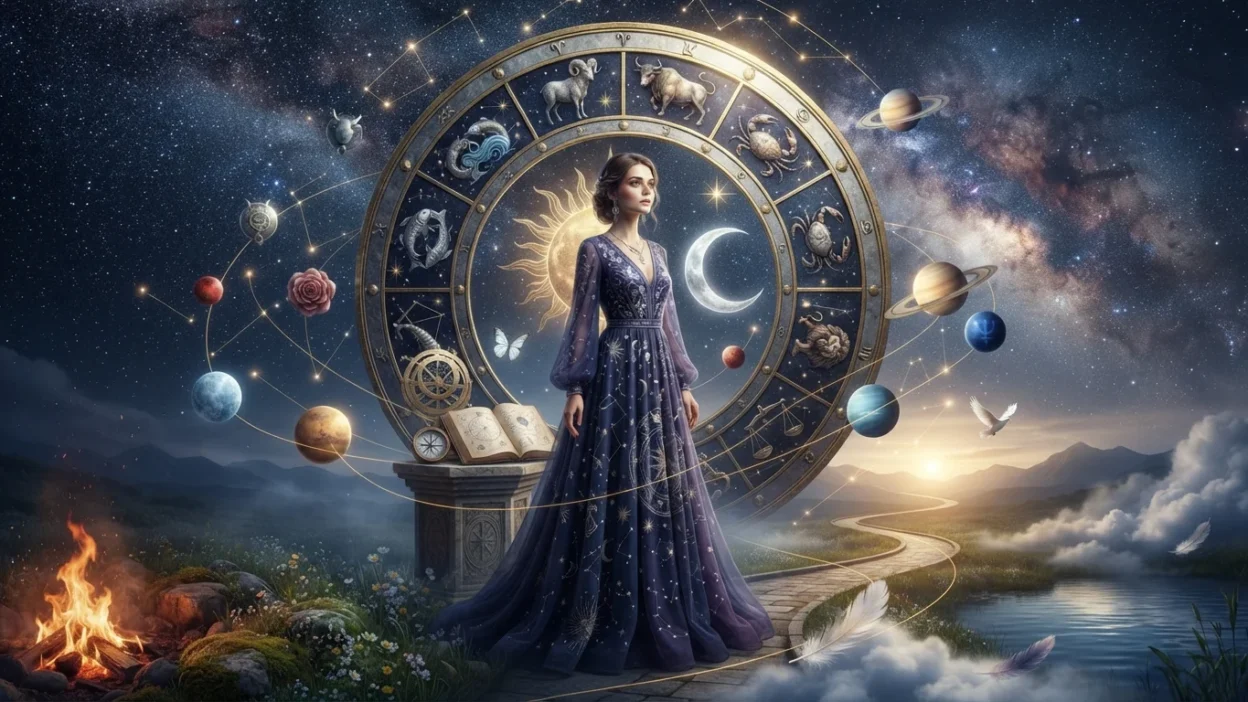
Astrology symbolism is the symbolic language used to interpret the Sun, Moon, planets, zodiac signs, houses and other celestial concepts in astrological traditions. For centuries, people have looked toward the sky to create stories about identity, personality, relationships, transformation, destiny, timing and the mysteries of human life.
Unlike astronomy, which is a scientific study of celestial objects and phenomena, astrology interprets celestial positions symbolically. Its claims about personality or future events are not supported by established scientific evidence, but its symbols remain culturally influential in art, literature, spirituality and popular culture.
Astrology Symbolism Meaning (Clear Definition)
Astrology symbolism refers to the meanings traditionally assigned to celestial bodies, zodiac signs, planetary movements, houses, aspects and other elements within astrology.
Some of the most recognizable astrological symbols include:
- ☉ Sun — identity and vitality
- ☽ Moon — emotions and instincts
- ☿ Mercury — communication and thought
- ♀ Venus — love and beauty
- ♂ Mars — action and desire
- ♃ Jupiter — expansion and opportunity
- ♄ Saturn — discipline and responsibility
- ♅ Uranus — innovation and change
- ♆ Neptune — imagination and spirituality
- ♇ Pluto — transformation and renewal
These meanings come from astrological traditions rather than scientific measurements of human personality.
What Does Astrology Symbolism Represent?
Astrology symbolism represents an ancient attempt to connect patterns in the heavens with patterns in human experience.
Its symbolic language can explore themes such as:
- Identity
- Emotion
- Love
- Ambition
- Communication
- Responsibility
- Growth
- Transformation
- Imagination
- Conflict
- Personal purpose
The symbolic system gives abstract human experiences recognizable celestial forms.
For example, the Sun can symbolize vitality and identity, while Saturn can symbolize boundaries, discipline, and responsibility.
Spiritual Meaning of Astrology Symbolism
In modern spiritual practice, astrology symbolism is often used as a tool for self-reflection and personal exploration.
People may look at a birth chart and reflect on questions such as:
- What motivates me?
- How do I communicate?
- What emotional patterns do I recognize?
- What challenges keep appearing in my life?
- What qualities do I want to develop?
- How do I understand my relationships?
From this perspective, astrology functions more like a symbolic language than a scientifically demonstrated predictive system.
Its spiritual significance ultimately depends on the beliefs of the person using it.
Biblical / Religious Meaning of Astrology Symbolism
The relationship between astrology and religion has varied considerably throughout history.
Biblical traditions contain references to stars, celestial signs, seasons, and heavenly bodies, but many religious interpretations distinguish observing creation from using celestial positions to predict individual destinies.
Christian traditions have often been critical of divination and astrology.
Islamic traditions developed sophisticated astronomical sciences, including observation of celestial bodies for navigation, calendars and determining religious times. Astrological divination, however, has traditionally been distinguished from astronomy and treated differently.
Other religions and ancient cultures developed their own celestial traditions.
Therefore, astrology symbolism should be considered within its specific historical and religious context rather than treated as a universal spiritual doctrine.
Astrology Symbolism in History and Culture
Astrology has a long and complicated history.
Early Mesopotamian civilizations carefully observed celestial events and recorded astronomical phenomena. Over time, celestial observations became connected with omens and interpretations.
Greek and Hellenistic thinkers contributed significantly to the development of Western astrology.
Roman culture later adopted and adapted many Greek astrological ideas.
Astrology subsequently influenced medieval and Renaissance intellectual culture, medicine, art, literature and political thought.
Today, astrology appears in:
- Social media
- Popular culture
- Jewelry
- Tattoos
- Books
- Fashion
- Art
- Spiritual communities
- Personality discussions
Although modern astrology differs greatly from ancient practices, many of its symbols remain recognizable.
Sun Symbolism in Astrology


The Sun is one of the most important symbols in Western astrology.
It traditionally represents:
- Identity
- Vitality
- Self-expression
- Confidence
- Creativity
- Purpose
The Sun’s central position in the solar system makes it a natural metaphor for the center of personal identity.
This is why people often associate the Sun sign with a person’s outward sense of self and individuality.
Moon Symbolism in Astrology


The Moon traditionally symbolizes:
- Emotions
- Instincts
- Memory
- Security
- Nurturing
- Inner life
Because the Moon visibly changes phases, it has long been associated with cycles, change, renewal, and emotional rhythms.
In astrology, the Moon is often interpreted as representing a more private or emotionally instinctive dimension of the individual.
Mercury Symbolism
Mercury is traditionally associated with:
- Communication
- Thinking
- Learning
- Language
- Reasoning
- Information
Its symbolism comes partly from the Roman god Mercury, who was associated with communication, travel, commerce, and messages.
In astrology, Mercury therefore represents the symbolic world of thought and communication.
Venus Symbolism


Venus is associated with:
- Love
- Beauty
- Attraction
- Pleasure
- Art
- Harmony
- Relationships
The association comes from Venus’s connection with the Roman goddess of love and beauty.
As a symbol, Venus represents the human desire to connect, appreciate beauty, and experience harmony.
Mars Symbolism


Mars traditionally symbolizes:
- Action
- Courage
- Desire
- Competition
- Passion
- Conflict
- Assertiveness
Its connection with the Roman god of war helped establish its symbolic association with strength, aggression, and action.
In symbolic terms, Mars represents the force that pushes us to act.
Jupiter Symbolism
Jupiter is traditionally associated with:
- Expansion
- Growth
- Wisdom
- Opportunity
- Optimism
- Abundance
As the largest planet in the solar system, Jupiter naturally became a symbol of greatness and expansion.
Astrological traditions often portray it as representing growth beyond existing limitations.
Saturn Symbolism
Saturn represents:
- Discipline
- Structure
- Responsibility
- Boundaries
- Patience
- Maturity
- Time
Its slow movement across the sky contributed to its traditional association with limitation and time.
Symbolically, Saturn represents the idea that growth often requires patience, responsibility, and accepting boundaries.
Uranus Symbolism
Uranus is traditionally associated with:
- Innovation
- Independence
- Revolution
- Disruption
- Originality
- Sudden change
Its modern discovery and unusual astronomical characteristics contributed to its association with breaking from established patterns.
Neptune Symbolism
Neptune traditionally represents:
- Dreams
- Imagination
- Intuition
- Spirituality
- Mystery
- Illusion
- Compassion
Its association with the Roman god of the sea makes Neptune especially connected with the symbolism of deep and mysterious waters.
Pluto Symbolism
In modern Western astrology, Pluto is commonly associated with:
- Transformation
- Power
- Hidden forces
- Psychological depth
- Endings
- Renewal
Astronomically, Pluto is classified as a dwarf planet rather than one of the eight major planets, but it continues to have an important role in many modern astrological traditions.
Symbolically, Pluto represents the process of destruction, regeneration, and profound change.
Zodiac Signs in Astrology Symbolism
The twelve zodiac signs provide another major layer of astrological symbolism.
Aries
Symbolizes:
Courage, initiative, independence, action, and beginnings.
Taurus
Symbolizes:
Stability, patience, persistence, sensuality, and material grounding.
Gemini
Symbolizes:
Communication, curiosity, adaptability, duality, and intellectual exploration.
Cancer
Symbolizes:
Emotion, family, protection, home, and nurturing.
Leo
Symbolizes:
Confidence, creativity, leadership, courage, and self-expression.
Virgo
Symbolizes:
Analysis, organization, practicality, service, and attention to detail.
Libra
Symbolizes:
Balance, harmony, justice, beauty, and partnership.
Scorpio
Symbolizes:
Intensity, mystery, transformation, resilience, and hidden power.
Sagittarius
Symbolizes:
Adventure, freedom, philosophy, exploration, and truth-seeking.
Capricorn
Symbolizes:
Discipline, ambition, responsibility, patience, and achievement.
Aquarius
Symbolizes:
Innovation, independence, originality, humanitarian ideals, and vision.
Pisces
Symbolizes:
Imagination, compassion, intuition, spirituality, and emotional depth.
These descriptions represent traditional astrological archetypes, not scientifically established personality categories.
Astrology Houses Symbolism
Astrological houses represent different areas of life within a birth chart.
The First House is traditionally associated with identity and self-presentation.
The Second House relates symbolically to possessions, resources, and values.
The Third House concerns communication, learning, and immediate surroundings.
The Fourth House is associated with home, family, and roots.
The Fifth House represents creativity, pleasure, romance, and self-expression.
The Sixth House is associated with work, routines, and service.
The Seventh House represents partnerships and relationships.
The Eighth House is associated with shared resources, intimacy, transformation, and psychological depth.
The Ninth House represents philosophy, travel, higher learning, and exploration.
The Tenth House is traditionally associated with career, reputation, achievement, and public identity.
The Eleventh House represents friendships, communities, groups, and aspirations.
The Twelfth House is associated with solitude, dreams, the unconscious, and hidden experiences.
Astrology Symbolism and the Four Elements
The zodiac is traditionally divided into four elements.
Fire
Aries, Leo, Sagittarius
- Passion
- Energy
- Courage
- Creativity
- Action
Earth
Taurus, Virgo, Capricorn
- Stability
- Practicality
- Patience
- Grounding
- Material reality
Air
Gemini, Libra, Aquarius
- Thought
- Communication
- Ideas
- Social interaction
- Intellectual freedom
Water
Cancer, Scorpio, Pisces
- Emotion
- Intuition
- Sensitivity
- Depth
- Adaptability
These elemental categories belong to astrological tradition and are not scientific classifications.
Astrology Symbolism and the Four Modes
The zodiac is also divided into three traditional modes.
Cardinal signs — Aries, Cancer, Libra, Capricorn — are associated with initiation and beginnings.
Fixed signs — Taurus, Leo, Scorpio, Aquarius — symbolize persistence, stability, and endurance.
Mutable signs — Gemini, Virgo, Sagittarius, Pisces — symbolize flexibility, adaptation, and transition.
Together, these categories create a symbolic model of:
Beginning → Stability → Change
Astrology Symbolism and Birth Charts
A birth chart is traditionally presented as a symbolic map of the sky at a particular time and location.
It combines:
- Planets
- Zodiac signs
- Houses
- Angles
- Aspects
Astrologers interpret the relationships between these elements.
From a symbolic perspective, the birth chart can function like a visual vocabulary for exploring identity and life themes.
Scientifically, however, there is no established evidence that the positions of planets at birth determine personality or future events.
Astrology Symbolism and Dreams
Astrological imagery can also appear in dreams.
Dreaming about a moon may evoke emotions, intuition, or cycles.
Dreaming about the Sun may suggest vitality, identity, or recognition.
A zodiac wheel might represent identity, life cycles, or the desire to understand oneself.
A planet may represent a particular archetype associated with it.
Dream symbolism remains personal, so the dreamer’s own experiences and emotions are more important than any fixed interpretation.
Astrology Symbolism in Literature and Art
Astrology has deeply influenced visual culture.
Zodiac symbols appear in:
- Medieval manuscripts
- Renaissance paintings
- Architecture
- Jewelry
- Tattoos
- Tarot-inspired artwork
- Contemporary fashion
- Digital illustrations
- Popular media
Artists often use celestial symbols to explore fate, time, love, transformation, mystery, and the relationship between humanity and the universe.
A zodiac wheel can symbolize the cycle of existence.
A planetary symbol can represent a psychological archetype.
A constellation can symbolize destiny or eternal connection.
Frequently Asked Questions About Astrology Symbolism
What does astrology symbolism mean?
Astrology symbolism is the traditional symbolic language used to interpret planets, zodiac signs, houses, aspects, and celestial patterns.
What does the Sun symbolize in astrology?
The Sun traditionally represents identity, vitality, creativity, confidence, self-expression, and personal purpose.
What does the Moon symbolize?
The Moon commonly symbolizes emotions, instincts, memory, security, nurturing, cycles, and the inner self.
What does Venus symbolize?
Venus traditionally represents love, attraction, beauty, pleasure, harmony, art, and relationships.
What does Mars symbolize?
Mars symbolizes action, courage, desire, passion, competition, assertiveness, and conflict.
What does Saturn symbolize?
Saturn represents discipline, responsibility, structure, boundaries, patience, maturity, and time.
Is astrology scientifically proven?
No. Astrology’s claims that celestial positions determine personality or predict future events are not supported by established scientific evidence.
Is astrology the same as astronomy?
No. Astronomy is a scientific discipline studying celestial objects and phenomena. Astrology is an interpretive tradition that assigns symbolic meanings to celestial positions.
Conclusion
Astrology symbolism has created a fascinating vocabulary through which generations of people have explored human identity and the mysteries of existence.
The Sun represents vitality and identity. The Moon symbolizes emotion and inner life. Mercury represents communication. Venus symbolizes love and beauty. Mars represents action and desire. Jupiter suggests expansion. Saturn represents discipline and responsibility. Uranus symbolizes innovation. Neptune evokes dreams and imagination. Pluto represents transformation.
The zodiac signs add another layer, using animals, people, and objects to symbolize different human archetypes. The elements and houses further expand this symbolic language into themes involving emotion, relationships, work, creativity, identity and personal development.
Whether viewed as ancient cultural history, mythology, artistic symbolism, spiritual practice or modern self reflection, astrology remains influential because celestial imagery provides humans with a powerful way to tell stories about themselves.
Ultimately, astrology symbolism is less about proving that the stars control our lives and more about understanding why humanity has always looked upward and what we discover about ourselves when we do.