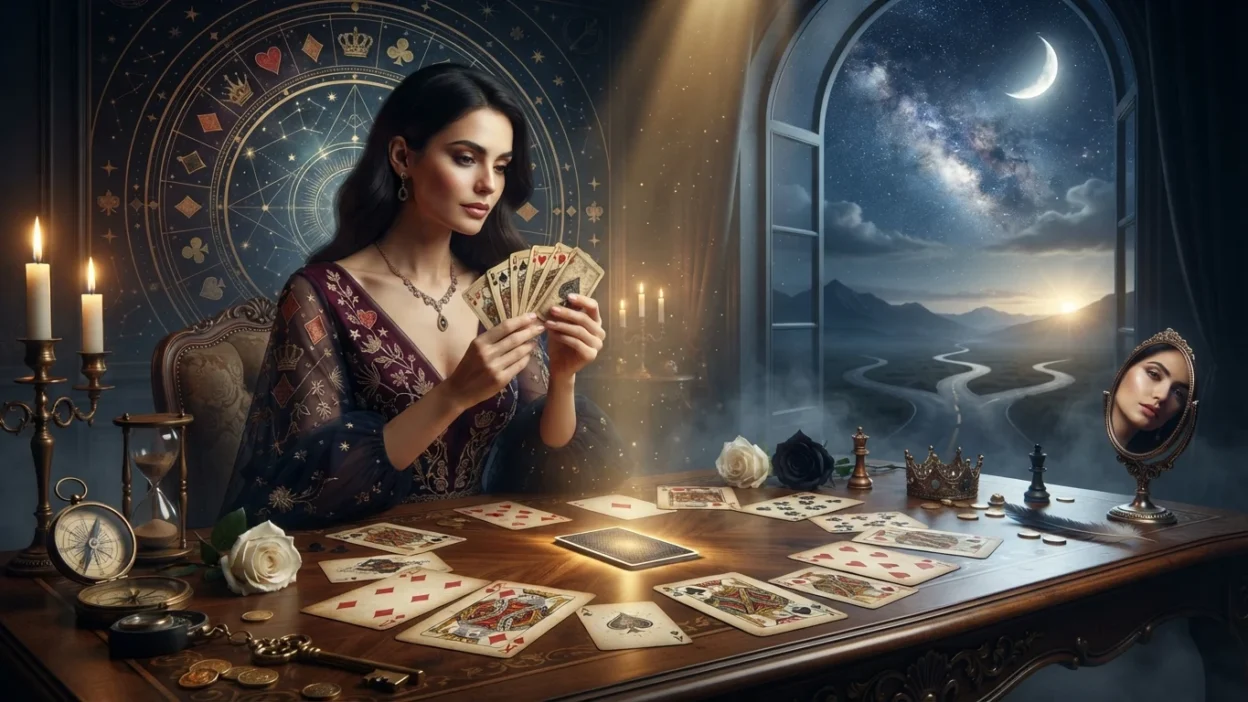
Card symbolism refers to the meanings people attach to playing cards, tarot cards, oracle cards and other symbolic card systems. Cards can represent luck, chance, identity, relationships, choices, mystery, fortune, transformation and the unpredictable nature of life.
From the familiar four suits of playing cards to the richly illustrated imagery of tarot, cards have evolved from simple objects used for games into powerful symbols in art, literature, divination, storytelling and popular culture.
Card Symbolism Meaning (Clear Definition)
Card symbolism is the use of images, suits, numbers, colors, characters, and patterns on cards to communicate ideas or represent particular concepts.
A card’s meaning can depend heavily on the type of deck.
For example:
- Playing cards are commonly associated with games, chance, competition, and luck.
- Tarot cards contain elaborate archetypal imagery associated with symbolic interpretation.
- Oracle cards can use almost any theme or visual system.
- Collectible cards may symbolize identity, fandom, achievement, or belonging.
Therefore, there is no single universal meaning for every card.
What Does Card Symbolism Represent?
Card symbolism often represents the idea that life can be divided into recognizable situations, possibilities, challenges, and choices.
Cards can symbolize:
- Chance
- Fate
- Luck
- Choice
- Competition
- Strategy
- Risk
- Mystery
- Knowledge
- Transformation
- Identity
- Achievement
The act of drawing a card can itself symbolize uncertainty because the result is unknown until the card is revealed.
This makes cards particularly powerful metaphors for life.
Spiritual Meaning of Card Symbolism
In contemporary spiritual practices, cards may be used as tools for:
- Reflection
- Meditation
- Introspection
- Journaling
- Exploring emotions
- Storytelling
- Divination
Tarot and oracle cards are particularly associated with symbolic and spiritual interpretation.
However, spiritual interpretations vary considerably among traditions and individuals. Card readings should not be treated as scientifically established methods for predicting future events.
Biblical / Religious Meaning of Card Symbolism
Cards are not inherently a biblical religious symbol.
Playing cards developed in historical cultures outside biblical traditions, while tarot later acquired connections with European occult and esoteric traditions.
Some religious communities discourage divination or fortune-telling, while others may view symbolic cards primarily as cultural or artistic objects.
The meaning of cards therefore depends greatly on historical context, religious beliefs, and how the cards are being used.
Card Symbolism in History and Culture


Playing cards have a long history and eventually spread throughout Europe after emerging in earlier card traditions connected with Asia and the Islamic world.
European playing-card suits developed into different regional systems. The familiar hearts, diamonds, clubs and spades became especially influential through French-suited cards.
Tarot emerged in 15th century Italy, initially as a form of playing cards rather than primarily as a fortune-telling system.
Over time, cards became associated with:
- Games
- Gambling
- Fortune-telling
- Magic
- Art
- Literature
- Collecting
- Social identity
This history gives card symbolism a fascinating mixture of play, chance, mystery, and cultural storytelling.
Playing Card Suit Symbolism


The four familiar playing-card suits are hearts, diamonds, clubs, and spades.
Their symbolic meanings are not universally fixed, but popular interpretations often associate them with different aspects of life.
Hearts Symbolism
Hearts commonly symbolize:
- Love
- Emotion
- Relationships
- Compassion
- Affection
- Passion
Because the heart has long been used as a metaphor for emotional life, the heart suit naturally became associated with feelings and relationships.
Diamonds Symbolism
- Wealth
- Material resources
- Value
- Success
- Possessions
- Prosperity
Their association with precious gemstones makes diamonds a natural metaphor for material value and abundance.
Clubs Symbolism
Clubs are sometimes associated with:
- Action
- Energy
- Work
- Growth
- Competition
- Physical effort
The club’s resemblance to a branch or weapon contributes to its associations with strength and action.
Spades Symbolism
Spades can symbolize:
- Conflict
- Power
- Challenge
- Death
- Transformation
- Seriousness
The spade’s dark visual appearance has contributed to many of these interpretations.
It is important to remember that these meanings are popular symbolic associations rather than universal historical definitions.
Card Number Symbolism
Numbers also play an important role in card symbolism.
Ace Symbolism
The Ace often represents:
- Beginnings
- Potential
- Opportunity
- Individuality
- New energy
An Ace can symbolically represent the start of a new cycle.
Two Symbolism
Two commonly suggests:
- Partnership
- Duality
- Choice
- Balance
- Opposition
It can represent two forces interacting with one another.
Three Symbolism
Three may represent:
- Growth
- Creativity
- Development
- Expansion
- Cooperation
Four Symbolism
Four often symbolizes:
- Stability
- Structure
- Foundation
- Security
- Order
Five Symbolism
Five can represent:
- Change
- Competition
- Disruption
- Challenge
- Uncertainty
Six Symbolism
Six may symbolize:
- Harmony
- Cooperation
- Balance
- Generosity
- Progress
Seven Symbolism
Seven is often associated with:
- Mystery
- Reflection
- Searching
- Spirituality
- Hidden knowledge
Eight Symbolism
Eight may represent:
- Power
- Movement
- Discipline
- Achievement
- Continuity
Nine Symbolism
Nine often suggests:
- Maturity
- Completion
- Reflection
- Individual achievement
Ten Symbolism
Ten can symbolize:
- Completion
- Fulfillment
- The end of a cycle
- Transition toward something new
These numerical associations vary across symbolic systems.
Face Card Symbolism


Face cards introduce human characters into card symbolism.
King Symbolism
The King commonly represents:
- Authority
- Leadership
- Power
- Experience
- Responsibility
- Control
The king can symbolize established authority or mastery.
Queen Symbolism
The Queen may represent:
- Wisdom
- Influence
- Intuition
- Grace
- Leadership
- Emotional intelligence
Jack Symbolism
The Jack can represent:
- Youth
- Energy
- Adventure
- Service
- Potential
- Action
Together, the King, Queen, and Jack can symbolically represent different stages or expressions of social power and personal development.
Joker Symbolism


The Joker is one of the most fascinating symbols in card culture.
It can represent:
- Uncertainty
- Freedom
- Chaos
- Humor
- Trickery
- Unpredictability
- Breaking rules
Because the Joker often functions differently from ordinary cards in games, it naturally symbolizes the unexpected element that disrupts established rules.
In literature and popular culture, the Joker can also represent the outsider, trickster, or unpredictable force.
Tarot Card Symbolism
Tarot represents one of the richest forms of card symbolism.


A traditional tarot deck contains 78 cards:
- 22 Major Arcana
- 56 Minor Arcana
The Major Arcana contain prominent archetypal images such as:
- The Fool
- The Magician
- The High Priestess
- The Empress
- The Emperor
- The Lovers
- The Hermit
- Death
- The Tower
- The Star
- The Moon
- The Sun
- The World
These cards are frequently interpreted as representing major themes of human experience.
The Minor Arcana contain four suits:
Wands, Cups, Swords, and Pentacles.
Their symbolism is often connected respectively with action, emotion, thought, and material life.
Card Symbolism and Chance
One of the deepest meanings of cards is chance.
When someone shuffles a deck and draws a card, the outcome is unknown.
This creates a natural metaphor for life:
We make choices, but we cannot control every outcome.
Cards therefore appear frequently in stories about gambling, risk, adventure, competition, and fate.
A hidden card can symbolize uncertainty.
A revealed card can symbolize knowledge.
A winning card can symbolize opportunity.
A losing card can symbolize disappointment or unexpected consequences.
Card Symbolism and Fate
Cards have often been associated with the idea of fate.
The phrase “the cards you are dealt” has become a metaphor for the circumstances a person receives in life.
This creates an important symbolic distinction between:
What we are given and what we choose to do with it.
A card may therefore symbolize circumstances, while the player’s response symbolizes personal agency.
Card Symbolism and Relationships
Hearts are particularly connected with relationships, but cards more broadly can symbolize interpersonal dynamics.
A pair of cards may represent:
- Partnership
- Attraction
- Conflict
- Cooperation
- Opposition
- Shared destiny
In tarot and oracle traditions, cards are often interpreted in relation to one another, creating a symbolic conversation between images.
Card Symbolism in Dreams
Cards appearing in dreams may symbolize uncertainty, choices, hidden information, risk, or a desire to understand an unpredictable situation.
Dreaming about a deck of cards might represent many possibilities.
Drawing a card may symbolize waiting for an answer.
A winning card might evoke confidence or opportunity.
A lost card could suggest something missing or uncertain.
A Joker may represent unpredictability, humor, or disruption.
The personal circumstances surrounding the dream are important when interpreting such imagery.
Card Symbolism in Literature and Art
Cards are powerful literary symbols because they can represent an entire philosophy of life in a single object.
A writer may use a deck of cards to represent:
- Fate
- Gambling
- Risk
- Deception
- Strategy
- Social hierarchy
- Chance
A King may symbolize authority.
A Queen may represent influence.
A Joker can symbolize rebellion or chaos.
A heart may represent love.
A spade may evoke darkness or conflict.
A hidden card can represent a secret.
A shuffled deck can symbolize the unpredictability of life.
This versatility explains why cards appear so frequently in novels, films, paintings, and visual storytelling.
Card Symbolism and Personal Reflection
Cards can also serve as prompts for reflection without requiring belief in supernatural prediction.
Looking at an evocative image may encourage questions such as:
- What does this image remind me of?
- What choice am I currently facing?
- What am I afraid to discover?
- What possibilities have I overlooked?
- What does success mean to me?
- How do I respond when circumstances are uncertain?
In this sense, cards can function as visual storytelling devices and reflective prompts.
Frequently Asked Questions About Card Symbolism
What does card symbolism mean?
Card symbolism refers to the meanings associated with card images, suits, numbers, characters, colors, and visual motifs.
What do hearts symbolize in playing cards?
Hearts are commonly associated with love, emotions, relationships, affection, and compassion.
What do diamonds symbolize?
Diamonds are often associated with wealth, material value, prosperity, possessions, and success.
What do clubs symbolize?
Clubs can be associated symbolically with action, energy, work, competition, and growth.
What do spades symbolize?
Spades may symbolize challenge, conflict, power, seriousness, death, or transformation, depending on context.
What does the Joker symbolize?
The Joker commonly represents unpredictability, freedom, chaos, humor, trickery, and breaking established rules.
What does a King symbolize?
A King often symbolizes authority, leadership, power, experience, responsibility, and control.
What does a Queen symbolize?
A Queen can represent wisdom, influence, intuition, grace, leadership, and emotional intelligence.
Are card meanings universal?
No. Card symbolism varies between cultures, decks, historical periods, games, spiritual traditions, and individual interpretations.
Conclusion
Card symbolism transforms an ordinary deck into a fascinating visual language of chance, choice, identity, power, love, uncertainty and transformation.
Hearts can evoke emotion. Diamonds suggest value. Clubs may represent action. Spades can suggest challenge or darkness. Kings and Queens embody different forms of authority, while the Joker introduces the unpredictable element that can overturn expectations.
Tarot expands this symbolic vocabulary even further, using archetypal characters, landscapes, objects, numbers and colors to tell stories about the human experience.
Perhaps the most powerful symbolism of cards comes from the simple act of drawing one without knowing what it will be. It mirrors life itself: we do not always choose the circumstances we receive, but we can choose how we respond to them.
In this sense, card symbolism ultimately represents a timeless human question:
What will the next card reveal and what will we do with what we are given?