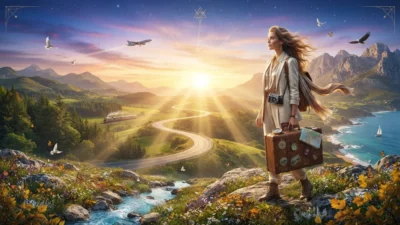

Path symbolism represents journey, direction, personal growth, choices, destiny, transformation and the search for purpose. A path is more than a physical route from one place to another. Symbolically, it represents the journey of life itself the decisions we make, the challenges we overcome and the destinations we hope to reach.
Throughout history, paths have appeared in spirituality, mythology, literature, art, dreams and religious traditions as powerful symbols of guidance and discovery. A straight path may suggest clarity and confidence, while a winding or unfamiliar path can represent uncertainty, exploration and personal transformation.
Path Symbolism Meaning (Clear Definition)
Path symbolism refers to the emotional, spiritual, and cultural meanings associated with a road, trail, walkway, or route leading from one place to another.
Because a path requires movement, it naturally represents progress and the passage from one stage of life to another. It can symbolize choices, opportunities, challenges, direction, and destiny.
The primary meanings associated with path symbolism include:
- Journey
- Direction
- Purpose
- Personal growth
- Choices
- Transformation
- Destiny
- Discovery
- Progress
- Guidance
- Freedom
- New beginnings
At its deepest level, a path represents the idea that life is a journey rather than a single destination.
What Does Path Symbolism Represent?
Path symbolism represents the journey toward personal purpose and self-discovery.
One of its strongest meanings is direction. A path gives us somewhere to go, making it a natural symbol of goals, dreams, and life decisions.
A path can also represent choice. When several paths appear before us, they may symbolize different possibilities or directions in life.
A winding path represents uncertainty and exploration. It reminds us that we do not always need to know exactly where the journey will lead.
A difficult, rocky path can symbolize challenges and perseverance, while a smooth path may represent peace, clarity, and easier progress.
Most importantly, path symbolism teaches that every step has value, even when the final destination remains unknown.
Spiritual Meaning of Path Symbolism
Spiritually, a path symbolizes guidance, faith, purpose, spiritual growth, and the journey toward greater understanding.
Many spiritual traditions describe life as a journey in which individuals gradually discover wisdom and meaning. The path may include moments of uncertainty, transformation, solitude, and revelation.
Spiritually, path symbolism can represent:
- Divine guidance
- Spiritual awakening
- Faith
- Personal transformation
- Inner wisdom
- Purpose
- Self discovery
- Enlightenment
- Renewal
A path may remind you that you do not need to see the entire journey at once. Sometimes you only need enough clarity to take the next step.
Biblical Meaning of Path Symbolism
Path imagery is especially significant in the Bible. Scripture frequently uses the ideas of paths, ways, roads and walking to describe one’s relationship with God, moral choices, wisdom, and spiritual direction.
A righteous or straight path can represent obedience, wisdom, faith, and a life aligned with God’s guidance. A wrong or crooked path may symbolize choices that lead away from righteousness.
Biblical path symbolism may therefore represent:
- God’s guidance
- Wisdom
- Faith
- Righteousness
- Obedience
- Spiritual direction
- Moral choices
- Trust
The symbolic message is powerful: the direction we choose matters, but guidance and wisdom can help us navigate the journey.
Path Symbolism in History and Culture
Paths have played an important role in human civilization since ancient times.
Ancient Pilgrimage Paths
Sacred paths and pilgrimage routes represented spiritual journeys, devotion, transformation, and the search for divine understanding.
Indigenous Traditions
Trails and natural pathways can represent ancestral connections, movement across sacred landscapes, community, and relationships with nature.
Eastern Traditions
Walking paths through gardens, forests, and temples are often associated with contemplation, mindfulness, simplicity, and spiritual reflection.
Medieval Europe
Pilgrimage roads represented faith, sacrifice, endurance, and the search for spiritual renewal.
Modern Culture
Today, paths commonly symbolize:
- Life choices
- Career journeys
- Personal development
- Adventure
- Freedom
- New opportunities
- Self-discovery
The simple image of a road stretching toward the horizon continues to represent possibility and hope.
Path Symbolism in Literature and Art
Paths are among the most recognizable symbols in literature.
A character standing before two paths may represent a difficult decision. A lonely path through a forest can symbolize uncertainty or self-discovery. A path leading toward sunlight may represent hope, while a disappearing path may symbolize an unknown future.
In literature, paths commonly symbolize:
- Choices
- Destiny
- Adventure
- Transformation
- Discovery
- Freedom
- Uncertainty
- Personal growth
In visual art and photography, paths are often used as leading lines that guide the viewer’s eyes toward mountains, forests, oceans, houses, or distant horizons.
This creates a natural metaphor for moving forward.
Path Symbolism in Dreams
Dreaming about a path often reflects your current direction in life, important decisions, relationships, goals, or personal development.
Straight Path
A straight path symbolizes clarity, confidence, focus, and knowing where you want to go.
Winding Path
A winding path represents uncertainty, exploration, flexibility, and a journey filled with unexpected experiences.
Fork in the Path
A fork in the road symbolizes an important decision or multiple opportunities.
Difficult Path
A rocky, muddy, or steep path may represent obstacles, emotional struggles, or challenges that require perseverance.
Beautiful Path
A beautiful path surrounded by flowers, trees, or sunlight symbolizes hope, happiness, growth, and positive opportunities.
Dark Path
A dark or unfamiliar path can represent fear of the unknown, uncertainty, hidden emotions, or anxiety about the future.
Path Through a Forest
A forest path symbolizes self-discovery, mystery, intuition, and exploring parts of yourself that may remain hidden.
Path Toward Light
A path leading toward sunlight represents hope, healing, clarity, spiritual awakening, and a positive new chapter.
Broken Path
A broken or blocked path may symbolize disappointment, unexpected obstacles, or the need to change direction.
Modern Meaning of Path Symbolism
Today, path symbolism is strongly connected with personal development and the idea of creating your own future.
Modern interpretations include:
- Career growth
- Personal transformation
- Self-improvement
- Life purpose
- Independence
- Emotional healing
- New beginnings
- Decision-making
- Adventure
The phrase “finding your path” has become a powerful way to describe discovering a meaningful direction in life.
Similarly, “walking your own path” represents individuality and refusing to let other people’s expectations determine your choices.
Types of Paths and Their Symbolic Meanings
Forest Path
A forest path symbolizes mystery, intuition, exploration, self-discovery, and personal transformation.
Mountain Path
A mountain path represents ambition, perseverance, challenge, spiritual growth, and reaching higher goals.
Desert Path
A desert path symbolizes endurance, solitude, faith, survival, and continuing forward despite limited resources.
Garden Path
A garden path represents peace, beauty, healing, harmony, and personal growth.
Stone Path
A stone path symbolizes stability, tradition, endurance, and the lasting foundations built through experience.
Hidden Path
A hidden path represents mystery, undiscovered opportunities, secret knowledge, and unexpected possibilities.
Winding Path
A winding path symbolizes life’s unpredictability, flexibility, exploration, and learning through experience.
Golden Path
A golden path symbolizes success, prosperity, divine guidance, opportunity, and a promising future.
Frequently Asked Questions About Path Symbolism
What does a path symbolize?
A path symbolizes life’s journey, direction, choices, purpose, personal growth, transformation, discovery, and destiny.
Is a path a positive symbol?
Generally, yes. Paths often represent progress, opportunity, hope, and personal growth. However, a dark or blocked path can symbolize uncertainty or obstacles.
What does a path symbolize spiritually?
Spiritually, a path represents divine guidance, faith, purpose, spiritual growth, self-discovery, transformation, and the journey toward enlightenment.
What does dreaming about a path mean?
Dreaming about a path often reflects your current life direction, important decisions, personal growth, uncertainty, or the desire to discover your purpose.
What does a fork in the path symbolize?
A fork in the path symbolizes a choice between different possibilities. It may reflect an important decision involving relationships, career, personal goals, or life direction.
What does a path leading to light symbolize?
A path leading toward light symbolizes hope, healing, clarity, spiritual awakening, positive change, and moving toward a better chapter of life.
Conclusion
Path symbolism reminds us that life is a journey made of countless choices and individual steps. We may not always know where a path will lead, and sometimes the road may be difficult, winding or unfamiliar. Yet every part of the journey can teach us something valuable.
Across spirituality, religion, dreams, literature, art and culture, paths continue to symbolize direction, purpose, choice, transformation, perseverance, discovery and personal growth. The most important lesson may be that there is no need to compare your path with someone else’s. Your journey has its own timing, challenges, discoveries and destination.