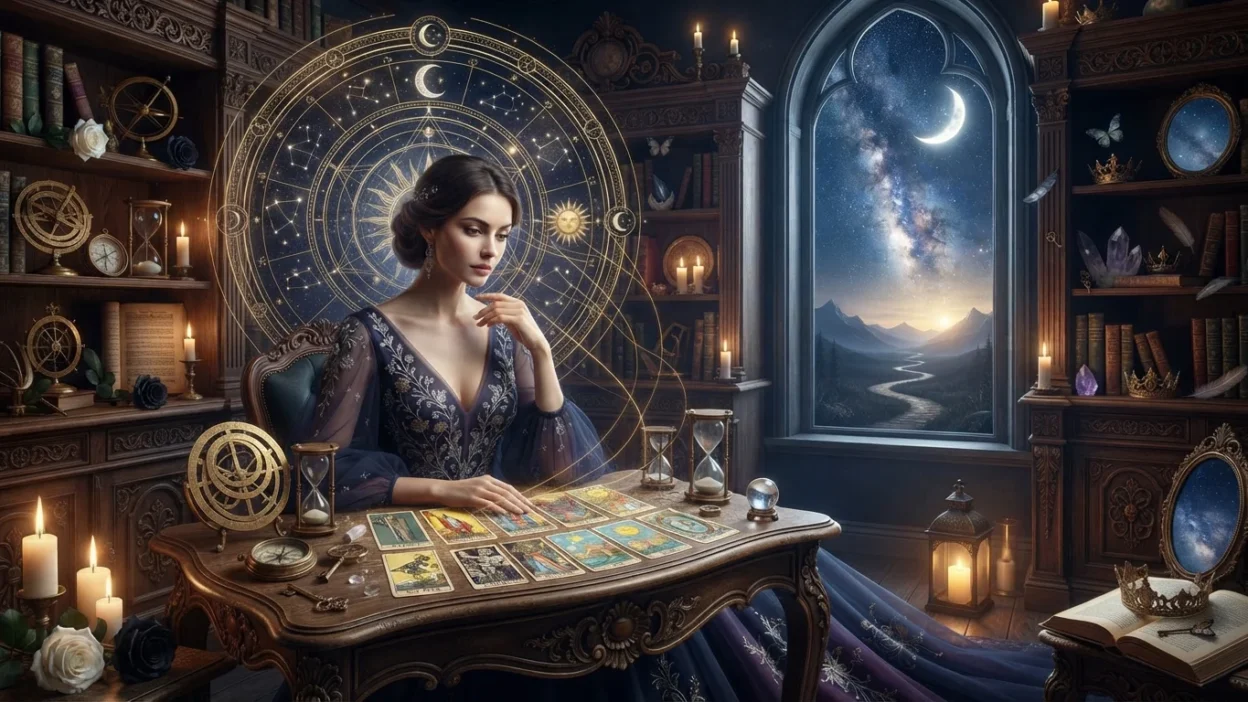
Tarot symbolism is a rich visual language built from images, archetypes, numbers, colors, objects and characters found throughout tarot cards. From the mysterious High Priestess and transformative Death card to the hopeful Star and illuminating Sun, tarot imagery has become a powerful system for exploring themes of change, identity, choices, relationships, challenges, intuition and personal growth.
Although tarot is commonly associated today with divination, its history began with playing cards in Europe. Modern tarot symbolism has since developed into a complex cultural and artistic tradition.
Tarot Symbolism Meaning (Clear Definition)
Tarot symbolism refers to the meanings and interpretations associated with the imagery, figures, colors, numbers, suits and archetypes found in tarot cards.
A traditional tarot deck contains 78 cards:
- 22 Major Arcana cards
- 56 Minor Arcana cards
The Major Arcana generally feature larger archetypal themes, while the Minor Arcana explore more everyday experiences through four suits.
The four traditional suits are:
- Wands — energy, creativity, ambition, action
- Cups — emotions, relationships, intuition
- Swords — thought, conflict, communication, decisions
- Pentacles — material life, work, resources, stability
Tarot symbolism is interpretive rather than scientifically validated. Its meanings can vary between decks, traditions, readers and individual interpretations.
What Does Tarot Symbolism Represent?
Tarot symbolism represents the use of visual storytelling to explore human experiences.
A tarot card may contain multiple symbolic layers simultaneously.
For example, a card might combine:
Color + Number + Character + Object + Landscape + Gesture
to communicate a broader theme.
A bridge may symbolize transition.
A mountain may represent a challenge.
A sunrise may suggest renewal.
A closed door may represent mystery or an unexplored possibility.
This makes tarot particularly interesting as a symbolic art form.
Spiritual Meaning of Tarot Symbolism
In contemporary spiritual practices, tarot is often used for:
- Self-reflection
- Introspection
- Meditation
- Exploring emotions
- Considering difficult decisions
- Personal storytelling
- Symbolic guidance
Some people regard tarot as a spiritual or divinatory practice, while others use the cards primarily as prompts for reflection.
The meaning of a card often depends on its context, surrounding cards, question and personal associations.
Biblical / Religious Meaning of Tarot Symbolism
Tarot does not originate as a biblical or Christian symbolic system.
Its earliest known European forms developed as playing cards during the Renaissance. Later occult and esoteric traditions assigned additional mystical meanings to tarot.
Because of its later association with divination, some Christian traditions have viewed tarot negatively or discouraged its use.
It is therefore important not to describe tarot as inherently biblical or as part of traditional Christian religious symbolism.
At the same time, some tarot imagery contains Christian-influenced medieval European visual motifs, particularly in cards such as the Pope/Hierophant, Judgement, and Devil.
Tarot Symbolism in History and Culture


The earliest known tarot-like cards appeared in 15th-century Italy.
Early tarot decks were associated with games rather than fortune-telling.
Over subsequent centuries, tarot became connected with occultism and esoteric systems.
The Tarot de Marseille became particularly influential, while later decks developed increasingly elaborate symbolic systems.
The Rider Waite Smith tarot, first published in the early 20th century, became especially influential because its illustrated Minor Arcana made symbolic interpretation more accessible.
Today tarot imagery appears in:
- Art
- Literature
- Fashion
- Film
- Tattoos
- Jewelry
- Psychology-inspired discussions
- Spiritual communities
- Popular culture
Major Arcana Symbolism


The Major Arcana contains 22 cards traditionally numbered from 0 to 21.
They are often interpreted as representing major stages, archetypes, challenges and transformations in human experience.
The Fool New Beginnings
The Fool symbolizes:
- Adventure
- Innocence
- Freedom
- Risk
- Possibility
- New beginnings
The figure standing near the edge of a cliff can represent stepping into the unknown.
The Magician Potential and Action
The Magician represents:
- Creativity
- Skill
- Initiative
- Personal power
- Manifestation
- Resourcefulness
The objects on the table traditionally connect with the four suits, suggesting access to different forms of knowledge and capability.
The High Priestess Mystery and Intuition
The High Priestess symbolizes:
- Intuition
- Hidden knowledge
- Mystery
- Silence
- Inner wisdom
- The subconscious
She represents knowledge that may not be immediately visible.
The Empress Creation and Nurturing
The Empress traditionally symbolizes:
- Fertility
- Creativity
- Nature
- Abundance
- Nurturing
- Sensuality
Her connection with vegetation and natural abundance reinforces themes of growth.
The Emperor Authority and Structure
The Emperor represents:
- Leadership
- Structure
- Authority
- Discipline
- Stability
- Order
His symbolism emphasizes creating boundaries and systems.
The Hierophant Tradition and Teaching
The Hierophant can symbolize:
- Tradition
- Education
- Institutions
- Spiritual teaching
- Belief systems
- Guidance
The card frequently incorporates religious imagery reflecting its European historical context.
The Lovers Choice and Connection
The Lovers commonly symbolize:
- Love
- Partnership
- Values
- Attraction
- Choice
- Commitment
The card can represent both romantic connection and important personal decisions.
The Chariot Determination and Direction
The Chariot represents:
- Ambition
- Discipline
- Movement
- Victory
- Willpower
- Direction
Its imagery emphasizes controlling opposing forces while moving toward a goal.
Strength Courage and Compassion
Strength traditionally represents:
- Courage
- Patience
- Compassion
- Inner strength
- Self-control
- Emotional mastery
The gentle interaction between the woman and lion symbolizes strength through calmness rather than brute force.
The Hermit Solitude and Wisdom
The Hermit symbolizes:
- Reflection
- Solitude
- Wisdom
- Inner guidance
- Contemplation
- Searching for truth
His lantern can represent illumination within darkness.
Wheel of Fortune Cycles and Change
The Wheel of Fortune represents:
- Change
- Cycles
- Fate
- Opportunity
- Turning points
- Uncertainty
The turning wheel symbolizes the changing circumstances of life.
Justice Balance and Truth
Justice symbolizes:
- Fairness
- Truth
- Accountability
- Balance
- Consequences
- Decision making
The scales emphasize equilibrium and judgment.
The Hanged Man Surrender and Perspective
The Hanged Man represents:
- Surrender
- Patience
- Pause
- Sacrifice
- New perspective
- Letting go
His unusual position suggests seeing reality from another angle.
Death Transformation
Despite its name, the Death card does not necessarily represent literal death.
Symbolically, it commonly represents:
- Endings
- Transformation
- Release
- Renewal
- Transition
- Rebirth
The card is one of tarot’s strongest symbols of change.
Temperance Harmony and Integration
Temperance represents:
- Balance
- Moderation
- Patience
- Healing
- Integration
- Harmony
The mixing of liquids symbolizes combining different forces into a balanced whole.
The Devil Attachment and Temptation
The Devil can symbolize:
- Temptation
- Attachment
- Materialism
- Obsession
- Fear
- Self-imposed limitations
The chains traditionally depicted in the card can represent unhealthy attachments or perceived restrictions.
The Tower Sudden Change
The Tower symbolizes:
- Shock
- Disruption
- Revelation
- Collapse
- Liberation
- Breaking old structures
Lightning striking the tower represents sudden transformation.
The Star Hope and Renewal


The Star represents:
- Hope
- Healing
- Inspiration
- Renewal
- Faith
- Possibility
Its stars and flowing water create imagery of restoration after difficulty.
The Moon Illusion and the Unconscious
The Moon symbolizes:
- Dreams
- Intuition
- Mystery
- Uncertainty
- Illusion
- The subconscious
Its nighttime landscape represents things that remain unclear or hidden.
The Sun Joy and Illumination
The Sun represents:
- Happiness
- Vitality
- Clarity
- Success
- Confidence
- Celebration
It contrasts strongly with the uncertainty represented by the Moon.
Judgement Awakening and Reflection
Judgement symbolizes:
- Awakening
- Renewal
- Self-evaluation
- Transformation
- Acceptance
- A new phase
The imagery of rising figures suggests responding to a call toward change.
The World Completion and Wholeness
The World represents:
- Completion
- Achievement
- Integration
- Wholeness
- Fulfillment
- A completed cycle
It traditionally serves as the culmination of the Major Arcana journey.
Minor Arcana Symbolism
The Minor Arcana contains 56 cards divided into four suits.
Each suit explores a different symbolic area of life.
Wands Symbolism
Wands commonly represent:
- Fire
- Energy
- Creativity
- Ambition
- Passion
- Action
- Inspiration
A growing branch or flowering wand can symbolize potential becoming action.
Cups Symbolism
Cups traditionally represent:
- Water
- Emotions
- Love
- Relationships
- Intuition
- Imagination
Because cups hold liquids, they naturally symbolize the emotional inner world.
Swords Symbolism
Swords represent:
- Air
- Thought
- Intellect
- Communication
- Decisions
- Conflict
- Truth
A sword can both defend and harm, making it a powerful symbol of the double edged nature of thought and communication.
Pentacles Symbolism
Pentacles traditionally represent:
- Earth
- Money
- Work
- Health
- Resources
- Security
- Material reality
The pentacle’s connection with earth makes it strongly associated with practical life.
Tarot Colors and Their Symbolism
Color plays an important role in many tarot decks.
Red
Often symbolizes:
Passion, energy, desire, action, and vitality.
Blue
May represent:
Calmness, intuition, spirituality, wisdom, and emotion.
Yellow
Often suggests:
Joy, awareness, intellect, optimism and illumination.
Green
Can symbolize:
Nature, growth, fertility, renewal and abundance.
Black
May represent:
Mystery, the unknown, endings, hidden aspects or the subconscious.
White
Often symbolizes:
Purity, clarity, innocence, peace or spiritual illumination.
Color meanings vary between decks and artistic traditions.
Tarot Numbers and Their Symbolism
Numbers can add another symbolic layer.
Zero can represent potential, openness, or the unknown.
One often suggests beginnings and individuality.
Two can represent duality, partnership, and choices.
Three may symbolize growth and creation.
Four often suggests stability and structure.
Five can represent conflict, disruption, or change.
Six may symbolize harmony, balance, or cooperation.
Seven often represents challenge, reflection, or evaluation.
Eight can suggest movement, power, or discipline.
Nine may represent culmination or individual achievement.
Ten frequently symbolizes completion and the end of a cycle.
These interpretations vary depending on the deck and tradition.
Tarot Symbolism and the Four Elements
The four Minor Arcana suits are traditionally connected with elements.
Wands → Fire → Passion and action
Cups → Water → Emotion and intuition
Swords → Air → Thought and communication
Pentacles → Earth → Material life and stability
This elemental framework helps create relationships between seemingly different cards.
Tarot Symbolism in Dreams
Tarot imagery can appear in dreams because its symbols are culturally familiar and visually powerful.
Dreaming about The Fool might evoke a new beginning or uncertainty.
Dreaming about The Tower might symbolize sudden disruption or emotional instability.
The Star may evoke hope and renewal.
The Moon can suggest uncertainty, dreams, or hidden emotions.
The Death card may symbolize transformation rather than literal death.
Dream interpretation is subjective, so these meanings should be treated as possibilities rather than fixed predictions.
Tarot Symbolism in Literature and Art
Tarot has become an influential source of visual storytelling.
Its archetypal images are especially attractive to artists because a single card can communicate a complicated idea without words.
A tower struck by lightning immediately suggests disruption.
A figure carrying a lantern evokes searching and wisdom.
A wheel communicates cycles.
A star-filled sky evokes hope and possibility.
A sunrise suggests renewal.
These visual metaphors have influenced novels, films, paintings, fashion, tattoos, jewelry, and contemporary graphic design.
Tarot Symbolism and Personal Reflection
One reason tarot symbolism remains popular is that the cards can encourage people to think about experiences from different perspectives.
A card representing The Hermit, for example, might prompt someone to consider whether they need solitude.
The Chariot might inspire reflection about determination and direction.
Justice can encourage consideration of consequences and fairness.
The Tower may serve as a metaphor for unexpected change.
The Star can represent hope after a difficult period.
Used this way, tarot can function as a symbolic storytelling tool, regardless of whether someone believes in divination.
Frequently Asked Questions About Tarot Symbolism
What does tarot symbolism mean?
Tarot symbolism refers to the meanings communicated through tarot cards’ imagery, archetypes, numbers, colors, suits, characters, and objects.
What does the Death card symbolize?
The Death card traditionally symbolizes transformation, endings, release, transition, and renewal rather than necessarily representing literal death.
What does The Star symbolize?
The Star commonly symbolizes hope, healing, inspiration, renewal, faith, and optimism.
What does The Moon symbolize?
The Moon represents mystery, dreams, intuition, uncertainty, illusion, and the subconscious.
What do tarot Cups symbolize?
Cups traditionally represent emotions, relationships, intuition, love, imagination, and the inner emotional world.
What do tarot Swords symbolize?
Swords commonly represent thought, intellect, communication, decisions, conflict, and truth.
What do tarot Wands symbolize?
Wands traditionally represent creativity, passion, ambition, energy, inspiration, and action.
What do tarot Pentacles symbolize?
Pentacles generally represent material resources, work, money, stability, practical concerns, and physical life.
Is tarot scientifically proven?
No. Tarot divination has not been scientifically established as a reliable method for predicting future events. Its symbolic value can nevertheless be meaningful as a cultural, artistic, or reflective practice.
Conclusion
Tarot symbolism is a fascinating combination of visual storytelling, mythology, cultural history, archetypes and personal interpretation.
The Fool symbolizes new beginnings. The Magician represents potential and action. The High Priestess evokes intuition and hidden knowledge. The Empress represents creation and abundance. The Emperor symbolizes structure and authority. The Lovers explore connection and choice. The Hermit represents introspection. Death symbolizes transformation. The Tower represents disruption and revelation. The Star offers hope. The Moon embodies mystery. The Sun represents clarity and vitality. The World symbolizes completion.
Meanwhile, the Minor Arcana provide a more detailed symbolic language through Wands, Cups, Swords and Pentacles, representing action, emotion, thought and material life.
Whether tarot is approached as divination, spiritual practice, historical artifact, artistic tradition or a tool for self reflection, its enduring appeal comes from its ability to transform complex human experiences into memorable visual symbols.
At its heart, tarot symbolism tells stories about beginnings and endings, fear and courage, confusion and clarity, loss and renewal and the endless process of becoming who we are.