
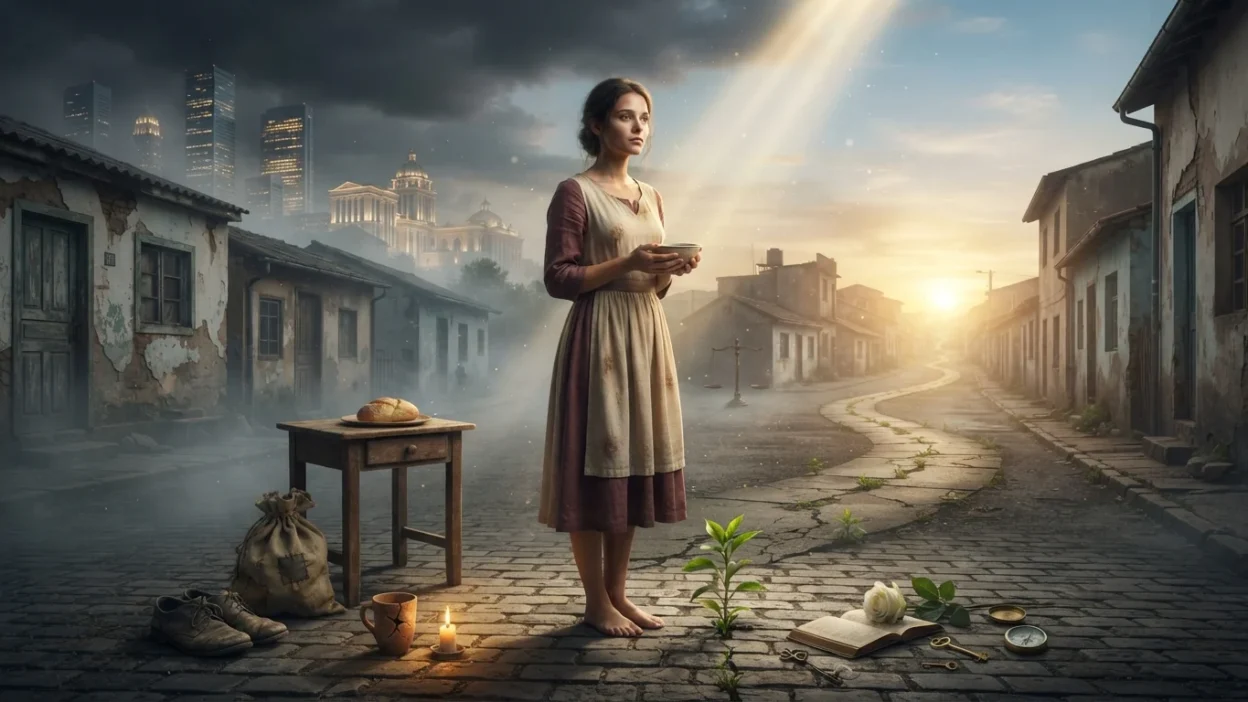
Poverty symbolism represents far more than a lack of money or material possessions. Throughout history, poverty symbolism has been used to express humility, hardship, sacrifice, inequality, vulnerability, resilience, simplicity, exclusion and the struggle for survival. A worn shoe, empty bowl, broken shelter, patched clothing or barren landscape can communicate powerful ideas about the human condition.
Poverty can carry different meanings depending on its context. In religious traditions, it may symbolize humility and freedom from material attachment. In literature and art, it can expose social inequality or demonstrate human resilience. In dreams, poverty may reflect insecurity, fear, loss or feelings of inadequacy.
Poverty Symbolism Meaning (Clear Definition)
Poverty symbolism refers to the symbolic meanings associated with financial hardship, scarcity, deprivation, limited resources and difficult living conditions.
At its most basic level, poverty symbolizes lack and scarcity. However, its symbolic meaning can extend far beyond material conditions.
Poverty may symbolize:
- Hardship and struggle
- Scarcity and deprivation
- Vulnerability
- Inequality
- Humility
- Simplicity
- Resilience
- Survival
- Sacrifice
- Social exclusion
- Injustice
- Freedom from materialism
- Hope and perseverance
- Transformation
Importantly, poverty should not be romanticized. Real poverty can involve serious deprivation and suffering. When used symbolically, however, its imagery can help explore deeper questions about society, human dignity, values and resilience.
What Does Poverty Represent?
Poverty commonly represents scarcity, hardship, vulnerability, inequality and the struggle to survive.
An empty wallet can represent financial insecurity. An empty cupboard can represent deprivation. A damaged home can symbolize instability.
But poverty symbolism can also represent something less obvious: the ability to survive with limited resources.
Poverty as a Symbol of Hardship
One of the clearest meanings of poverty is struggle.
A person facing scarcity may have to overcome obstacles that others never experience. In symbolic storytelling, poverty can therefore represent adversity and difficult circumstances.
Poverty as a Symbol of Inequality
Poverty frequently symbolizes the unequal distribution of resources and opportunities.
An image of a wealthy mansion standing beside a small, damaged home can communicate inequality without words.
This contrast appears frequently in literature, film, photography and social commentary.
Poverty as a Symbol of Vulnerability
Limited resources can create vulnerability.
A person without adequate food, shelter, clothing, or financial security may have fewer choices during difficult circumstances. Symbolically, this can represent exposure to uncertainty and the fragility of human life.
Poverty as a Symbol of Resilience
Poverty can also represent strength.
People experiencing hardship often demonstrate creativity, endurance, resourcefulness, and determination. In symbolic storytelling, a small plant growing through cracked pavement may represent the resilience of life despite difficult conditions.
Spiritual Meaning of Poverty Symbolism
Spiritually, poverty has a complex meaning.
It can symbolize humility, simplicity, detachment, surrender, compassion, dependence on something greater and freedom from excessive material attachment.
At the same time, spiritual interpretations should not suggest that actual poverty is inherently desirable or that financial hardship is automatically a blessing.
Poverty and Humility
In some spiritual traditions, living simply can symbolize humility.
Possessing fewer material objects may encourage a person to focus on relationships, wisdom, compassion, faith and inner development.
The symbolic lesson is often about reducing attachment rather than celebrating deprivation.
Poverty and Spiritual Detachment
Poverty symbolism can represent freedom from material obsession.
A simple room with very few possessions may symbolize a conscious decision to live with less and focus on what matters most.
This is different from involuntary poverty. Spiritual simplicity is chosen, while economic poverty may be imposed by circumstances.
Poverty and Compassion
Images of poverty can inspire compassion.
An empty bowl, worn clothing, or struggling family may remind viewers of the importance of generosity and social responsibility.
In this sense, poverty symbolism can encourage people to notice suffering rather than ignore it.
Poverty and Inner Richness
One of the most powerful symbolic contrasts is material poverty versus inner wealth.
A person may have very few possessions yet possess extraordinary kindness, wisdom, courage, creativity or love.
This theme appears throughout spiritual teachings and literature, where inner richness is often presented as more enduring than material wealth.
Biblical / Religious Meaning of Poverty Symbolism
Poverty has an important place in biblical and religious symbolism.
Biblical teachings frequently address the poverty, generosity, compassion, justice, humility, and the responsible use of wealth.
The Bible repeatedly emphasizes concern for people experiencing poverty and encourages generosity toward those in need.
The widow’s offering is particularly significant as a symbolic example. Her small contribution is presented as meaningful because of the sacrifice behind it rather than its monetary size.
The teachings of Jesus also repeatedly emphasize compassion toward the poverty and vulnerable.
The story of Lazarus and the rich man, for example, explores themes of wealth, suffering, responsibility, and moral accountability.
Religious symbolism can therefore use poverty to raise questions such as:
- How should wealth be used?
- What responsibility do people have toward the vulnerable?
- Does material wealth determine spiritual worth?
- What does true richness mean?
- How should society respond to suffering?
Some religious traditions also emphasize voluntary poverty or simplicity as a spiritual discipline. Monastic traditions, for example, have historically included practices of renunciation and reduced attachment to material possessions.
Poverty in History and Culture
Poverty has existed throughout human history, although its causes and social meanings have varied significantly between societies.
War, famine, disease, political instability, unequal access to land, economic exploitation, discrimination, unemployment, and natural disasters have all contributed to poverty in different historical contexts.
Because poverty has been a persistent social reality, cultures have developed numerous symbols to represent it.
The Empty Bowl
An empty bowl is one of the strongest symbols of poverty.
It can represent hunger, scarcity, deprivation, and the basic human need for nourishment.
The Beggar’s Cup
A simple cup or bowl held out for assistance can symbolize dependence, vulnerability, and the need for compassion.
It can also represent the relationship between those who possess resources and those who need them.
Torn Clothing
Patched or torn clothing can symbolize poverty, hardship, age, survival, and limited resources.
In storytelling, worn clothing can immediately communicate a character’s social circumstances.
Small or Damaged Homes
A fragile shelter may symbolize insecurity and vulnerability.
A collapsing roof, cracked wall, or poverty protected home can represent the absence of safety and stability.
Bare Feet and Worn Shoes
Bare feet can symbolize deprivation and exposure.
Worn shoes can represent a long journey through hardship, suggesting endurance as well as poverty.
Poverty in Literature and Art
Poverty has played a major role in literature and visual art because it allows creators to explore social class, inequality, dignity, survival, compassion, injustice and human resilience.
Writers may portray poverty characters not simply to show deprivation, but to examine how society treats people with limited power.
A character living in poverty may represent innocence, resilience, injustice, or resistance.
Poverty and Social Criticism
Many literary works use poverty to criticize systems that allow extreme inequality.
Descriptions of crowded neighborhoods, hungry families, dangerous workplaces, or neglected children can expose social problems and encourage readers to question accepted structures.
Poverty and Human Dignity
Another important theme is dignity.
A person experiencing poverty does not lose their humanity or inherent worth. Literature and art can emphasize this by showing characters maintaining courage, kindness, humor, creativity, or moral strength despite hardship.
Poverty and Transformation
Poverty can also serve as the beginning of a transformation story.
A character may move from deprivation toward stability, education, independence, or success. In such narratives, poverty represents the difficult starting point of a larger journey.
Common Symbols Associated With Poverty
Several objects can communicate poverty without directly showing money.
Empty Wallet
An empty wallet represents financial scarcity, insecurity, and lack of resources.
Empty Pantry
An empty pantry or cupboard can symbolize hunger, deprivation, and uncertainty about the future.
Broken Chair
A damaged household object can represent limited resources, neglect, hardship, or long-term struggle.
Cracked Shelter
A damaged home can symbolize instability and the absence of security.
Bare Tree
A leafless or barren tree may symbolize scarcity, deprivation, loneliness, or difficult circumstances.
Cracked Earth
Dry, cracked soil can represent drought, scarcity, famine, and the struggle for survival.
Single Candle
A small candle burning in a dark room can symbolize hope during hardship.
This is especially powerful because the candle represents a small source of light surviving despite surrounding darkness.
Positive Symbolism of Poverty
Although poverty itself is a serious social condition, symbolic representations of hardship can carry positive themes.
These include:
- Resilience
- Perseverance
- Humility
- Simplicity
- Resourcefulness
- Compassion
- Gratitude
- Courage
- Community
- Hope
- Inner strength
These meanings focus on the human response to hardship rather than suggesting that poverty itself is desirable.
Negative Symbolism of Poverty
Poverty can also represent painful realities such as:
- Hunger
- Deprivation
- Insecurity
- Inequality
- Exclusion
- Powerlessness
- Fear
- Vulnerability
- Exploitation
- Social injustice
- Desperation
- Loss of opportunity
These interpretations are particularly common in social realism, documentary photography, political art, and serious literature.
Poverty Symbolism in Dreams
Dreaming about poverty can have several possible symbolic interpretations.
Dream symbolism is personal, so the meaning depends on the dreamer’s circumstances and emotions.
Dreaming that you have no money may reflect anxiety about security, control, or the future.
Living in a poverty or damaged home may symbolize emotional instability or a feeling that something in life lacks support.
An empty wallet may represent fear of losing resources or opportunities.
An empty refrigerator may symbolize emotional or psychological emptiness as well as concerns about physical security.
Giving food or money to someone experiencing poverty may symbolize compassion, generosity, responsibility, or the desire to help.
Interestingly, a dream about being poverty does not necessarily predict financial hardship. It may instead represent feeling unprepared, powerless, overlooked or emotionally depleted.
Poverty and Self Worth
One of the most important symbolic distinctions is the difference between having little and being worth little.
Poverty can affect opportunities and living conditions, but it does not determine a person’s inherent value.
Symbolic stories sometimes challenge the assumption that wealth equals worth.
A humble character with little money may possess extraordinary courage or wisdom, while a wealthy character may be morally empty.
This contrast reminds us that human value cannot be accurately measured by income or possessions.
Poverty and Hope
Hope is one of the most powerful symbols that can emerge from poverty imagery.
A tiny flower growing beside a broken wall, a candle burning in an empty room, or a child looking toward a sunrise can transform an image of hardship into one of possibility.
These symbols suggest that difficult circumstances do not necessarily define the final outcome.
The combination of darkness and light is especially powerful:
Poverty represents the hardship, while light represents the possibility of change.
Poverty and Generosity
Poverty symbolism often highlights the importance of giving.
A hand offering bread, clothing, money, or water can represent compassion and shared humanity.
In many cultural and religious traditions, helping those in need is considered an important moral responsibility.
The symbolic contrast between an empty hand and an offering hand can communicate an entire story about generosity.
Frequently Asked Questions About Poverty Symbolism
What does poverty symbolize?
Poverty can symbolize hardship, scarcity, vulnerability, inequality, humility, resilience, social injustice, simplicity, and the struggle for survival.
What is the spiritual meaning of poverty?
Spiritually, poverty can symbolize humility, simplicity, detachment from material possessions, compassion, surrender, and inner richness. It should not be confused with or romanticized as involuntary economic hardship.
What does poverty represent in dreams?
Poverty in dreams may represent insecurity, fear of loss, emotional depletion, lack of control, vulnerability, or concerns about the future.
What does an empty bowl symbolize?
An empty bowl commonly symbolizes hunger, scarcity, poverty, deprivation, and an unmet basic need.
What does a broken home symbolize?
A damaged or fragile home can symbolize insecurity, instability, hardship, vulnerability, or a lack of emotional or financial support.
Is poverty a positive symbol?
Poverty itself represents a serious condition of deprivation, but symbolic depictions of poverty can communicate positive themes such as resilience, courage, compassion, humility, and hope.
Conclusion
Poverty symbolism explores one of humanity’s most difficult realities while also revealing powerful ideas about dignity, resilience, inequality, compassion, humility and hope.
An empty bowl can represent hunger. A worn shoe can represent a difficult journey. A damaged home can represent insecurity. Yet a small candle in that same home can symbolize hope.
Religious traditions may use poverty to explore generosity and spiritual priorities, while literature and art often use it to expose inequality and celebrate human resilience.
Perhaps the most important lesson of poverty symbolism is that material circumstances do not define human worth.
True richness can exist in courage, kindness, wisdom, community, creativity, and hope. And sometimes, the smallest light becomes most meaningful when it shines against the deepest darkness.