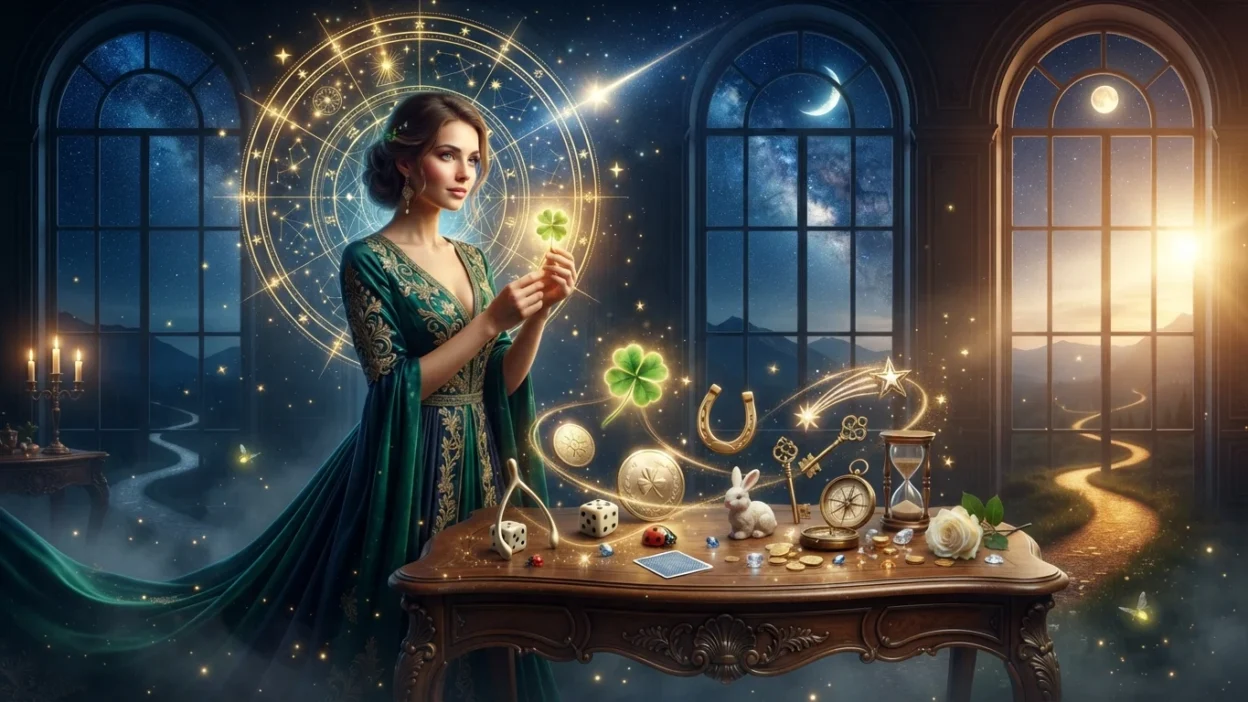
Luck symbolism has fascinated people for centuries. From four leaf clovers and horseshoes to lucky coins, rabbits, charms, stars and the number seven, luck symbolism appears throughout cultures, religions, folklore, dreams, literature and art. These symbols often represent good fortune, opportunity, protection, hope, destiny and unexpected positive change.
Luck can also have a deeper meaning. Sometimes it represents the belief that life contains forces beyond our control. At other times, lucky symbols remind us to recognize opportunities, remain hopeful and believe that circumstances can change.
Luck Symbolism Meaning (Clear Definition)
Luck is often connected with uncertainty because it describes outcomes that seem difficult to predict or control.
Common symbols of luck include:
- Four-leaf clovers
- Horseshoes
- Lucky coins
- Rabbits
- Ladybugs
- Wishbones
- Shooting stars
- Rainbows
- Lucky numbers
- Charms and talismans
- Bamboo
- Acorns
- Elephants
- Keys
- Dice
Different cultures may interpret the same object differently. A symbol considered lucky in one tradition may have no special significance—or even a negative meaning in another.
What Does Luck Represent?
Luck commonly represents fortune, opportunity, hope, chance, destiny, protection and unexpected change.
Unlike achievement, which is generally connected with effort, luck suggests that circumstances can sometimes change without being completely controlled by human action.
Luck as a Symbol of Opportunity
A lucky event may create an opportunity that did not previously exist.
A chance meeting, unexpected discovery, or surprising success can therefore symbolize a door opening at exactly the right moment.
Lucky keys, open doors, shooting stars, and crossroads can all communicate this idea of unexpected possibility.
Luck as a Symbol of Hope
People often turn toward lucky symbols during uncertain times.
Carrying a charm or noticing a familiar lucky sign can provide emotional encouragement. The object may not literally control events, but it can remind someone to stay hopeful.
Luck as a Symbol of Chance
Dice, cards, coins, and spinning wheels are closely associated with chance.
These symbols emphasize uncertainty and remind us that not every outcome can be predicted.
Luck as a Symbol of Destiny
Luck sometimes overlaps with ideas of fate and destiny.
An unexpected event may feel too perfectly timed to be random, leading people to interpret it as a sign that they are moving toward a particular path.
Spiritual Meaning of Luck Symbolism
Spiritually, luck can symbolize divine timing, blessings, synchronicity, opportunity, protection and openness to life’s possibilities.
Some spiritual perspectives view fortunate events as meaningful coincidences. Others interpret them as blessings or reminders that life can unfold in unexpected ways.
Luck and Divine Timing
A fortunate event occurring at an important moment may be interpreted spiritually as meaningful timing.
For example, meeting the right person during a difficult period or discovering an unexpected opportunity can feel like the universe has opened a door.
Luck and Synchronicity
Luck can also be associated with synchronicity the experience of meaningful coincidences.
Repeatedly encountering a particular symbol, number, animal or message may feel significant to someone who believes that events can carry personal meaning.
Luck and Gratitude
Lucky experiences can encourage gratitude.
When something unexpectedly positive happens, recognizing it as fortunate can help cultivate appreciation for life’s opportunities.
Luck and Personal Action
An important spiritual interpretation is that luck does not necessarily replace action.
A fortunate opportunity may appear, but recognizing and acting on that opportunity still requires awareness and courage.
In this sense, luck can symbolize the meeting point between opportunity and readiness.
Biblical / Religious Meaning of Luck Symbolism
The concept of luck has a complicated relationship with religion.
Many religious traditions emphasize divine providence, prayer, wisdom, and moral action rather than relying entirely on chance.
Within Christianity, events are often understood through ideas of God’s providence rather than impersonal luck. Biblical teachings frequently encourage trust, faith, wisdom and responsible action.
The Bible also contains many examples of unexpected blessings and circumstances that change people’s lives. However, these events are generally interpreted through a theological framework rather than simply as random good luck.
Some religious traditions also caution against superstition, fortune telling, or treating objects as if they possess supernatural control over the future.
This creates an important distinction between a lucky symbol as a cultural reminder and a belief that an object has guaranteed supernatural power.
Luck in History and Culture
Beliefs about luck have existed across civilizations for thousands of years.
Ancient societies often created amulets, charms, rituals, symbols and protective objects intended to attract good fortune or ward off misfortune.
Over time, many of these traditions became part of folklore and everyday culture.
Four Leaf Clover Symbolism
The four-leaf clover is one of the world’s best-known symbols of good luck.
Because four-leaf clovers are much rarer than ordinary three leaf clovers, finding one has traditionally been considered fortunate.
Its four leaves are often associated with ideas such as:
- Hope
- Faith
- Love
- Good fortune
Horseshoe Symbolism
The horseshoe has long been associated with protection and good luck.
Its connection with horses, strength, iron, and the traditional placement of horseshoes above doors helped make it a popular protective symbol.
Lucky Coin Symbolism
Coins symbolize prosperity, opportunity, wealth and fortune.
A coin carried as a lucky charm combines financial symbolism with the idea of unexpected good fortune.
Rabbit Symbolism
Rabbits have been associated with fertility, abundance, speed, and good fortune in various cultural traditions.
Expressions involving rabbits have also contributed to their reputation as lucky animals.
Ladybug Symbolism
Ladybugs are commonly associated with good luck, happiness, protection, and favorable change.
Their gentle appearance and association with gardens and growing plants have contributed to their positive symbolic reputation.
Shooting Star Symbolism
A shooting star is often connected with wishes, opportunity, hope, and sudden positive change.
Because it appears briefly, it can also symbolize the importance of recognizing a special moment before it passes.
Number Seven Symbolism
The number seven is considered lucky in many cultures.
Its association with completeness, mystery, spirituality and positive fortune has helped make it one of the world’s most recognizable lucky numbers.
Luck in Literature and Art
Luck is a powerful theme in literature because it allows writers to explore the tension between choice and chance.
A character may work hard toward a goal but succeed because of an unexpected event.
Another character may experience terrible misfortune despite making wise decisions.
These situations raise an important philosophical question:
How much of life is determined by our choices and how much is influenced by chance?
Lucky Charms in Stories
A charm or magical object can represent hope, protection, or hidden potential.
Writers may give an ordinary object extraordinary symbolic importance to show how belief can influence a character’s decisions.
Luck and the Hero’s Journey
Unexpected fortune often appears at important moments in stories.
A lost object is found, a stranger provides assistance, or an unexpected path opens.
These moments can symbolize turning points in a character’s journey.
Luck and Tragedy
Literature also explores bad luck.
A seemingly harmless decision may lead to disaster, demonstrating how unpredictable life can be.
This contrast between fortune and misfortune creates tension and reminds readers that circumstances can change quickly.
Positive Symbolism of Luck
Luck is commonly associated with positive ideas such as:
- Good fortune
- Opportunity
- Hope
- Success
- Protection
- Blessings
- Favorable change
- Happiness
- Prosperity
- Synchronicity
- New beginnings
- Unexpected rewards
Lucky symbols can therefore function as reminders to remain optimistic and attentive to possibilities.
Negative Symbolism of Luck
Luck also has a darker side.
It can symbolize:
- Uncertainty
- Randomness
- Risk
- Gambling
- Superstition
- Fear of bad fortune
- Dependence on chance
- Loss of control
- Unpredictability
Someone who becomes overly dependent on luck may stop taking responsibility for decisions.
This is why luck symbolism can represent both hope and uncertainty.
Luck Symbolism in Dreams
Dreams about luck can have many possible interpretations.
Finding a lucky charm may symbolize hope or the belief that circumstances are improving.
Winning something may represent confidence, success, recognition, or the desire for a breakthrough.
Seeing a four-leaf clover may symbolize optimism and unexpected opportunity.
Rolling favorable dice may represent taking risks and hoping for a positive outcome.
Dreaming about repeated bad luck may reflect anxiety about uncertainty or a feeling that circumstances are beyond your control.
As with all dream symbolism, personal emotions and circumstances are essential to interpretation.
Luck and Love
Luck symbolism frequently appears in romantic contexts.
Meeting a partner unexpectedly may be described as being lucky or fortunate.
Lucky charms can symbolize hopes for a successful relationship.
A pair of matching objects may represent two people who feel that meeting each other was a fortunate event.
A shooting star can symbolize a romantic wish, while a four-leaf clover may represent hope for lasting love.
In this context, luck becomes a symbol of unexpected connection and meaningful timing.
Luck and Prosperity
Because good fortune is often associated with financial success, luck symbolism frequently overlaps with prosperity symbolism.
Lucky coins, golden objects, bamboo, elephants, and abundance imagery can represent hopes for financial growth.
However, prosperity and luck are not identical.
Luck represents unexpected fortune, while prosperity may result from planning, effort, opportunity, and long-term decisions.
Together, they can symbolize the hope that hard work meets favorable circumstances.
Luck and Personal Growth
Luck can symbolize a turning point.
Sometimes an unexpected event changes someone’s direction completely.
A chance encounter may introduce a new career. A surprising opportunity may lead to a new relationship. A mistake may reveal a better path.
In this interpretation, luck represents the unpredictable moments that contribute to personal growth.
The important lesson is not simply to wait for luck, but to remain prepared enough to recognize it when it appears.
Frequently Asked Questions About Luck Symbolism
What does luck symbolize?
Luck commonly symbolizes good fortune, opportunity, hope, chance, destiny, protection, blessings, and unexpected positive change.
What is the most common symbol of good luck?
The four-leaf clover is one of the most widely recognized symbols of good luck, largely because of its rarity.
What does a horseshoe symbolize?
A horseshoe commonly symbolizes good fortune and protection and has a long history in folklore.
What does a lucky coin symbolize?
A lucky coin can symbolize prosperity, financial opportunity, abundance, fortune, and unexpected success.
What does luck mean spiritually?
Spiritually, luck may symbolize blessings, divine timing, synchronicity, opportunity, gratitude, or openness to unexpected possibilities.
What does luck mean in dreams?
Luck in dreams may represent hope, opportunity, confidence, uncertainty, risk, or a desire for circumstances to improve.
Conclusion
Luck symbolism reflects humanity’s fascination with chance, fortune, hope, opportunity and the mysteries of life.
From the rare four-leaf clover to the protective horseshoe, lucky coin, shooting star, rabbit, ladybug, and lucky number, these symbols give people a way to express optimism during uncertain times.
Spiritually, luck may represent meaningful timing or unexpected blessings. In religion, it can raise questions about providence, faith and superstition. In literature and art, it provides a powerful way to explore the tension between fate and personal choice.
Perhaps the most meaningful lesson of luck symbolism is that good fortune is not always something we simply wait for.
Sometimes luck arrives as an opportunity but we still have to recognize it, choose it and have the courage to follow where it leads.