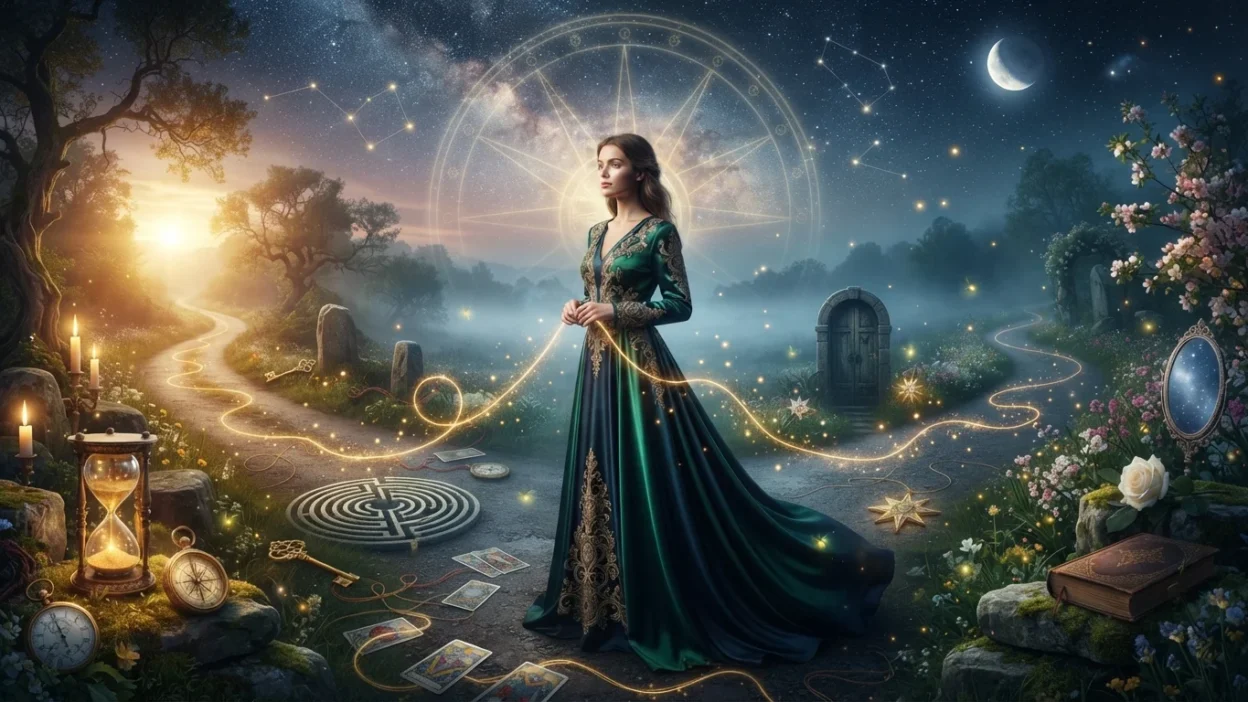
Fate symbolism explores one of humanity’s oldest questions: how much of life is shaped by our choices and how much is determined by forces beyond our control? Throughout history, fate has been represented through symbols such as threads, wheels, crossroads, stars, clocks, keys, pathways and celestial patterns.
These symbols often express ideas of destiny, inevitability, life changing events, timing, purpose and the mysterious direction of human life. Fate symbolism can also represent the tension between accepting what cannot be changed and taking responsibility for the choices that still remain within our control.
Fate Symbolism Meaning (Clear Definition)
Fate symbolism refers to symbols, images, stories, and objects associated with the idea that certain events or outcomes are destined, predetermined or influenced by forces beyond individual control.
Fate may symbolize:
- Destiny and life’s purpose
- Inevitable change
- Divine timing
- The unknown future
- Cause and consequence
- Life changing encounters
- Acceptance
- Mystery
- Cosmic order
- Inevitability
- Choice and responsibility
- The connection between past, present and future
The meaning of fate depends on personal beliefs and cultural traditions. For some, fate represents a fixed path. For others, it is a constantly changing journey influenced by both circumstance and personal choice.
What Does Fate Represent?
Fate commonly represents destiny, inevitability, purpose, timing and the forces that shape human life.
It often appears when people experience events that seem unexpectedly meaningful. Meeting someone at a particular moment, narrowly avoiding danger, discovering an unexpected opportunity or experiencing a dramatic life change may lead someone to describe the event as fate.
Fate as a Symbol of the Unknown
The future is one of the greatest mysteries of human existence.
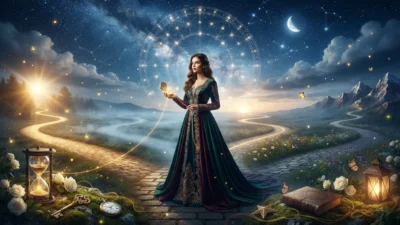
For this reason, fate often symbolizes what cannot yet be seen. A winding road disappearing into mist, a closed door or a path hidden beyond the horizon can represent an unknown future waiting to unfold.
Fate as a Symbol of Inevitability
Some events appear impossible to avoid.
A falling domino, a turning wheel, flowing river, or moving clock can symbolize the idea that life continues forward regardless of human wishes.
This interpretation makes fate a symbol of acceptance and the recognition that some circumstances cannot be controlled.
Fate as a Symbol of Choice
Fate does not always mean that every detail of life is predetermined.
A crossroads is one of the strongest symbols connecting fate with personal choice. The road may place a person at the intersection, but the decision about which direction to take can still shape what happens next.
Spiritual Meaning of Fate Symbolism
Spiritually, fate can symbolize divine timing, life purpose, cosmic order, meaningful connections, transformation and trust in life’s unfolding journey.
Many spiritual traditions encourage people to recognize that not everything can be controlled.
Fate symbolism can therefore represent the balance between surrender and action.
Fate and Divine Timing
An opportunity may arrive only after a long period of waiting.
Spiritually, this can be interpreted as divine timing the idea that certain experiences happen when the conditions are right, even if their purpose is not immediately understood.
A clock, hourglass, sunrise or opening flower can symbolize this interpretation.
Fate and Life Purpose
Fate can represent the belief that life contains a larger purpose.
A compass, guiding star, or distant pathway may symbolize the search for direction and meaning.
This does not necessarily mean that every event is predetermined. Instead, it can suggest that people discover purpose through experiences, relationships, challenges and choices.
Fate and Acceptance
One of the deepest spiritual meanings of fate is acceptance.
A person cannot change the past, control every event or predict every outcome.
Fate symbolism can therefore encourage people to release what cannot be controlled while remaining responsible for their present actions.
Biblical / Religious Meaning of Fate Symbolism
The idea of fate is interpreted differently across religious traditions.
In Christianity and other faith traditions, concepts such as divine providence, purpose, free will and God’s plan are often discussed instead of an impersonal force controlling every event.
Biblical themes frequently emphasize both divine purpose and human responsibility.
People make choices, experience consequences, face unexpected events and seek guidance through uncertainty.
Religious interpretations of fate often raise important questions:
- Is life guided by divine purpose?
- How much freedom do people possess?
- Can difficult experiences lead to growth?
- How should someone respond to circumstances they cannot change?
Rather than presenting fate as a simple fixed script, many religious perspectives explore the relationship between trust, responsibility, wisdom and acceptance.
Fate in History and Culture
Fate has appeared in mythology and cultural traditions for thousands of years.
Ancient civilizations often imagined fate as a powerful force capable of influencing the lives of individuals, families, rulers and entire nations.
One of the most famous symbolic images comes from ancient Greek mythology: the thread of life.
The Moirai, or Fates, were associated with the spinning, measuring and cutting of life’s thread. This imagery created a powerful metaphor for human existence.
The thread symbolizes the beginning of life, the passage of time, and its eventual end.
The Thread of Fate
A thread represents the connection between different moments of life.
It can symbolize:
- Continuity
- Connection
- Destiny
- Life’s journey
- Relationships
- Cause and effect
- The passage from beginning to end
A tangled thread may symbolize confusion or complicated circumstances, while a broken thread can symbolize separation or an unexpected ending.
The Wheel of Fate
The wheel represents changing circumstances.
As the wheel turns, a person may rise, fall, lose something, gain something, or experience an unexpected transformation.
The wheel reminds us that no situation remains completely permanent.
Fate and the Stars
Stars have long been associated with destiny and guidance.
A star-filled sky can symbolize the vastness of the universe and humanity’s attempt to understand its place within it.
A single bright star may represent a guiding purpose, while constellations can symbolize the belief that separate events may form part of a larger pattern.
Fate in Literature and Art
Fate is one of the most powerful themes in literature because it creates a dramatic conflict between what a character wants and what seems unavoidable.
Characters may struggle against prophecy, circumstances, family history, social expectations, or consequences created by earlier choices.
This makes fate a powerful storytelling device.
Fate and Tragedy
In tragic stories, a character may attempt to escape a predicted outcome only to discover that their actions contribute to its fulfillment.
This creates the famous symbolic question: Are we escaping fate, or are our attempts to escape it becoming part of the path?
Fate and Transformation
Fate can also represent an unexpected turning point.
A chance meeting, lost letter, mysterious discovery, or sudden journey may completely change a character’s life.
In this context, fate symbolizes transformation and the unpredictable nature of existence.
Fate in Visual Art
Artists often represent fate through:
- Threads
- Wheels
- Clocks
- Hourglasses
- Stars
- Labyrinths
- Crossroads
- Doors
- Keys
- Paths
- Celestial patterns
- Hands reaching toward one another
These symbols allow artists to communicate complex ideas about time, choice, destiny, and human connection.
Common Symbols Associated With Fate
Thread
The thread is one of the oldest symbols of fate.
It represents the continuous journey of life, connections between events, and the idea that every person follows a unique path.
Crossroads
A crossroads symbolizes a moment of decision.
It represents the point where fate and free will meet.
Wheel
The wheel symbolizes changing fortune, cycles, and the rise and fall of circumstances.
Clock
A clock represents time, timing, mortality, and the unstoppable movement of life.
Hourglass
An hourglass symbolizes the limited nature of time and the movement from past to future.
Compass
A compass symbolizes direction, purpose, guidance, and the search for one’s path.
Key
A key can symbolize an opportunity or event capable of changing the direction of a person’s life.
Star
A star symbolizes guidance, hope, destiny, and a connection with something larger than oneself.
Labyrinth
A labyrinth represents the complicated and sometimes confusing journey of life.
Although the path may twist and turn, it can symbolize the belief that every journey eventually leads somewhere meaningful.
Fate Symbolism in Dreams
Dreams involving fate often reflect uncertainty, major decisions, or a search for meaning.
A dream about standing at a crossroads may symbolize an important choice.
Following a long road can represent life’s journey and the uncertainty surrounding the future.
Seeing a broken clock may symbolize anxiety about missed opportunities or the feeling that something is happening at the wrong time.
Finding a key can symbolize discovering a new possibility.
Seeing a compass may represent a desire for direction.
A dream involving stars or celestial patterns may symbolize the search for guidance or a larger sense of purpose.
Dream symbolism is personal, so emotions and personal experiences should always be considered when interpreting these images.
Positive Fate Symbolism
Fate can symbolize many hopeful ideas, including:
- Purpose
- Guidance
- Meaning
- Transformation
- Divine timing
- Important connections
- Opportunity
- Personal discovery
- Acceptance
- Hope
- New beginnings
These meanings often encourage people to remain open to experiences they cannot predict.
Negative Fate Symbolism
Fate can also carry darker meanings.
It may symbolize:
- Loss of control
- Inevitability
- Fear of the future
- Tragedy
- Uncertainty
- Restriction
- Unavoidable consequences
- Helplessness
- Repetition
- Difficult cycles
The darker side of fate often appears when a person feels trapped by circumstances or believes that change is impossible.
Fate and Free Will
Perhaps the most important question in fate symbolism concerns free will.
If certain events are destined, do personal choices still matter?
Symbolically, the answer often appears in the image of a road.
You may not have chosen where the road begins, the weather you encounter, or every obstacle placed along the journey. However, you may still choose how to respond, what to learn, and which direction to take when another path appears.
This makes fate symbolism less about passive surrender and more about understanding the relationship between circumstance and response.
Fate and Love
Fate symbolism is especially common in romantic stories.
Two people meeting unexpectedly may describe the encounter as destined.
Symbols associated with fated love include:
- Intertwined threads
- Two stars
- Matching keys
- Crossed paths
- A shared journey
- Hands reaching toward each other
- Celestial alignments
These symbols express the idea that certain relationships can feel unexpectedly meaningful or perfectly timed.
Frequently Asked Questions About Fate Symbolism
What does fate symbolize?
Fate symbolizes destiny, inevitability, life’s purpose, timing, mystery, transformation, and the forces or circumstances that shape human life.
What is the spiritual meaning of fate?
Spiritually, fate can symbolize divine timing, life purpose, acceptance, meaningful connections, transformation and trust in the unfolding journey of life.
What symbolizes fate?
Common symbols of fate include threads, wheels, crossroads, clocks, hourglasses, stars, compasses, keys, labyrinths and winding pathways.
What does a thread symbolize in fate?
A thread symbolizes the continuous journey of life, the connection between events, relationships, time and the idea of an individual life path.
Does fate mean that everything is predetermined?
Not necessarily. Some traditions interpret fate as a predetermined path, while others see life as a combination of circumstances, consequences, choices and unpredictable events.
What does fate symbolize in love?
In love, fate can symbolize meaningful timing, unexpected encounters, deep connections, and the belief that two people’s paths were destined to cross.
Conclusion
Fate symbolism explores the mysterious relationship between destiny, time, circumstance, choice and human purpose.
A thread can represent the journey of life. A wheel can represent changing circumstances. A crossroads can represent an important decision. A star can represent guidance, while a clock reminds us that time continues moving forward.
Perhaps the deepest meaning of fate symbolism is not that every moment of life is completely predetermined.
Instead, it reminds us that life contains both things we cannot control and choices that remain entirely our own.
We may not choose every road that appears before us, but we can still decide how to walk it.