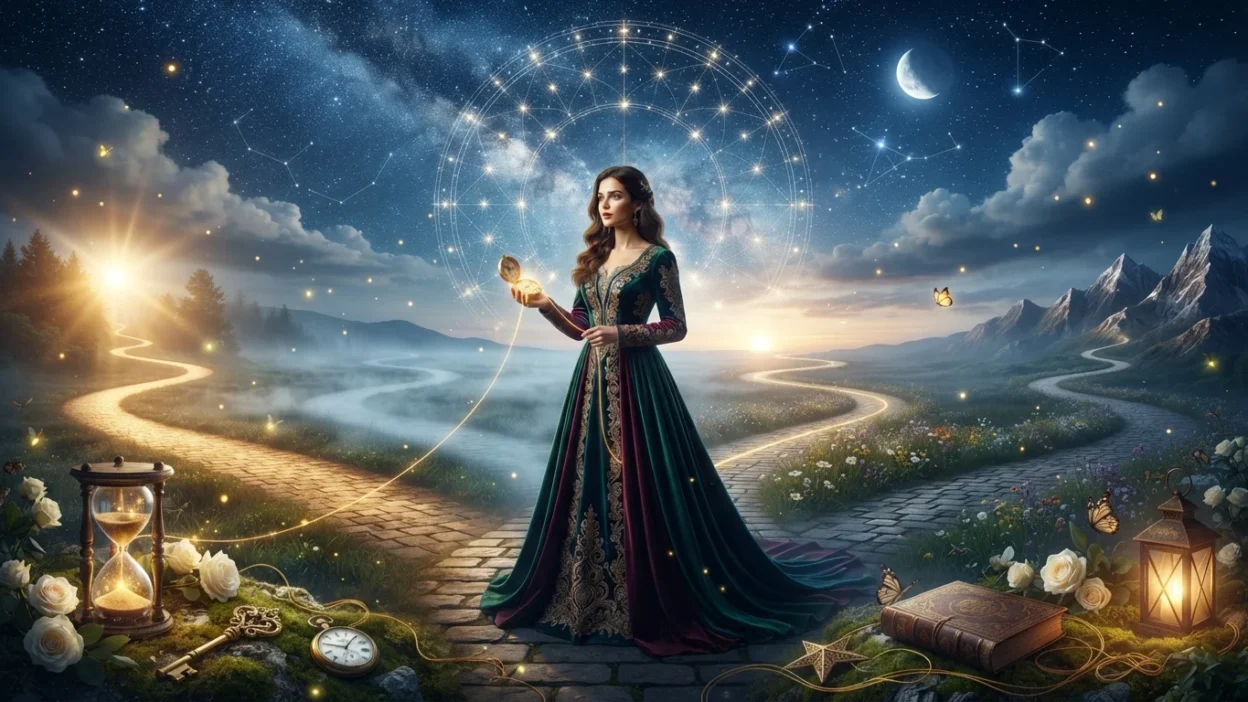
Destiny symbolism explores the idea that certain events, relationships, opportunities and life experiences may form part of a larger path. Across cultures, destiny has been represented through stars, crossroads, threads, compasses, doors, clocks, paths, keys, celestial patterns and other powerful images.
Unlike simple luck, destiny often suggests something deeper: a sense of purpose, direction, or a future that seems connected to who we are becoming. Destiny symbolism can represent fate, life purpose, divine timing, personal transformation, meaningful relationships and the mysterious possibilities waiting ahead.
Destiny Symbolism Meaning (Clear Definition)
Destiny symbolism refers to objects, images, stories, and signs that represent a predetermined or meaningful life path, future purpose, inevitable events or a person’s journey toward a particular outcome.
Destiny can symbolize:
- Life purpose
- Fate
- Future possibilities
- Divine timing
- Personal direction
- Meaningful relationships
- Transformation
- Spiritual guidance
- Choices and consequences
- Hope
- Achievement
- The unknown future
The concept of destiny can be interpreted in different ways. Some people believe destiny is largely predetermined, while others see it as something created through choices, circumstances, relationships and personal growth.
What Does Destiny Represent?
Destiny represents the possibility that life has a larger direction, even when that direction is not immediately visible.
Destiny as Life Purpose
One of the strongest meanings of destiny is purpose.
A compass pointing toward a distant horizon can symbolize the search for the path a person is meant to follow.
Destiny in this sense is not simply about predicting the future. It is about discovering what gives life meaning.
Destiny as a Journey
Destiny is often represented by roads and pathways.
A winding road suggests that the future may contain unexpected turns, obstacles, and discoveries.
The destination may remain hidden, but every step contributes to the journey.
Destiny as Transformation
Destiny can symbolize becoming the person you are meant to become.
A butterfly emerging from a chrysalis, a sunrise after darkness, or a seed growing into a tree can represent transformation and potential.
Destiny as Meaningful Encounters
Some relationships feel unusually important.
Meeting someone at a particular moment can seem like more than coincidence. Destiny symbolism often represents these encounters as connections between two paths that were somehow meant to cross.
Spiritual Meaning of Destiny Symbolism
Spiritually, destiny symbolism can represent divine purpose, spiritual guidance, divine timing, personal growth, meaningful experiences and trust in the journey of life.
Many spiritual interpretations suggest that people may have a purpose that becomes clearer through experience.
Destiny and Divine Timing
Sometimes an opportunity appears only after years of preparation.
A door opening at exactly the right moment can symbolize divine timing and the idea that certain experiences arrive when we are ready to receive them.
Destiny and Spiritual Purpose
Destiny can symbolize the search for a deeper reason behind one’s experiences.
A person may view challenges, relationships, and unexpected changes as opportunities to discover lessons or develop important qualities.
Destiny and Inner Guidance
A compass, guiding star, or glowing pathway can represent intuition and inner direction.
These symbols suggest that the path forward may not always be obvious, but inner wisdom can help guide important decisions.
Destiny and Acceptance
Destiny can also teach acceptance.
We cannot control every event in life. However, we can choose how we respond to circumstances and what meaning we give them.
Biblical / Religious Meaning of Destiny Symbolism
Religious traditions often discuss ideas related to destiny through concepts such as divine purpose, providence, calling, free will, and God’s plan.
In Christianity, for example, the idea of divine purpose is often connected with the belief that human life has meaning while individuals remain responsible for their choices.
Biblical stories frequently involve people receiving a calling, facing unexpected circumstances, or following a difficult path toward a larger purpose.
This creates an important distinction between destiny and passive fatalism.
A religious interpretation of destiny may suggest that life has divine direction without necessarily implying that every human decision is meaningless.
Other religious and philosophical traditions have developed their own understandings of karma, providence, reincarnation, fate, and spiritual purpose.
Destiny in History and Culture
Destiny has influenced mythology, religion, philosophy, literature, and art for thousands of years.
Ancient civilizations often believed that gods, celestial forces, prophecies, or supernatural powers could influence human lives.


In Greek mythology, the Moirai, commonly called the Fates, were associated with the thread of life. Their imagery became one of the most enduring representations of destiny.
Stars have also played an important role in destiny symbolism. Ancient people often looked toward the heavens for guidance, signs, calendars, and explanations of mysterious events.
Astrology developed another cultural connection between celestial patterns and human destiny, although its interpretations vary widely and are not scientifically established.
Crossroads became another powerful symbol because they represent moments when different possibilities meet.
Destiny Symbolism in Literature and Art
Destiny is one of literature’s most enduring themes.
Stories about prophecy, forbidden choices, unexpected encounters, family legacies, and heroic journeys often explore whether characters are following destiny or creating their own futures.
Prophecy as a Symbol of Destiny
A prophecy represents knowledge about an uncertain future.
It can create tension because characters may attempt to escape the predicted outcome, only to discover that their actions influence the very events they hoped to avoid.
The Road as Destiny
A road often represents life’s journey.
A straight road may suggest certainty, while a winding path can represent uncertainty and discovery.
A road disappearing beyond the horizon symbolizes a future that cannot yet be known.
The Thread of Destiny
The thread is particularly powerful because it connects past, present, and future.
An unbroken thread may symbolize continuity, while tangled threads can represent complicated relationships or circumstances.
A broken thread may symbolize separation, loss, or the end of one chapter.
Common Symbols of Destiny
Stars
Stars are among the most beautiful symbols of destiny.
They can represent guidance, purpose, hope, dreams, and the belief that something greater is directing the journey.
Compass
A compass symbolizes direction and purpose.
In destiny symbolism, it can represent finding the path that feels personally meaningful.
Crossroads
A crossroads represents choice and possibility.
It is especially meaningful because it connects destiny with free will.
Door
A door can symbolize an important opportunity or transition.
An unopened door may represent an unknown future, while an open door can suggest that a destined opportunity has arrived.
Key
A key symbolizes access, discovery, opportunity, and unlocking hidden potential.
It may represent discovering something that changes the direction of life.
Clock
A clock symbolizes timing, destiny, mortality, and the importance of particular moments.
It can suggest that certain events happen at specific points in a person’s journey.
Hourglass
An hourglass represents the passage of time.
In destiny symbolism, it can suggest that life is moving toward an inevitable future while reminding us that our available time is limited.
Pathway
A pathway symbolizes the journey toward a destination.
Its direction, condition, and surroundings can communicate different interpretations of the future.
Butterfly
A butterfly can symbolize transformation and the realization of potential.
It represents the process of becoming rather than simply arriving at a destination.
Destiny Symbolism in Dreams
Dreams involving destiny symbols may reflect major decisions, uncertainty, hopes, or a search for direction.
Dreaming about a crossroads may indicate that you are thinking about an important choice.
A dream about following a mysterious road can represent uncertainty about the future.
Seeing a bright star may symbolize hope or guidance.
Finding a key can suggest the discovery of a new possibility.
Dreaming about a locked door may represent an opportunity that feels inaccessible or a future that remains uncertain.
A compass may symbolize the desire to find clarity and direction.
A clock can represent concerns about timing, aging, missed opportunities, or an important upcoming event.
Dream interpretation is highly personal, so the emotions you experience during the dream are often just as important as the symbol itself.
Positive Destiny Symbolism
Destiny can represent many positive ideas, including:
- Purpose
- Hope
- Guidance
- Transformation
- Opportunity
- Divine timing
- Meaningful relationships
- Personal growth
- Achievement
- Spiritual development
- New beginnings
- Self-discovery
- Confidence
- Possibility
These meanings make destiny symbols especially popular in jewelry, tattoos, artwork, inspirational designs, and personal keepsakes.
Negative Destiny Symbolism
Destiny can also have a darker interpretation.
It may represent:
- Inevitability
- Loss of control
- Fear of the future
- Predetermined suffering
- Helplessness
- Unavoidable consequences
- Uncertainty
- Obsession with prediction
- Fear of making the wrong choice
When destiny is interpreted too rigidly, it can create the feeling that personal choices do not matter.
This is why many symbolic interpretations balance destiny with free will.
Destiny and Free Will
The relationship between destiny and free will is one of the most fascinating aspects of the symbolism.
A crossroads provides a perfect metaphor.
You may arrive at a particular crossroads because of circumstances you did not choose. However, you still have a decision about which path to follow.
This suggests that destiny and free will do not necessarily have to be opposites.
Destiny can represent the circumstances and possibilities that appear before us, while free will represents how we respond to them.
The meaning becomes less about asking, “What is going to happen to me?”
Instead, it becomes:
“What can I do with the path that has appeared before me?”
Destiny and Love
Destiny symbolism is particularly powerful in romantic relationships.
People sometimes describe an unexpected meeting, lifelong connection, or extraordinary relationship as “meant to be.”
Common destiny symbols in love include:
- Intertwined threads
- Two stars
- Matching keys
- Crossed pathways
- Joined hands
- Two compasses pointing toward each other
- Celestial alignments
- Two flowers growing together
These symbols communicate the idea that two individual journeys have become connected.
Destiny in love does not necessarily mean that a relationship will always be easy. Instead, it can symbolize the meaningful influence one person has on another’s life.
Destiny and Personal Growth
Destiny symbolism can encourage a person to think about potential.
A seed does not immediately look like a tree, but it contains the possibility of becoming one.
Similarly, destiny can represent qualities, abilities, or possibilities that have not yet fully developed.
This makes destiny a powerful symbol of personal growth.
The journey toward destiny may involve learning, failure, patience, courage, and change.
Destiny and Life Changes
Major life transitions often make people think about destiny.
Graduation, moving to a new place, starting a career, meeting a partner, ending a relationship, or beginning a completely new chapter can all feel like turning points.
Symbols such as doors, bridges, crossroads, stairways, keys, and pathways communicate these transitions visually.
A bridge can symbolize moving from one stage of life to another.
A door can represent a new opportunity.
A staircase can symbolize gradual progress.
A sunrise can symbolize the beginning of a new chapter.
Destiny and the Future
Destiny symbolism naturally connects with the future.
Because the future cannot be completely known, destiny provides a symbolic framework for thinking about possibility.
A distant horizon represents something that exists ahead but cannot yet be reached.
Stars provide guidance without revealing the entire journey.
A winding road shows that the future may contain unexpected turns.
Together, these images communicate a hopeful message: the future may be uncertain, but uncertainty does not mean that the journey lacks meaning.
Frequently Asked Questions About Destiny Symbolism
What does destiny symbolize?
Destiny symbolizes life purpose, future possibilities, divine timing, meaningful relationships, transformation, guidance, and the mysterious direction of life.
What is the spiritual meaning of destiny?
Spiritually, destiny can represent divine purpose, spiritual guidance, personal growth, meaningful experiences, and trust in the unfolding journey of life.
What symbolizes destiny?
Common destiny symbols include stars, threads, crossroads, compasses, roads, doors, keys, clocks, hourglasses, butterflies, and celestial patterns.
What does a star symbolize in destiny?
A star can symbolize guidance, hope, purpose, dreams, and the belief that a person is being guided toward a meaningful future.
What does a crossroads symbolize?
A crossroads symbolizes an important decision where different possibilities meet. It represents the relationship between destiny, choice, and free will.
What is the difference between fate and destiny?
Fate is often associated with events that seem unavoidable or predetermined, while destiny more commonly suggests a meaningful direction, purpose, or future toward which a person is moving.
Conclusion
Destiny symbolism represents one of humanity’s deepest ideas: the possibility that our lives contain a meaningful direction beyond what we can immediately see.
Stars symbolize guidance. Threads represent life’s continuity. Crossroads represent choice. Compasses represent direction. Doors symbolize opportunities, while pathways represent the journey toward an unknown future.
Destiny does not have to mean that every detail of life has already been written.
Instead, it can be understood as a reminder that circumstances, choices, relationships, challenges and opportunities can all become part of a meaningful journey.
Perhaps the most inspiring lesson of destiny symbolism is this:
You may not know exactly where the road leads, but every step can help reveal who you are becoming.